

The La Recoleta Convent Museum was founded in 1648 by the Franciscan order, within the context of the evangelizing work carried out during the colonial period. Some sources indicate that it was founded by Father Pedro de Mendoza and that its plans were designed by Father Pedro de Peñaloza.
By around 1651, a church and two cloisters had already been built. Over time, the architectural complex came to include four cloisters built in sillar, the volcanic stone characteristic of Arequipa. During the colonial period, this place served as a space for training and retreat for missionaries who prepared to bring Catholicism to remote Indigenous communities.
Throughout its history, the convent has undergone several restorations and modifications, but it still preserves much of its original character. Since 1978, it has also operated as a museum, with rooms dedicated to pre-Columbian art, the Amazon, religious art, and a valuable library with more than 20,000 ancient volumes.
The La Recoleta Convent features sober colonial architecture, characterized by cloisters with arches, sillar walls, and peaceful spaces for reflection. Its design is organized around inner courtyards, following the typical structure of colonial convents.
The complex includes cloisters, gardens, narrow corridors, cells, a sacristy, and the chapter house, spaces that allow visitors to imagine monastic life during the 17th and 18th centuries. The convent church stands out for its simple façade and austere interior, reflecting the Franciscan spirit.
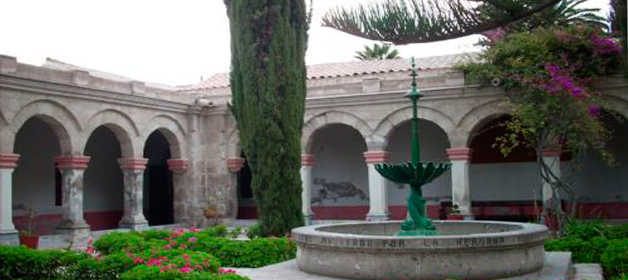
It is located at La Recoleta Street 117, in the traditional neighborhood of Antiquilla, just a few blocks from the historic center of Arequipa. From the Main Square, visitors can walk there in approximately 15 minutes, crossing a quiet area with a local atmosphere, ideal for those who wish to get away from the tourist bustle for a while.
The convent museum is distributed across several areas:
Located in front of the Chapel of the Wake, this space displays archaeological pieces from pre-Hispanic cultures such as Chimú, Mochica, Inca, Churajón, and Chancay. It also features textiles related to traditions such as Wari, Paracas, and Inca.
Two solid sillar rooms contain an interesting collection related to Amazonian wildlife, including birds, mammals, snakes, arachnids, reptiles, butterflies, and insects. Objects from the daily life of Amazonian peoples such as the Shipibo, Asháninka, Machiguenga, Huitoto, and Yagua are also displayed.
This space preserves representative works of religious art, miniature sculptures made of wax and Huamanga stone or alabaster, as well as monstrances, sacred vessels, and ornaments finely embroidered with gold, silver, and silk threads.
These rooms are a clear reflection of the austerity of convent life. One of the great figures linked to this house, Monsignor Fray Mariano Holguín, the first archbishop of Arequipa, spent several years of his life here.
The current library space dates back to 1926. Its shelves hold approximately 20,000 volumes, many of them printed in the 16th, 17th, and 18th centuries.

Reference opening hours:
Monday to Saturday
9:00 a.m. to 1:30 p.m.
2:30 p.m. to 5:00 p.m.
The entrance fee may vary for adults, students, and children. Updated prices can be checked directly at the museum.

Happy passengers