
Holy Week is one of the most important religious and cultural events in Peru. For eight days, the city of Cusco is transformed: its streets fill with processions, traditional rituals, masses, and unique expressions that combine Spanish and Andean heritage.
For many foreign travelers, Holy Week is also the perfect time to visit Machu Picchu.
Holy Week in Cusco is a period of religious and cultural celebration. It is generally held between March and mid-April, although the date varies because it depends on the Catholic liturgical calendar.
The celebration begins on Palm Sunday. On this day, the blessing of palm branches, the procession, and the Eucharistic celebration take place at the Basilica Cathedral. In addition, devotees attend different churches in the city carrying crosses or branches woven from palm leaves, which are blessed during Mass. These crosses are placed in homes as a symbol of protection.
Holy Week in Cusco has its central day on Holy Monday. On this day, the city’s patron saint, the Lord of the Tremors, is carried in procession. Thousands of devotees accompany the procession in search of his blessing.
Holy Thursday is one of the most important days of Holy Week in Cusco. On this day, the Last Supper of Jesus with his disciples is commemorated.
During Holy Week, especially toward Good Friday, some Cusco families prepare the traditional 12 dishes. According to tradition, these represent the 12 apostles. Among the most common dishes are corn cream soup, or lawa de maíz, olluco soup, shrimp soup, and rice with seafood. The most common desserts are stewed fruit, usually peach or loquat, rice pudding, mazamorra, empanadas, maicillos, and other traditional sweets.
At night, families often walk through the streets of Cusco’s historic center and visit the seven churches as part of a tradition of reflection and prayer. This practice refers to the seven falls of Jesus on his way to Mount Calvary.
Good Friday commemorates the crucifixion and death of Jesus. In the city of Cusco, a reenactment of the Way of the Cross takes place, starting at Plaza San Francisco and reaching the Pope’s Cross, located in Sacsayhuamán. This event is organized by the Convent of San Francisco.
At the same time, the Hampi Rantikuy takes place in Plaza San Francisco, a fair where different types of medicinal plants are sold. According to tradition, all plants gathered during Holy Week are blessed.
Holy Week comes to an end on Easter Sunday. Cusco devotees attend Mass very early to celebrate the resurrection of Jesus. On this day, the image of the Risen Jesus is also carried in procession, accompanied by parishioners who express their joy.
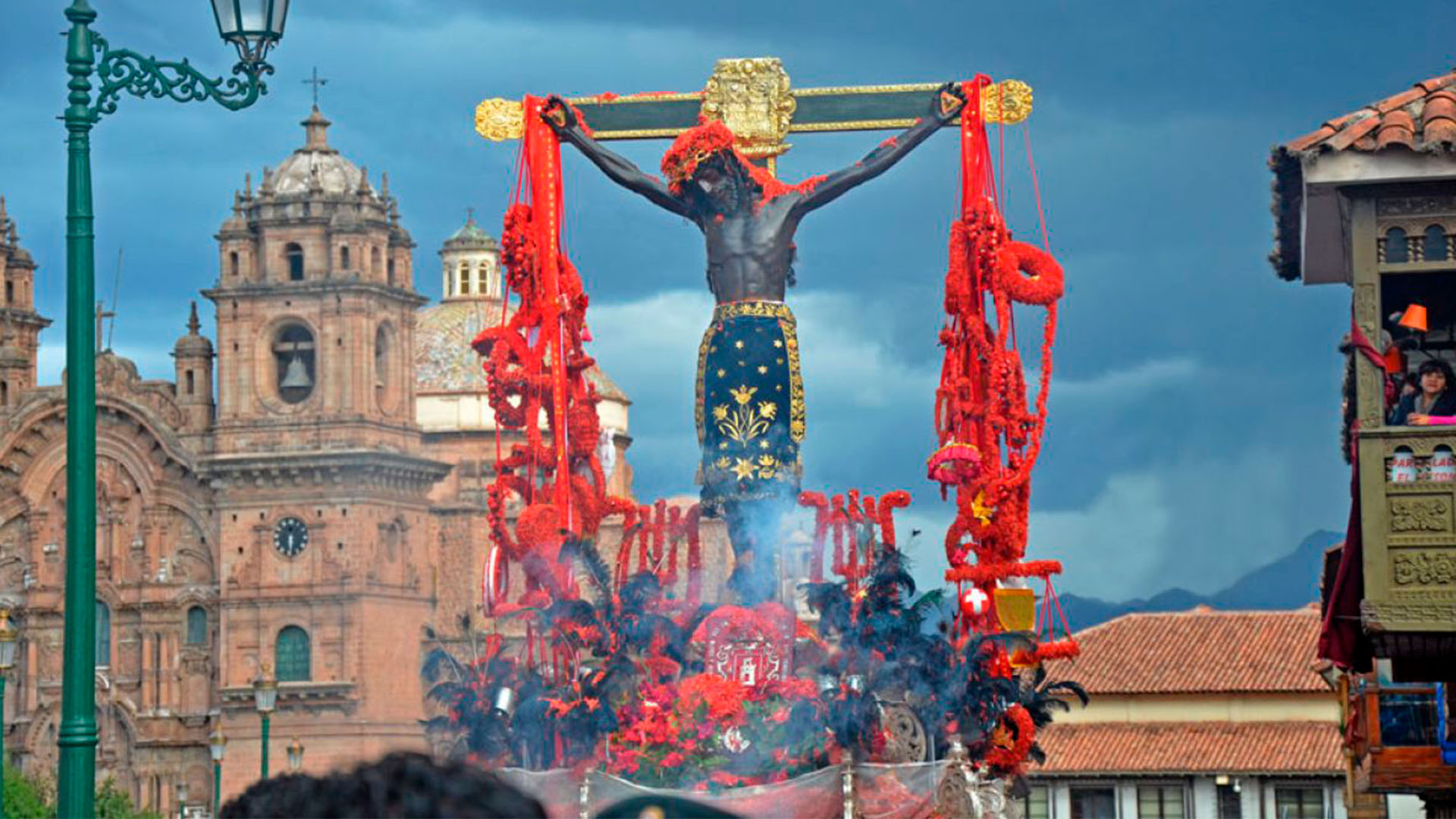
The Lord of the Tremors is a venerated figure in Cusco dating back to colonial times. Devotion to him was especially consolidated after the earthquake of 1650, when the miraculous image became closely associated with the city’s protection against earthquakes. Since then, the Lord of the Tremors has been deeply revered by the people of Cusco, who consider him their patron and protector.
According to tradition, Emperor Charles V sent the image to Cusco, made especially for the city’s inhabitants. It is said that its features were adapted to create a stronger connection with the image, as part of the process of consolidating the Spanish conquest over the former Inca capital.
On March 31, 1650, the faith of the people of Cusco grew stronger. That afternoon, an earthquake struck the city and brought down large houses and religious temples. At that moment, people from different social groups joined together in prayer, asking for the tremor to stop.
Since that event, the Lord of the Tremors has been carried in procession every Holy Monday through the streets of the city of Cusco, followed by a multitude of faithful devotees who accompany him with songs and prayers to receive his blessing.
The procession of the Lord of the Tremors is one of the most important events of Holy Week in Cusco and brings together thousands of faithful devotees and visitors. It is an experience that allows visitors to closely appreciate the culture and religious traditions of the region.


Happy passengers