

The Lord of Miracles is one of Peru’s most important religious devotions. It is also known as the Christ of Pachacamilla, the Brown Christ, or the Purple Christ. The painting depicts Jesus Christ crucified and is preserved on an adobe wall behind the main altar of the Sanctuary and Monastery of Las Nazarenas, located in Lima’s Historic Center.
This celebration is closely linked to the history of Lima and Afro-Peruvian culture, and every year it brings together thousands of people in one of the largest expressions of faith in Latin America.
The devotion has also spread beyond Peru. Peruvians living in cities around the world also organize Masses, celebrations, and processions during the Purple Month.
The origins of the devotion date back to the 17th century. At that time, Pachacamilla was an area located on the outskirts of Lima’s walled city. Members of a brotherhood made up mainly of people of African descent from Angola gathered there.
These brotherhoods were religious and mutual-aid associations. Their members gathered to pray, care for the sick, organize funerals, and maintain their community ties in a society marked by slavery and deep social inequalities.
According to tradition, around 1651 one of the members of this community painted an image of the crucified Christ on an adobe wall. Although tradition attributes it to an Afro-descendant member of the brotherhood, the painter’s exact identity has not been confirmed.
On November 13, 1655, a powerful earthquake struck Lima and Callao. Numerous buildings and homes were destroyed; however, the wall bearing the image of Christ remained standing.
This event was interpreted as a miracle by members of the brotherhood and other residents of the city. From that time onward, prayer gatherings in front of the image increased, and its fame began to spread.
Years later, a local resident named Antonio León began caring for the site and promoting the veneration of the image. According to religious tradition, León suffered from an illness and attributed his recovery to the intervention of the Christ of Pachacamilla.
The gatherings continued to grow and began to concern some civil and ecclesiastical authorities because they were held without formal supervision. At first, an order was issued to erase the painting, but it was never carried out. Later, the Church authorized the devotion and ordered the construction of a chapel.
On September 14, 1671, one of the first official Masses was celebrated in the chapel built to venerate the image.
The original painting mainly depicted Christ on the cross. Over time, other figures from Christian tradition were added: God the Father, the Holy Spirit, the Virgin Mary, and Mary Magdalene.
Because these additions were made at different times, they cannot all be attributed with complete certainty to the same painter. What is known is that the image was expanded over time until it took the form in which it is venerated today.
On October 20, 1687, another major earthquake struck Lima and Callao. Once again, the mural image survived the disaster.
After the earthquake, Sebastián de Antuñano, one of the main promoters of the devotion, commissioned a copy of the painting on canvas. Unlike the original mural, which remains attached to the sanctuary wall, this replica could be carried through the streets.
This marked the first procession of the Christ of Pachacamilla through the streets of Lima. Over the years, the processional outings became an annual tradition.
Lord of Miracles
This name is associated with the favors and extraordinary events that devotees attributed to the image, especially after the wall survived the earthquakes of the 17th century.
Christ of Pachacamilla
This name recalls the place where the devotion began and where the former brotherhood of Afro-descendant Angolans was based.
Brown Christ
This name highlights the Afro-Peruvian origins of the devotion and the essential role of the Afro-descendant community in its birth and spread.
Purple Christ
This name comes from the purple color worn by members of the Brotherhood, the Nazarene nuns, and many devotees during October.
The original mural is preserved in the Sanctuary and Monastery of Las Nazarenas, at 515 Jirón Huancavelica, near the intersection with Avenida Tacna, in central Lima.
The religious complex is administered by the Discalced Carmelite Nazarene Mothers. Inside is the main altar, which protects the adobe wall bearing the original painting.
The present building underwent several stages of construction and reconstruction because of the earthquakes that affected Lima during the colonial period. In addition to its religious importance, it forms part of the historical and architectural heritage of Lima’s Historic Center.
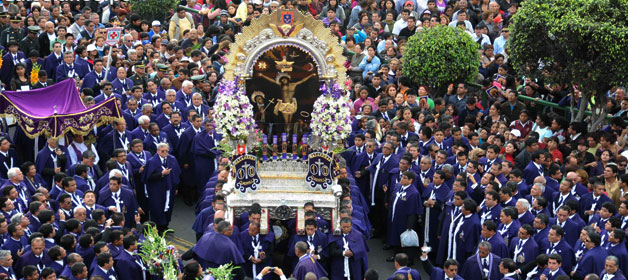
During the procession, the original mural is not moved. Instead, a canvas is placed on a large structure known as an anda, or processional platform. One side displays the Lord of Miracles, while the reverse features an image of Our Lady of the Cloud.
The platform is carried on the shoulders of teams of bearers belonging to the Brotherhood of the Lord of Miracles of Las Nazarenas. Its movement is slow and coordinated. Along the route, prayers, religious songs, and music can be heard, while the faithful offer incense and tributes prepared by institutions, parishes, businesses, and families.
The procession travels through streets and avenues in the Historic Center and nearby areas. On some routes, it visits landmarks such as the Main Square, Lima Cathedral, the Government Palace, the Metropolitan Municipality of Lima, the Congress of the Republic, and various hospitals.

The main celebration takes place in October, popularly known as the Purple Month. The calendar usually includes several processional outings during October and, in some years, a final procession in early November.
The most traditional dates have included routes around October 18, 19, and 28, as well as the final return on November 1. However, these dates and routes may change.
For this reason, before attending, visitors should check the program published by the Brotherhood of the Lord of Miracles of Las Nazarenas, the Sanctuary of Las Nazarenas, the Archdiocese of Lima, or the municipal authorities. It is not advisable to use the itinerary from a previous year, as streets, schedules, tribute points, and traffic restrictions may change.
The sanctuary is located at:
Address: 515 Jirón Huancavelica, Cercado de Lima.
Landmark: the intersection of Jirón Huancavelica and Avenida Tacna.
By public transportation
You can get there using services that travel along Avenida Tacna, Avenida Emancipación, and other roads in the Historic Center. You can also use the Metropolitano bus system and continue on foot from a station near the Historic Center, checking in advance which stations are operating during the procession.
On procession days, many streets remain closed and public transportation routes may be diverted. Therefore, it is often necessary to walk several blocks to reach the sanctuary or approach the procession route.
By taxi or private vehicle
On the busiest dates, it is not advisable to try to reach the sanctuary entrance by car. Traffic is restricted, and nearby parking facilities tend to fill up quickly.
The best option is to get out in an authorized area and continue on foot, following the instructions of the National Police, the Municipality of Lima, and security personnel.
Visiting hours
The sanctuary and Mass schedules may change, especially in October, during Holy Week, and on other religious occasions. Before visiting, it is advisable to check the official channels.
The purple habit
During October, many devotees wear a purple tunic or habit tied with a white cord. Some wear it as an expression of faith; others do so to fulfill a promise or give thanks for a favor received.
The color also identifies members of the Brotherhood and the Nazarene nuns.
The bearers
The bearers are organized into teams. Their task is to support and carry the heavy processional platform for several hours, following the foreman’s instructions and maintaining coordinated movement.
Membership in a team is often passed down through generations and requires preparation, discipline, and commitment to the Brotherhood’s religious and social activities.
The incense bearers
The incense bearers walk near the processional platform carrying vessels filled with incense. The aromatic smoke forms part of the ceremonial atmosphere and symbolizes the prayers and tribute offered to the image.
The singers
The singers perform hymns, prayers, and religious songs along the route. One of the most representative compositions is the Hymn to the Lord of Miracles, sung by the faithful at various moments during the procession.
The floral carpets
Institutions, parishes, schools, families, and local residents prepare decorative carpets using flowers, colored sawdust, and other materials. These works are placed on the streets along which the processional platform will pass.
Because of their temporary nature, the carpets disappear as the procession moves over them, which forms part of their ceremonial meaning.
Doña Pepa nougat
Doña Pepa nougat is the most representative sweet of the Purple Month. It is made with bars of baked dough covered in a sweet syrup prepared with fruit and spices and decorated with colorful sprinkles.
Its origin is traditionally associated with Josefa Marmanillo, an Afro-Peruvian woman known as Doña Pepa. According to popular tradition, she prepared the sweet in gratitude for a favor attributed to the Lord of Miracles.
Although it is now sold throughout the year, consumption increases considerably in October.
Street vendors and traditional food
Along the procession routes, it is common to find vendors selling sweets and popular Lima dishes. Their presence recalls the old tradition of street criers and merchants who accompanied the city’s major public celebrations.
However, visitors should consume food only at authorized establishments or stalls that maintain proper hygiene standards.
Devotion to the Lord of Miracles extends beyond the strictly religious sphere. It brings together Lima’s colonial history, the memory of the Afro-Peruvian population, music, gastronomy, urban customs, and expressions of community solidarity.
The procession also serves as a gathering place for people from different regions and social backgrounds. For believers, it represents an opportunity for prayer, gratitude, and spiritual renewal. For visitors to Lima, the procession offers a chance to discover how a tradition born within an Afro-descendant community became one of the great symbols of Peruvian identity.
The Lord of Miracles has received official recognitions connected with Peru’s Catholic religious tradition and the city of Lima, including the title of Sworn Patron of Lima.
Before attending, check the official date, time, and route for the corresponding year. Routes may change even a few days beforehand because of security measures or roadworks.
Wear comfortable clothing, suitable walking shoes, and sun protection. For daytime routes, it is also advisable to carry water in a reusable container.
Avoid carrying valuables, large amounts of cash, or bulky backpacks. Keep your belongings secure and remain alert in the most crowded areas.
Minors should remain accompanied by a responsible adult. It is advisable to agree on a meeting point in advance in case anyone becomes separated from the group.
Do not attempt to cross through the teams of bearers or get too close to the processional platform. Respect barriers, evacuation routes, and the instructions of security personnel.
People with reduced mobility, older adults, or visitors with health conditions should choose less crowded areas and avoid remaining in dense crowds for many hours.
Do not litter or damage the floral carpets, and behave respectfully. The procession is a religious celebration as well as a cultural and tourist event.

Happy passengers