

Maras began to grow as a populated center during the colonial period, when families connected to Cusco moved to settlements in the Sacred Valley, including Maras.
During the colonial period, Maras was part of a route used by muleteers who transported products such as coca leaves from the high jungle of Cusco to Cusco and other areas.
Maras has a particular identity because it does not depend solely on one tourist attraction. Its charm lies in its old streets, colonial doorways, farming fields, traditional salt production, and the daily life of its residents.
Unlike other towns in the Sacred Valley that are more closely linked to mass tourism, Maras preserves a quieter atmosphere. Its streets, old houses, colonial doorways, and local customs allow visitors to get closer to a more traditional way of life.
In addition, the Salt Mines and Moray help visitors understand two key aspects of Andean life: the use of natural resources and the agricultural knowledge of ancient cultures.
Maras deserves more than a quick stop before visiting the Salt Mines. The town preserves very interesting old architecture, especially its colonial doorways, adobe mansions, and narrow streets.
It is also an ideal place to observe the daily life of the Sacred Valley. In its surroundings, visitors can see farming fields, rural paths, mountains, and open views of the high Andean landscape. For this reason, walking through the town allows you to discover old doorways, quiet streets, views of the fields, and scenes of local life that often go unnoticed on quick tours.
The town of Maras is located in the province of Urubamba, in the department of Cusco, approximately 40 km northwest of the city of Cusco. It is situated at about 3,375 meters above sea level, in a high area of the Sacred Valley of the Incas.
From the city of Cusco, you can reach Maras by road. The route passes through Chinchero and then continues along the turnoff that leads to the town of Maras. The trip usually takes between 1 hour and 1 hour 30 minutes, depending on traffic, the type of transportation, and the stops along the way.
Another practical option is to book a half-day or full-day tour that includes transportation and visits to Maras, Moray, and the Salt Mines.
From Urubamba, the trip to Maras is usually shorter and can take around 30 to 40 minutes, depending on transportation and the route. You can take a taxi or tourist transportation to the Maras branch road and then continue to the town square.
From Chinchero, you can also get there by road. This route is widely used by travelers who want to combine Chinchero, Maras, Moray, and the Salt Mines in the same itinerary.
A practical route is to start the tour in Cusco, pass through Chinchero, continue to the town of Maras, visit Moray, and finish at the Maras Salt Mines. It can also be done in the opposite direction, depending on the traveler’s schedule and itinerary.
For a more relaxed visit, it is recommended to dedicate at least half a day. If you want to walk through the town, take photos, visit Moray, and explore the viewpoints of the Salt Mines without rushing, the ideal amount of time is between five and six hours.
The main square is the ideal starting point for exploring the town. Around it, you will find traditional buildings, public spaces, and streets that lead to old mansions and colonial doorways.
It is a good place to observe the daily life of the town, rest for a few minutes, and begin a walk through the historic center.
The main church of Maras is dedicated to San Francisco de Asís. It is a religious building of colonial origin that forms part of the town’s historical heritage.
Inside, it preserves works of religious art linked to the Cusco artistic tradition. Before publishing this information, it is advisable to confirm the presence of works attributed to Antonio Sinchi Roca Inka, an Indigenous painter associated with Maras.
Before visiting, it is advisable to check whether the church is open, since its hours may vary depending on religious celebrations, masses, or local activities.
One of the town’s most representative features is its colonial doorways carved in stone. Many of them are preserved in old mansions and stand out for their reliefs, coats of arms, religious symbols, and stone-carved details.
These doorways reflect the social and economic importance that Maras had during the colonial period. Walking through its streets allows visitors to find several examples of this architecture, especially in the areas near the square and along traditional streets in the town center.
In addition to its doorways, Maras preserves adobe mansions, old walls, tile roofs, and narrow streets that maintain the town’s traditional character. It is an ideal area for taking photos of old streets, colonial doors, adobe walls, and everyday scenes of the town.
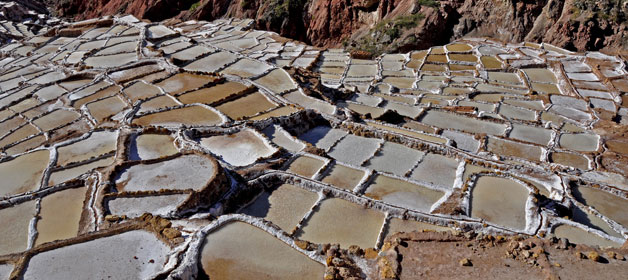
The Maras Salt Mines are one of the best-known attractions in the Sacred Valley. They are made up of thousands of evaporation ponds located on a hillside near the town of Maras. If Mount Qaqawiñay is mentioned, it is advisable to confirm the spelling of the name. Saltwater arrives through channels and is distributed by gravity to the ponds, where the salt crystallizes naturally.
Salt extraction in this area has been carried out since pre-Hispanic times and is still worked today by local families using traditional techniques. The ponds are worked by families from the communities of Maras and Pichingoto, who maintain traditional production techniques.
From the town of Maras, you can reach the Salt Mines by vehicle or by walking along rural paths. The route offers very attractive views of the Andean landscape and the ravine where the ponds are located.
To make the most of the route, it is recommended to visit the town of Maras first, continue to Moray, and then head to the Salt Mines. This way, you can begin with the town and its history, continue with the circular terraces of Moray, and finish with the views of the Salt Mines.
Another alternative is to visit the Salt Mines early, when there are fewer visitors, and leave Moray for mid-morning or midday. The choice will depend on the weather, transportation availability, and the type of experience you are looking for.
The town of Maras can be visited year-round. To walk through its streets, the square, and the colonial doorways, it is recommended to go in the morning or early afternoon, when there is better light for photography and the weather is usually more pleasant.
The Church of San Francisco de Asís is not always open throughout the day. It is best to check mass times or ask in the town square before organizing your visit.
To walk through the town, a good time is between 8:00 a.m. and 4:00 p.m. During this time, there is better light, more local activity, and good conditions for taking photos.
The Salt Mines are best appreciated in the morning or before sunset, when the light highlights the contrast between the white ponds, the saltwater, and the mountains. During the dry season, the colors usually look more intense.
The morning is ideal for those who want to complete the route calmly. The afternoon can be a good option for those who want softer light for photography, especially at the Salt Mines and in the fields near the town.
The dry season, between May and October, is usually the most recommended time to visit Maras, Moray, and the Salt Mines. During these months, there are more sunny days, better conditions for walking, and greater visibility of the landscape.
The rainy season, between November and April, also allows visits to the area, but it is advisable to bring a rain poncho, footwear with good grip, and check road conditions before leaving. During this season, the fields tend to look greener, although there may be fog, rain, or wet roads.

During your visit to the town of Maras, you can walk through its colonial streets, observe its stone doorways, visit the main square, see the Church of San Francisco de Asís, and take photos of the Andean landscape.
You can also add Moray and the Salt Mines to the route, or choose an experience with nearby communities to learn more about rural life in the Sacred Valley. For those looking for a more local experience, some routes include experiential tourism activities, tastings of traditional products, handicraft shopping, or rural walks.
Wear comfortable shoes, especially if you plan to walk through the town, Moray, or the trails near the Salt Mines. Bring sunscreen, a cap or hat, as radiation in high Andean areas can be strong even on cloudy days.
It is also advisable to bring a light jacket or windbreaker, because the weather can change during the day. If you travel during the rainy season, bring a rain poncho and protect your electronic devices.
Respect marked areas, do not enter the salt ponds if it is not allowed, and avoid touching ancient structures or colonial doorways. Remember that Maras is not only a tourist attraction: it is also a living town, where local families carry out their daily activities.
Where is the town of Maras located?
The town of Maras is located in the province of Urubamba, in the department of Cusco, about 40 km northwest of the city of Cusco.
Is Maras close to Moray and the Salt Mines?
Yes. Maras is one of the best points for visiting Moray and the Salt Mines, since both attractions are located within the district and can be combined in a half-day route.
What can you see in the town of Maras?
In the town, you can see the main square, the Church of San Francisco de Asís, colonial doorways carved in stone, old mansions, traditional streets, and Andean agricultural landscapes.
What is the best time of year to visit Maras?
The dry season, between May and October, is usually the most recommended due to the stable weather and good visibility. However, Maras can be visited year-round.
Is it worth visiting the town or only the Salt Mines?
Yes, the town is worth visiting. Maras preserves history, colonial architecture, local traditions, and its own identity, which complements a visit to Moray and the Salt Mines very well.
Can you imagine walking among thousands of salt ponds in the heart of the Andes? Join one of the tours created to enjoy Maras, where you can explore the impressive salt mines, used since pre-Inca times. Enjoy a spectacular landscape, surrounded by history, culture and nature, all in one place. A unique experience you won’t want to miss! [learn more here]
Related Tours
Tour In Motocycle To The Salt Mines Of Maras And Moray 7 Hours
Explore the Sacred Valley of the Incas
Tour Machu Picchu 4 Days - Cusco And Sacred Valley
Cusco, Sacred Valley Bicycle - Machu Picchu – Maras Moray - Lagoon – Mountain (8D 7N)

Happy passengers