
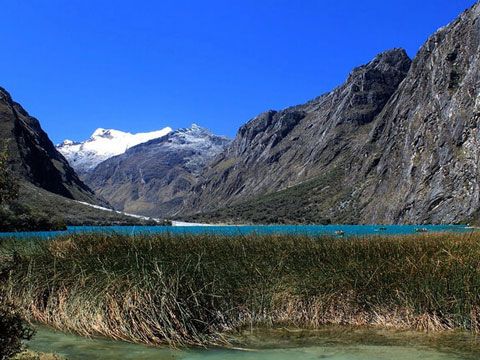
Huaraz is the capital of the Áncash region and one of Peru's main hiking and mountaineering destinations. It is located in the southern part of the Callejón de Huaylas, between the Cordillera Blanca and the Cordillera Negra, at an approximate altitude of 3,052 m above sea level. By road, it is situated about 400 km from Lima.
Huaraz is an excellent base for visiting attractions such as Lake 69, Lake Parón, Pastoruri Glacier, Chavín de Huántar, and the trekking routes of the Cordillera Blanca.

Huaraz brings together nature, adventure activities, and pre-Hispanic history. In a single trip, visitors can hike to glacial lakes, admire some of Peru's highest mountains, explore the villages of the Callejón de Huaylas, and visit the archaeological site of Chavín de Huántar.
Mount Huascarán reaches 6,768 m above sea level and is the highest peak in Peru. The Cordillera Blanca is also the world's largest tropical mountain range covered with ice, although its glaciers are currently retreating.
Huaraz also has an urban history marked by the earthquake of May 31, 1970. As a result of the subsequent reconstruction, its current architecture is mainly contemporary, although traditional areas and local cultural expressions still remain.
The road between Lima and Huaraz is approximately 400 km long and usually takes around eight hours. The route follows the coast to the Pativilca area and then climbs through the Cordillera Negra toward the Callejón de Huaylas. Travel time may vary depending on traffic, roadworks, and weather conditions.
There are both daytime and overnight bus services. For overnight trips, it is advisable to choose reputable companies, verify that the service is direct, and keep valuable personal belongings in your carry-on luggage.
Anta Airport, located near Huaraz, receives flights according to airline schedules. Before planning your trip, it is advisable to check whether direct flights from Lima are available. The flight takes approximately one hour and five minutes, depending on the schedule. The airport is located about 20 km from Huaraz, so an additional ground transfer to the city is required. Flight days, schedules, and frequencies may change and should be confirmed before purchasing your ticket.
Huaraz is located at more than 3,000 m above sea level, while several of its attractions exceed 4,000 meters. For this reason, it is not advisable to undertake the most demanding excursion immediately after arriving from a city located at sea level.
During the first 24 to 48 hours, it is advisable to engage in light activities, rest, avoid strenuous physical effort, and gain altitude gradually. The Centers for Disease Control and Prevention recommend limiting strenuous exercise during the first 48 hours after arriving at an altitude above 2,750 meters.
Located 411 km north of the city of Lima, in the Callejón de Huaylas Valley between the Cordillera Blanca and the Cordillera Negra, in the Áncash region.
Lake 69 is located in the Llanganuco sector, at the foot of the Chacraraju and Pisco snow-capped mountains. Its turquoise waters lie at approximately 4,595 m above sea level and can be reached through a high-altitude hike.
The excursion usually departs from Huaraz before dawn and continues through Yungay, the Llanganuco Lakes, and Cebollapampa. From this last point, the hike begins. It is a full-day route that requires good physical fitness, prior acclimatization, and appropriate clothing for sudden weather changes.
Lake Parón is located in the province of Huaylas, near Caraz, at about 4,185 m above sea level. It is the largest lake in Huascarán National Park and is fed by the surrounding snow-capped peaks, including Huandoy, Pisco, Chacraraju, Pirámide de Garcilaso, Artesonraju, and Caraz.
Unlike Lake 69, transportation can reach an area close to Lake Parón, so the visit requires less hiking. The exact drop-off point may vary depending on road conditions. For this reason, it is often recommended for travelers who wish to enjoy a spectacular high-mountain landscape without completing a long hike. From the entrance area, additional walks can be taken while following marked trails and local guidelines.
The excursion generally takes a full day from Huaraz, as the route first crosses the Callejón de Huaylas to the city of Caraz before ascending to the lake.
Pastoruri is part of the Climate Change Route in the Carpa sector of Huascarán National Park. The glacier is located at approximately 5,186 m above sea level, while the lake formed by its retreat lies at around 4,966 m above sea level.
A visit to Pastoruri may include stops such as Lake Patococha, the interpretation center, and other points of interest along the Climate Change Route. The available stops should be confirmed with the tour operator before booking.
Although the walking section is usually shorter than the hike to Lake 69, the altitude is considerable. Therefore, Pastoruri should not be chosen as the first excursion after arriving in Huaraz without proper acclimatization.
The archaeological monument of Chavín de Huántar is located in the province of Huari, east of the Cordillera Blanca. It was one of the main ceremonial centers of the ancient Andes and gave its name to the Chavín culture, which developed approximately between 1500 and 300 BC. UNESCO inscribed it on the World Heritage List in 1985.
The complex is renowned for its plazas, terraces, underground galleries, finely carved stone structures, and zoomorphic representations. Among its best-known features are the Lanzón, the Circular Plaza, the Square Plaza, and the famous tenon heads.
The visit is often combined with the Chavín National Museum, where original artifacts and materials recovered from the archaeological site are displayed, including sculptures, ceramics, and ceremonial objects.
The Santa Cruz–Huaripampa Trek is one of the best-known multi-day routes in Huascarán National Park. It passes through valleys, glacial lakes, and Punta Unión Pass, located at approximately 4,750 m above sea level. Sernanp recommends three to four days to complete the route.
This trek should be undertaken with proper planning, suitable equipment, and an authorized operator. It is not comparable to a conventional one-day excursion.

Visitors staying in the city can explore the Augusto Soriano Infante Áncash Archaeological Museum, the Sanctuary of the Lord of Solitude, the traditional José Olaya Street, the Rataquenua viewpoint, and the archaeological monuments of Willkawaín and Ichic Willkawaín. These attractions provide a better understanding of the region's history and are ideal during the first days of acclimatization.
Day Tours
The most popular tours include:
Not all tours have the same level of difficulty. Llanganuco and Parón require less hiking; Lake 69 and Churup are physically more demanding; Pastoruri involves significant exposure to high altitude; while Chavín de Huántar is mainly a cultural excursion with several hours of transportation.
Multi-day hikes and expeditions
For travelers with experience and sufficient acclimatization, there are the Santa Cruz–Huaripampa Trek, the Ishinca Valley routes, and other mountain trails. Ascents to snow-capped peaks require technical knowledge, specialized equipment, and professional guides.
For multi-day hikes, high-mountain routes, and climbing expeditions, it is recommended to hire authorized operators. Before visiting any area of Huascarán National Park, review the current entry requirements and Sernanp regulations. Before booking a tour, verify that the company is officially registered and clearly specifies transportation, guide services, entrance tickets, meals, equipment, and emergency protocols.
Suggested four-day itinerary
Day 1: Arrival and acclimatization. Enjoy a relaxed walk around Huaraz, visiting the Áncash Archaeological Museum, the Main Square, and José Olaya Street.
Day 2: Scenic excursion. Visit the Llanganuco Lakes or Lake Parón.
Day 3: Hike to Lake 69 for travelers who are well acclimatized and in good physical condition. As an alternative requiring less hiking, you may visit Pastoruri, although its higher altitude also requires proper acclimatization.
Day 4: Cultural tour. Excursion to Chavín de Huántar and the Chavín National Museum.
For multi-day trekking routes or mountain climbing expeditions, it is necessary to extend your stay and schedule additional acclimatization days.
The dry season generally lasts from May to September, while rainfall is more frequent between October and April. October is often a transitional month, with sunny days and occasional showers. In the high mountains, temperatures can range from –2°C to 15°C. During the early morning, especially with wind or rain, the perceived temperature can be much lower, so warm and waterproof clothing is recommended.
From June to August, clear mornings and cold nights are common. However, weather conditions can change rapidly at any time of the year, particularly above 4,000 meters.
Traveling during the rainy season is possible, but visitors should expect wet trails, reduced visibility, possible changes to access routes, and occasional tour rescheduling.
For mountain excursions, it is recommended to bring:
Do not walk on glaciers, leave marked trails, litter, or remove plants, rocks, or archaeological remains.
Entrance fees to Huascarán National Park vary depending on nationality, age, route, and length of stay. Before your trip, check the current rates on the official Sernanp website or consult an authorized operator. Reduced rates are also available for children and local residents. Prices should always be confirmed before traveling.
The Chavín de Huántar Archaeological Monument is generally open from Tuesday to Sunday, from 9:00 a.m. to 4:00 p.m.
The reference admission fee is S/15 for adults, S/5 for higher education students, and S/2 for minors. Admission fees should be confirmed before your visit.
The Chavín National Museum is open from Tuesday to Sunday, from 9:00 a.m. to 4:00 p.m., with a general admission fee of S/10 for adults.
Hire authorized tour operators, follow park ranger instructions, and stay only on marked trails. Register your visit when required and do not separate from your group during hikes.
Avoid leaving waste behind, feeding wildlife, or disturbing vegetation. In local communities and archaeological sites, ask permission before photographing people, ceremonies, or private activities.
It is also important to allow enough time for acclimatization. Arriving in Huaraz by plane shortens travel time, but it does not reduce the effects of a rapid ascent from Lima.
How many days are needed to visit Huaraz?
For a first visit, at least four days are recommended: one day for acclimatization, two days for nature excursions, and one day for cultural sightseeing. Staying five to seven days allows more time to rest between hikes and adapt to the altitude.
Is Lake 69 suitable for beginners?
It can be completed by people without technical hiking experience, but it is not an easy hike. The altitude of nearly 4,600 meters and the long uphill climb require proper acclimatization and a reasonable level of physical fitness.
Lake Parón or Lake 69?
Lake Parón is more accessible by vehicle and requires less hiking. Lake 69 offers a more demanding trekking experience. The best choice depends on your acclimatization, available time, and physical condition.
Is Pastoruri recommended on the first day?
No. It is not the best option for travelers who have just arrived from Lima, as the route reaches altitudes close to 5,000 meters. It is preferable to spend the first day on a lighter activity.
Can Huaraz be visited year-round?
Yes, although May to October generally offers the best conditions for hiking. During the rainy season, travelers should expect possible route changes and temporary access restrictions.
Is it necessary to hire a tour agency?
For mountain climbing, multi-day hikes, and high-altitude routes, hiring an authorized operator is highly recommended. For other visits within Huascarán National Park, review the current access requirements and Sernanp regulations beforehand. Urban sightseeing can be organized independently.
Does Huaraz preserve colonial architecture?
The city was largely rebuilt after the 1970 earthquake. As a result, it does not have a continuous colonial historic center comparable to other Peruvian cities. However, it still preserves traditional places such as José Olaya Street, along with churches, museums, and nearby archaeological sites.

Happy passengers