
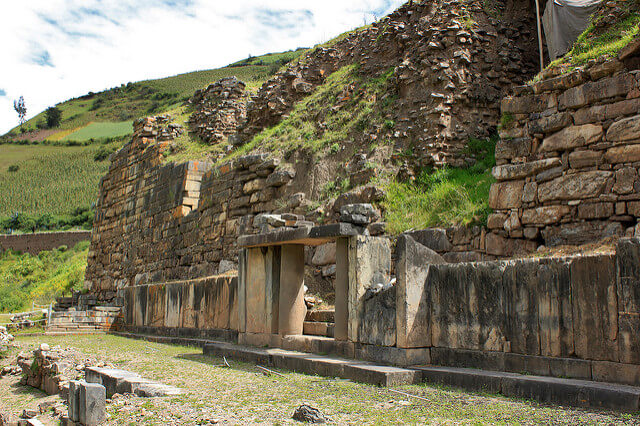
Chavín de Huántar is one of the most important ceremonial centers of ancient Peru. It is located in the district of Chavín de Huántar, Huari Province, Áncash Region, on the eastern slope of the Cordillera Blanca and within the Conchucos Valley.
The monument was built and transformed over several centuries. Its plazas, platforms, temples, canals, and interior galleries reveal advanced knowledge of stone architecture, water management, and the organization of ceremonial spaces.
The archaeological site gave its name to the Chavín cultural tradition. UNESCO inscribed it on the World Heritage List in 1985 and generally uses a chronology ranging from 1500 to 300 BC. Other archaeological sources place its main monumental phases approximately between the 13th and 5th centuries BC; therefore, the dates may vary depending on the periodization used.

Chavín de Huántar was an important ceremonial and religious center visited by people from different Andean regions. Its location between the coast, the highlands, and the eastern slopes of the Andes encouraged the exchange of people, products, and ideas among different regions.
It was not a city similar to modern urban centers or a military fortress. The complex consisted of ceremonial buildings, platforms, sunken plazas, stairways, canals, and galleries built inside the temples.
Its importance does not depend solely on its architecture. Its stone sculptures and the iconography of felines, birds of prey, snakes, and anthropomorphic beings reveal a complex religious system that influenced broad areas of the central Andes.
The monument was not built in a single stage. Researchers distinguish different phases of expansion and remodeling, traditionally associated with structures known as the Old Temple and the New Temple.
The so-called Old Temple was organized around a sunken circular plaza and housed the gallery where the Lanzón remains. In later stages, the buildings, platforms, and public spaces were expanded, including the large rectangular plaza.
The ceremonial center lost importance before the beginning of the Common Era. However, the site continued to be known by local populations and was later mentioned by chroniclers and travelers. During the colonial period, it was mentioned by chroniclers and travelers. In the 19th century, it attracted the attention of scholars such as Antonio Raimondi.
Julio C. Tello began systematic research in 1919 and regarded Chavín as a fundamental culture for understanding the development of Andean societies. Since then, various Peruvian and international projects have studied its architecture, art, and galleries.
The monument is located in the district of Chavín de Huántar, Huari Province, Áncash Region, near the confluence of the Huachecsa and Mosna rivers.
It is situated at approximately 3,180 m a.s.l. and occupies an area of the Conchucos Valley, east of the Cordillera Blanca.
The entrance and access point may vary according to the site’s current regulations. Before traveling, confirm the exact location through the official channels of Peru’s Ministry of Culture.
The Chavín National Museum is located in the town and is visited separately from the archaeological monument:
Chavín National Museum: Jirón 17 de Enero Norte, s/n, Chavín de Huántar.
From Huaraz
The most common tourist route begins in the city of Huaraz. The road journey is approximately 107 km and usually takes around three hours, although the duration depends on road conditions, the weather, and the number of stops.
The route crosses the Cordillera Blanca through the Cahuish Tunnel and continues toward the Conchucos Valley. From the bus terminal in the town of Chavín de Huántar to the monument, the distance is approximately one kilometer.
From Lima
The overland journey from Lima is usually made first to Huaraz and then to Chavín de Huántar. Depending on the road chosen, the complete journey may be close to 500 km and requires a long day of travel or an overnight stay in Huaraz.
For a more comfortable visit, it is advisable to spend at least one night in Huaraz or in the town of Chavín de Huántar rather than attempting to complete the entire journey from Lima in a single day.
The Lanzón is a granite sculpture approximately 4.53 meters tall. It remains inside a gallery located at the heart of the so-called Old Temple.
Its surface depicts an anthropomorphic figure with feline, serpent, and other features. The modern name “Lanzón” comes from its elongated, pointed shape, but it was probably a central sacred image associated with temple rituals.
Access to this gallery may be restricted for conservation, safety, capacity, or archaeological work. Check the visiting conditions before arriving.
The Raimondi Stela is a granite slab approximately 1.98 meters tall and 74 centimeters wide. It depicts an anthropomorphic deity holding two staffs and features a complex composition of feline, serpent-like, and avian elements.
It was recognized at Chavín de Huántar during the 19th century and was named in honor of Antonio Raimondi. The original piece forms part of the collection of the National Museum of Archaeology, Anthropology and History of Peru, in Pueblo Libre, Lima. A replica has been displayed at the Chavín National Museum.
The original Raimondi Stela is not displayed inside the archaeological monument of Chavín de Huántar.
The Tello Obelisk is a four-sided stone sculpture covered with a complex engraved composition. Its imagery has been interpreted as two mythical beings with caiman, feline, bird, serpent, and plant features.
The piece is named in honor of Julio C. Tello and is preserved in the Chavín National Museum, where it is one of the main elements of the permanent exhibition.
The circular plaza forms part of the sector associated with the Old Temple. It is surrounded by stone walls and was decorated with reliefs depicting human beings, felines, and supernatural creatures.
This space may have been used for ceremonies involving a limited group of people. Its design directed attention toward the entrances and temple platforms.
In addition to the circular plaza, the complex contains a large sunken rectangular or quadrangular plaza associated with later expansions of the ceremonial center.
Because of its size, it may have accommodated a larger number of participants. The plaza is connected to platforms, stairways, and buildings that altered the monument’s original layout.
The tenon heads are stone sculptures that were embedded in the exterior walls of the temples. Their elongated rear sections allowed them to be secured to the structures, which is the origin of their name.
Their faces combine human and animal characteristics. Some interpretations relate them to ritual transformations, supernatural beings, or figures associated with worship. Although they are often referred to as temple guardians, their exact meaning remains under study. Some interpretations connect them with supernatural beings and religious rituals.
Most of the pieces removed from the monument are preserved in the Chavín National Museum. One tenon head remains in place on one of the walls at the archaeological site.
The opening hours of the archaeological monument and the Chavín National Museum may vary. Before your visit, confirm the hours of each site through the official channels of the Ministry of Culture.
Tuesday to Sunday:
Admission may be subject to daily capacity limits, and online reservation procedures may change depending on the season. Review the official information before planning your visit.

Admission fees for the monument and the museum are updated periodically. Check the current prices on the official website of the Ministry of Culture before your trip.
Chavín de Huántar Archaeological Monument
Chavín National Museum
For generally drier roads and a lower probability of heavy rainfall, the months between May and September are usually preferred.
However, during this season, nights and early mornings can be cold. Solar radiation can also be intense because of the altitude.
Between approximately November and March, the chance of rainfall increases in the highlands of Áncash. This may affect roads, cause streams to rise, or lead to changes in the visitor circuits. Before traveling, it is advisable to check the weather forecast and official Senamhi advisories.
Set aside at least two or three hours to explore the monument without rushing. Allow additional time to visit the Chavín National Museum, as it is not located within the same complex.
Arrive in the morning. This allows you to explore the site more calmly and reduces the risk of being unable to enter because of capacity limits.
Chavín is located at approximately 3,180 m a.s.l. Walk slowly, stay hydrated, and avoid intense physical exertion immediately after arriving.
Bring layered clothing, a waterproof garment, a hat, sunscreen, and footwear with good traction. The weather may change throughout the day.
Do not touch the sculptures or walls, do not leave the authorized route, and follow the staff’s instructions. Access to some galleries may be temporarily closed.
Confirm the opening hours and admission fees of the monument and the museum separately, because older tourism websites may still display outdated prices or state that a single ticket provides access to both sites.
Are Chavín de Huántar and the Chavín culture the same thing?
Not exactly. Chavín de Huántar is the archaeological site and ceremonial center. The term “Chavín culture” is used to refer to a religious, artistic, and cultural tradition whose influence spread across different regions of ancient Peru.
Is the Raimondi Stela at Chavín de Huántar?
The original piece remains part of the collection of the National Museum of Archaeology, Anthropology and History of Peru in Lima. A replica of the stela is usually displayed at the Chavín National Museum. If you would like to see it, confirm its availability before traveling.
Is the Tello Obelisk inside the monument?
No. The Tello Obelisk is displayed at the Chavín National Museum.
Can visitors enter all the galleries?
No. Visitors may only enter the areas included in the authorized circuit. Some galleries remain closed for safety, conservation, or archaeological research.
How long does the visit take?
The tour of the monument may take between one and a half and two hours. To visit the museum as well and travel between both locations, it is advisable to allow between three and four hours.
Is it necessary to hire a guide?
Hiring a guide is not mandatory, but a guided visit can help you better understand the history of the temple, its construction phases, and the meaning of its sculptures.
Can Chavín de Huántar be visited on a day trip from Huaraz?
Yes. Many excursions leave Huaraz in the morning and return in the afternoon. The journey takes around three hours each way, making it a long day trip.
Is it suitable for people with reduced mobility?
Some areas have changes in elevation, stairs, uneven surfaces, and narrow galleries. Access conditions may vary, so it is advisable to contact the site administration directly before traveling.
Why is Chavín de Huántar a World Heritage Site?
UNESCO recognizes its importance as one of the oldest and best-known pre-Columbian ceremonial centers in the Andes, as well as the quality of its stone structures, plazas, terraces, and mainly zoomorphic ornamentation. It was inscribed in 1985.

Happy passengers