
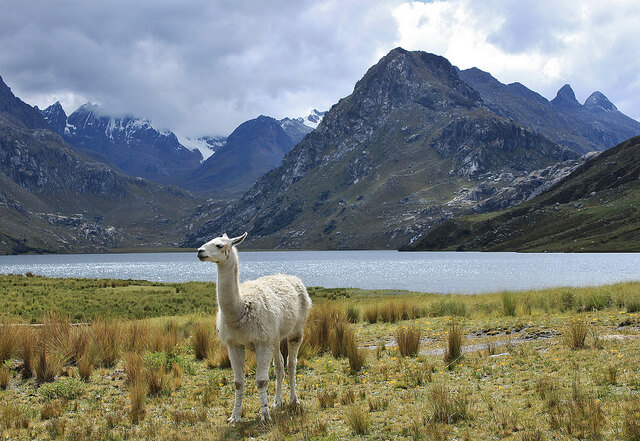
Huascarán National Park is one of the most important protected natural areas in Peru. It is located in the department of Áncash and preserves a large section of the Cordillera Blanca, considered the highest tropical mountain range in the world. Its territory includes snow-capped mountains, glaciers, ravines, queñual forests, high-Andean wetlands, and hundreds of glacial lakes.
It was created on July 1, 1975. Before publishing, confirm the decree number using the official information provided by SERNANP. In 1977, it became part of the core area of the Huascarán Biosphere Reserve, and in 1985, it was inscribed on the UNESCO World Heritage List because of its extraordinary scenic and geological value. Its protected area covers 340,000 hectares.
Huascarán, the highest mountain in Peru, is located within the park. The southern summit of Huascarán reaches 6,768 m above sea level and is the highest mountain in Peru. The Cordillera Blanca contains numerous peaks over 6,000 meters, including Huascarán, Huandoy, Chopicalqui, and Yerupajá.

Huascarán National Park is located in north-central Peru, within the department of Áncash. It extends across the provinces of Huaylas, Yungay, Carhuaz, Huaraz, Recuay, Bolognesi, Huari, Asunción, Mariscal Luzuriaga, and Pomabamba. For this reason, it does not have a single entrance: each ravine, lake, or mountain route has a different access point.
Huaraz is the most commonly used tourism base for visiting the southern and central sections of the park. Yungay provides access to Llanganuco, Lake 69, and the Santa Cruz circuit; Caraz is the main reference point for Lake Parón; Cátac leads toward Pastoruri; and Huari serves as an access point for Lake Purhuay and other attractions in the Conchucos area.
From Lima, the overland journey to Huaraz covers approximately 400 kilometers and usually takes around eight hours, although the travel time depends on traffic, road conditions, and the service hired.
The Llanganuco ravine is home to the Chinancocha and Orconcocha lakes, surrounded by the Huascarán and Huandoy massifs. Lake Chinancocha is located at approximately 3,850 m above sea level, around 25 kilometers from Yungay. Its turquoise-green waters and queñual forests form one of the most representative landscapes of Áncash.
Visitors can take short walks, observe birds, and enjoy authorized boat rides in this area. It also has a checkpoint, an interpretation center, and basic visitor services.
Lake 69 is located at 4,604 m above sea level, at the foot of the Chacraraju snow-capped mountain. Its intense turquoise color comes from glacial water. The excursion can be completed in one day, but it requires a high-altitude hike, proper acclimatization, and good physical condition.
This hike is not recommended for every traveler: it requires good physical fitness, prior acclimatization, and experience on high-altitude routes. The elevation and sudden weather changes can affect even people who exercise regularly.
Located east of Caraz, at approximately 4,185 m above sea level, Parón is the largest lake in Huascarán National Park. It is surrounded by peaks such as Artesonraju, Pirámide de Garcilaso, Huandoy, Chacraraju, and Pisco. Its waters have a striking turquoise-blue color.
A standard visit can be completed during the day. Some activities and more remote areas require authorization, planning, and professional assistance.
This is one of the best-known multi-day hikes in the Cordillera Blanca. The route crosses ravines, lakes, and camping areas, and passes through Punta Unión, located at approximately 4,750 m above sea level. SERNANP recommends three to four days to complete the circuit.
Although it does not require climbing a technical summit, the Santa Cruz–Huaripampa circuit involves several days of hiking, prior acclimatization, and good physical condition. Proper planning and suitable equipment are recommended, as well as the support of a guide or authorized operator when travelers do not have experience in high-altitude trekking.
The Climate Change Route, located in the Carpa sector, allows visitors to observe the effects of glacial retreat, new lakes formed by melting ice, and other geological features in the area. Pastoruri reaches approximately 5,240 m above sea level, while much of the tourist route takes place above 4,100 meters.
This sector also includes an interpretation center, Lake Patococha, the Pumapashimin spring, and the naturally carbonated waters of Pumapampa.
Lake Churup is located near Huaraz and is visited as a day trip. Along the route, travelers can see the Churup snow-capped mountain, waterfalls, rocky walls, and panoramic views of the valley. Some sections have been equipped to make passage easier, but the route still requires caution and acclimatization.
Lake Purhuay is located near Huari, in the Conchucos area. It is surrounded by native vegetation and has areas for short walks and authorized recreational activities. SERNANP mentions boat rides, kayaking, mountain biking, and camping, subject to local conditions and regulations.
Some of the best-known mountains in the park include Huascarán, Alpamayo, Pisco, Chopicalqui, Huandoy, Artesonraju, Taulliraju, Vallunaraju, and Copa. Their difficulty levels vary greatly: some viewpoints and base camps can be reached by hiking, while summit ascents require technical knowledge of glacier mountaineering.
Mount Pisco is often used for acclimatization expeditions, but it remains a glaciated mountain. Alpamayo, Huascarán, and other more difficult peaks are reserved for experienced mountaineers accompanied by accredited professionals. Glacier conditions change constantly, and a route used in previous seasons may no longer offer the same level of safety.
SERNANP records 901 plant species within the park. Vegetation changes according to altitude and includes puna grasslands, wetlands, shrublands, queñual forests, and small areas of montane vegetation.
One of the most representative plants is the Puya raimondii, known locally as titanca or the queen of the Andes, whose enormous flower cluster can produce thousands of blossoms. Queñual trees, quisuar trees, various medicinal plants, and species adapted to low temperatures and intense solar radiation are also noteworthy.
The protected area is home to emblematic species such as the Andean condor, vicuña, taruca deer, spectacled bear, puma, Andean cat, vizcacha, and Andean fox. Bird species also include the giant hummingbird, Andean gull, giant coot, torrent duck, and various species native to high-Andean lakes and wetlands.
Wildlife sightings are not guaranteed. Wild animals should be observed from a distance without feeding them, chasing them, or disturbing their shelters.
The climate varies according to altitude and the area of the park. On higher routes, mornings may be cold and sunny, while wind, hail, or rain are common in the afternoon. Even during the dry season, rain, hail, frost, strong winds, and significant temperature differences between day and night may occur.
According to information published by SERNANP, some checkpoints operate from Monday to Friday between 8:30 a.m. and 3:00 p.m. Confirm the schedule for the entrance you plan to use, as it may vary according to the route and season.
It is advisable to confirm the schedule of your chosen route directly before traveling. Access conditions may also change due to rainfall, maintenance work, fires, landslides, or high-mountain conditions.

Entrance fees may change depending on the area of the park and the validity period of the ticket. Before traveling or selling a package, check the latest prices on the official SERNANP website.
| Ticket validity | Foreign adult visitor | Peruvian adult visitor | Peruvian visitor aged 5 to 16 | Local adult resident and local minor resident |
| 1 day | S/ 30.00 | S/ 12.00 | S/ 5.00 | Adult S/ 5.00; minor S/ 3.00 |
| 2 to 3 days | S/ 60.00 | S/ 30.00 | S/ 15.00 | S/ 15.00 |
| 4 to 30 days | S/ 150.00 | S/ 75.00 | S/ 35.00 | S/ 35.00 |
Children under five years old enter free of charge. Lake 69 and Mount Mateo have specific rates for Peruvian visitors and local residents. Before including them in a package, confirm whether this payment replaces or supplements the general park entrance fee: for one day, the rate is S/ 15.00 per Peruvian adult and S/ 8.00 per Peruvian minor; the published local rate is S/ 8.00.
Rates may change and should therefore be verified before marketing a tourism package.
SERNANP states that visitors must register at checkpoints, respect opening hours, use marked trails, and follow park ranger instructions. For adventure activities, multi-day hikes, and mountain ascents, SERNANP recommends hiring authorized operators and experienced guides. For day trips, check the conditions of your chosen access point.
Before visiting lakes located above 4,000 meters, it is advisable to allow time for gradual acclimatization. Travelers should not continue ascending if they experience headaches, nausea, dizziness, or unusual fatigue. If symptoms worsen, medical advice is to descend and seek assistance.
It is advisable to bring clothing suitable for cold and rainy conditions, sun protection, water, light food, and appropriate footwear. Visitors must not remove plants, collect rocks, enter restricted areas, leave waste, or approach glaciers outside authorized routes.
Because of its vast size, it is best to choose attractions according to the number of days available. With three or four days, you can combine lakes, viewpoints, and a high-altitude hike; trekking circuits and ascents of snow-capped mountains require more time.
Multi-day circuits and expeditions to snow-capped mountains require separate itineraries, prior acclimatization, and professional planning.
The itinerary should be designed according to the season, the travelers’ ages, their experience at high altitude, and the current condition of each route.

Happy passengers