
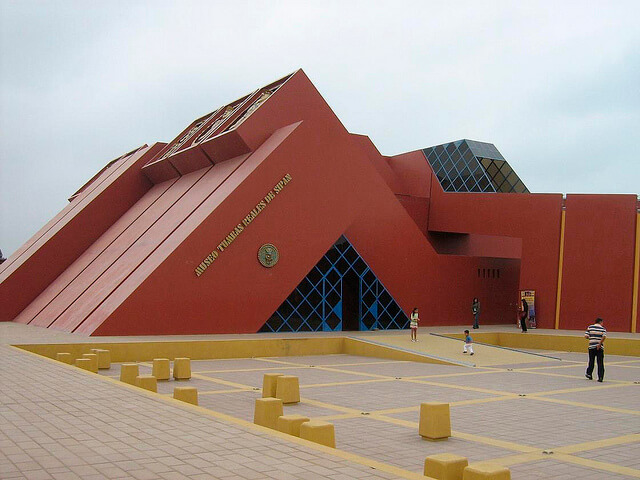

The cultural route through Túcume and the Royal Tombs of Sipán Museum offers an opportunity to discover two different periods in the pre-Hispanic history of Peru’s northern coast. The tour combines an extensive open-air archaeological complex with one of the most important museums in the Lambayeque region.
The Túcume Archaeological Complex, popularly known as the Valley of the Pyramids, is located approximately 33 km north of Chiclayo. It consists of 26 monumental adobe structures distributed around Cerro Purgatorio, also known as Cerro La Raya. The settlement was occupied by the Lambayeque, Chimú, and Inca societies until the arrival of the Spanish.
The Royal Tombs of Sipán Museum is located in the city of Lambayeque, approximately 12 km from Chiclayo. It preserves and displays the main objects recovered from the royal tombs discovered at Huaca Rajada-Sipán, including ornaments, symbols of power, pottery, and funerary offerings belonging to the Lord of Sipán and other members of the Moche elite.
Although both places can be visited on the same day, they do not belong to the same culture or historical period. Sipán is mainly associated with the Moche civilization and predates the height of Túcume by several centuries.
Túcume began to develop as an important political and religious center around the end of the tenth century, during the final stage of the Lambayeque or Sicán culture. It was later occupied by the Chimú, approximately from the late fourteenth century, and by the Incas during the fifteenth century. Its final abandonment was related to the Spanish conquest in the sixteenth century.
The large constructions at Túcume did not serve a single purpose. Research indicates that their platforms contained ceremonial and administrative spaces, as well as residences for high-ranking individuals.
Cerro Purgatorio formed the symbolic center of the settlement. The pyramids and platforms were arranged around this natural elevation, which likely held religious significance for the ancient inhabitants of the area.
The intact tomb of the Lord of Sipán was discovered on July 20, 1987, on the funerary platform of Huaca Rajada-Sipán. The archaeological excavation was led by Walter Alva and involved a team of Peruvian specialists.
The Lord of Sipán was a Moche ruler who lived approximately during the seventh century AD. He was buried with ornaments, symbols of authority, ceremonial weapons, vessels, and other objects that represented his political, military, and religious power.
The discovery provided a more precise understanding of Moche social organization and confirmed that several figures represented in Moche pottery and religious art corresponded to real people and official roles.
The Royal Tombs of Sipán Museum opened on November 8, 2002, with the purpose of preserving, researching, and exhibiting the objects recovered from the tombs.
It is important not to confuse these three places:
A replica of the original burial context of the Lord of Sipán can be visited at the Huaca Rajada-Sipán archaeological complex. The Royal Tombs Museum presents a museum reconstruction of the burial and displays numerous original objects.
Location of Túcume
The Túcume Site Museum and Archaeological Complex are located in the district of Túcume, province of Lambayeque, approximately 33 km north of Chiclayo.
The journey by public transportation to Túcume’s main stop takes approximately 45 minutes. From there, it is necessary to travel an additional 2 km to the complex by mototaxi, taxi, or on foot.
Location of the Royal Tombs of Sipán Museum
The museum is located at 895 Juan Pablo Vizcardo y Guzmán Avenue, in the city of Lambayeque. It is approximately 12 km from Chiclayo, and the road journey takes between 20 and 25 minutes, depending on traffic.
The archaeological landscape of Túcume consists of 26 large adobe structures and other smaller mounds. Many of these buildings are shaped like truncated pyramids with platforms, courtyards, ramps, and enclosures on their upper levels.
The monumental structures are mainly distributed around Cerro Purgatorio and belong to different periods of occupation. Among the best-known structures are Huaca Larga, Huaca I, Huaca Las Balsas, the Temple of the Sacred Stone, and the Central Plaza.
Huaca Larga is the largest structure in the complex. It is approximately 700 meters long and was one of the main political and administrative centers during the Chimú and Inca occupations.
Research has identified courtyards, corridors, storage facilities, residential areas, and ceremonial sectors. Not all of these spaces are included in the regular tourist circuit, as some remain protected or reserved for archaeological research.
Huaca I is one of the most important structures in the monumental sector. It has the characteristic shape of Lambayeque truncated platforms and was associated with local political power.
Its original access consisted of an extensive zigzagging ramp that led to the upper section. It is currently part of Route A, or the Northern Zone, of the visitor circuit.
Huaca Las Balsas is a smaller structure located in the southwestern sector of the complex. It stands out for its mud reliefs, which depict birds, boats, sea-related beings, and scenes associated with Lambayeque mythology.
Archaeological interpretations associate some of these images with water, navigation, rituals, and the tradition of Naylamp, the founding figure of Lambayeque mythology.
A visit to Huaca Las Balsas is included in Route B, or the Southern Zone.
The Temple of the Sacred Stone was a ceremonial enclosure located near Huaca Larga. Miniature metal offerings, Spondylus shells, camelid remains, and contexts associated with human sacrifices have been identified in this area.
Because it is a delicate archaeological area subject to conservation measures, access may be restricted. Its importance is mainly explained through the Site Museum and the complex’s interpretive materials.
The Túcume Site Museum opened on August 20, 1992. Its creation was connected to the research led by archaeologist Luis Alfredo Narváez and the archaeological project in which Norwegian researcher Thor Heyerdahl participated.
Its galleries explain the history of the complex from pre-Hispanic times to the present day. The exhibition includes archaeological objects, models, materials related to metallurgy, and content about the traditions, festivals, and cultural practices of Túcume’s population.
The museum seeks to show that local history did not end with the abandonment of the pyramids, but continues through the crafts, celebrations, religious practices, and traditional knowledge of the local population.
The complex offers different visitor routes:
Route A or Northern Zone: includes the museum galleries, educational trail, nursery, organic garden, Huaca I, and the viewpoint.
Route B or Southern Zone: includes the museum galleries, educational areas, and Huaca Las Balsas.
Comprehensive Route: combines the attractions of Routes A and B.
The viewpoints offer panoramic views of the pyramids, Cerro Purgatorio, agricultural fields, and the dry forest surrounding the complex.

The Lord of Sipán exhibition
The museum displays original objects recovered from the tomb of the Lord of Sipán. These items provide insight into his ceremonial clothing, social rank, and the complex funerary ritual prepared after his death.
The tour presents information about the archaeological excavation, the arrangement of the offerings, and the conservation process used for the materials.
Moche jewelry, ornaments, and symbols of power
The collection includes ear ornaments, necklaces, nose ornaments, chest pieces, crowns, body protectors, banners, scepters, and other objects made from gold, silver, copper, stones, and organic materials.
Among the most representative pieces are the large chest ornaments, decorated ear ornaments, scepters, banners, and other symbols associated with the authority of the Lord of Sipán.
Reconstruction of the burial
One of the museum’s central sections presents a museum reconstruction of the burial chamber. It allows visitors to observe the position of the ruler, his companions, and the offerings placed during the burial.
The gallery recreates the layout of the tomb to help visitors understand how the ruler, his companions, and the offerings were arranged during the burial.
The Old Lord of Sipán and other figures
The tour is not limited to the Lord of Sipán. It also presents materials related to the Old Lord of Sipán, the Priest, and other members of the Moche elite found in the mausoleum at Huaca Rajada.
These tombs make it possible to study several generations of rulers and religious authorities who occupied the sanctuary of Sipán.
Architecture of the Royal Tombs Museum
The building was designed with inspiration from the truncated pyramids of Moche architecture. Its exterior features large sloping volumes and an extensive access ramp.
Visitors climb the ramp to the third level and begin the tour from the top. As they descend through the galleries, they learn about the discovery, the excavation, the tombs, and the main objects recovered.
The interior lighting is dim to protect the artifacts and recreate the atmosphere of the funerary contexts.
The Túcume Site Museum and Archaeological Complex are usually open from Tuesday to Sunday. Before your visit, confirm the admission schedule through the official channels of Peru’s Ministry of Culture. They remain closed on Mondays, except for special openings announced by the Ministry of Culture.
Routes A or B:
Comprehensive Route:
Admission prices vary according to the selected route and visitor category. Before traveling, check the current admission rates for the Túcume Archaeological Complex through the official channels of the Ministry of Culture.
Special discounts are available for teachers, voluntary military service members, senior citizens, and people with disabilities, according to the conditions and documentation established in the official admission schedule.
The Royal Tombs of Sipán Museum is usually open from Tuesday to Sunday, from 9:00 a.m. to 5:00 p.m. Confirming the schedule before visiting is recommended. During 2026, it may also open on certain Mondays that coincide with national holidays, subject to official confirmation.
The current admission prices are:
Visitors receiving free or reduced admission must present the corresponding document.
Túcume and the Royal Tombs Museum usually participate in activities such as Open Museums. Check the official schedule before visiting to confirm the dates, opening hours, and conditions for free admission.
To reach the Royal Tombs Museum, visitors can take minibuses that operate along the Chiclayo–Lambayeque route. From Lambayeque’s main square, it is possible to continue on foot or take local transportation to the museum.
To travel to Túcume, minibuses depart from the area between Augusto B. Leguía and Fernando Belaúnde Terry avenues in Chiclayo. The vehicles arrive at the district’s main stop. From there, visitors can take a mototaxi to the archaeological complex.
Public transportation routes, stops, and fares may change, so confirming them locally is recommended.
Taking this route with tourist transportation makes it easier to coordinate the schedules of both sites and avoid long waits between Túcume and Lambayeque. If you prefer an organized visit, CuscoPeru.com can help you arrange transportation from Chiclayo, admission schedules, and a guide to visit Túcume and the Royal Tombs Museum in a single day. Before booking, confirm whether the program includes admission tickets, a tour guide, transportation, lunch, and pickup from your accommodation.
To explore only one of the Túcume routes, it is advisable to allow between one and a half and two hours. The Comprehensive Route, including the museum, trails, Huaca I, Huaca Las Balsas, and the viewpoints, may require between two and a half and three hours.
A visit to the Royal Tombs of Sipán Museum usually requires between one and a half and two hours, depending on the visitor’s level of interest and the availability of a guide.
Including transportation, lunch, and waiting times, the complete experience should be planned as an excursion lasting approximately seven or eight hours.

Wear sneakers or closed shoes for walking along the trails at Túcume. Bring a hat, sunscreen, water, and lightweight clothing, as a significant part of the tour takes place outdoors.
The climate in Chiclayo and Lambayeque is generally warm and dry throughout much of the year. For a more comfortable visit to Túcume, it is advisable to visit the complex in the morning. The site can be visited throughout the year, although the early morning hours are more comfortable for exploring the pyramids.
Do not climb onto platforms or structures that are not part of the authorized circuit. Do not touch the mud reliefs, walls, or other archaeological elements.
Before entering the galleries of the Royal Tombs Museum, ask the staff about the use of backpacks and bags and whether storage facilities are available.
Bring identification documents or a student ID card to qualify for free or reduced admission.
Can Túcume and the Royal Tombs Museum be visited on the same day?
Yes. Both places are located north of Chiclayo and can be included in a full-day excursion. Visiting Túcume in the morning and the Royal Tombs Museum in the afternoon is recommended.
Does Túcume belong to the Moche culture?
Not primarily. Túcume belongs to a later period and was mainly associated with the Lambayeque, Chimú, and Inca societies. The Lord of Sipán belonged to Moche society and lived several centuries before the development of Túcume.
Is the Royal Tombs Museum located where the tomb was discovered?
No. The tomb was discovered at Huaca Rajada-Sipán, in the district of Zaña. The Royal Tombs Museum is located in the city of Lambayeque.
Huaca Rajada has its own site museum and a replica of the funerary context.
Are the objects in the Royal Tombs Museum original?
A significant number of the ornaments, ceramics, and objects on display are original and come from the excavations at Sipán. The museum also uses models, reconstructions, and museum resources to explain the arrangement of the tombs.
Does the tour include a guide?
Admission does not necessarily include a guide. For a guided visit, check the availability, languages, and service rates in advance. The Royal Tombs Museum lists guided tours among its services, but availability, language, and format should be confirmed before the visit.
At Túcume, visitors can request information about local guides or book an organized tour from Chiclayo.
Are photographs allowed inside the museums?
At the Royal Tombs of Sipán Museum, photography and filming are only permitted outside. Photographs must not be taken inside the exhibition galleries.
At Túcume, personal-use photography is permitted in authorized areas. Before entering the Site Museum or approaching Huaca Las Balsas, follow the staff’s instructions. Particular care must be taken inside the Site Museum and near the reliefs at Huaca Las Balsas.
What is the best time of year to visit?
The route can be completed throughout the year. For walking around Túcume, it is advisable to enter in the morning and avoid the hours of strongest solar radiation.
Before traveling during the summer months, check the weather forecast and official announcements, especially when unusual rainfall associated with climatic events affects Peru’s northern coast.
Is it necessary to purchase two admission tickets?
Yes. Túcume and the Royal Tombs Museum are separate attractions, and each has its own ticket office and admission rates.

Happy passengers