

Qoraqora is a Quechua term commonly interpreted as “place with abundant grass” or “grassland.” During the Inca period, this ancient site was located next to Qasana and formed part of the urban area linked to Waqaypata, the current Main Square of Cusco.
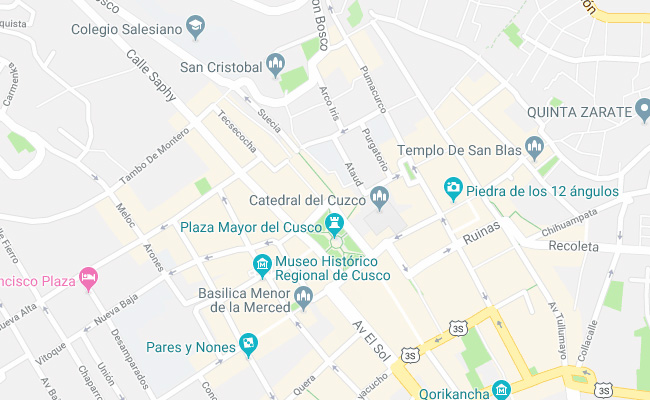
Unlike the modern city, both spaces were not separated by a street as they are today by Procuradores Street. Its eastern side probably faced an ancient public road, close to the route of the current Suecia Street.
According to historical references, this palace is attributed to Inca Roca and may have been linked to the Ayllu Raurau, his royal lineage or panaca. After the arrival of the Spaniards, part of the former estate was assigned to Gonzalo Pizarro and later transformed by colonial constructions.
It was located next to Qasana, and its façade possibly faced Waqaypata, in what is now Portal Harinas, north of the Main Square.
During the colonial period, residences and buildings were constructed over the foundations of the ancient Inca palace. As happened with other spaces in Cusco, part of its stone foundations became integrated into later mansions, arcades, and constructions.
Today, visitors can recognize this ancient sector through the urban layout, the arcades, and the colonial mansions surrounding the Main Square. Many of these buildings now function as shops, restaurants, and tourism services, showing how Cusco preserves its Inca and colonial past.
Qoraqora does not operate as an independent archaeological complex with regular visiting hours. Its remains and urban references can be appreciated during a walk through the Historic Center of Cusco, especially around the Main Square, Portal Harinas, Procuradores Street, and Suecia Street. With CuscoPeru.com, you can organize a more detailed visit or historical interpretation of the site, helping you plan your visit in a simple and safe way.

Happy passengers