

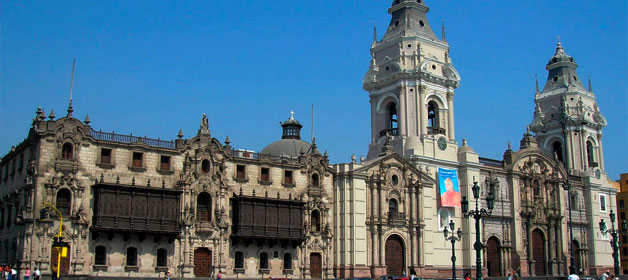
The Metropolitan Basilica Cathedral of Lima and Primate Cathedral of Peru is one of the main religious and historical monuments of the capital. It is located in the Plaza Mayor, next to the Archbishop's Palace, in the heart of Lima's Historic Center.
The current temple is the result of various constructions, expansions, earthquakes, and restorations carried out since the 16th century. Therefore, its architecture combines Renaissance, Baroque, Neoclassical, and Neo-Colonial elements. Besides serving as a place of worship, it houses the Cathedral Museum of Lima, several chapels, religious artworks, crypts, and the mausoleum of Francisco Pizarro.

The Cathedral of Lima is the main church of the city's archdiocese and one of the most representative buildings in the Plaza Mayor. Its importance is not limited to the religious sphere; it is also a testimony to Lima's architectural, artistic, and political evolution since its Spanish foundation.
It is part of the monumental complex of the Historic Center of Lima, which is included on the UNESCO World Heritage List. Inside, visitors can find altarpieces, sculptures, paintings, liturgical furniture, funerary monuments, and a remarkable choir stall.
On January 18, 1535, the day of the Spanish foundation of Lima, Francisco Pizarro laid the first stone of a church dedicated to Our Lady of the Assumption. This initial construction was much smaller and simpler than the current building.
On May 14, 1541, Pope Paul III elevated the temple to the category of cathedral through the creation of the Diocese of Lima.
Jerónimo de Loayza, the first Archbishop of Lima, promoted the construction of a second church with larger dimensions, completed approximately in 1551. As the city grew and the archdiocese gained importance, a more monumental building was later planned.
The current structure essentially corresponds to a third construction stage, although it has been modified many times throughout history.
The cathedral was damaged by several earthquakes, especially those that occurred in 1687, 1746, and 1940. After each disaster, reconstruction works were carried out, modifying its appearance.
The works developed between the 18th and 19th centuries incorporated numerous Neoclassical elements. After the 1940 earthquake, an important restoration was carried out under the direction of architect Emilio Harth-Terré. These interventions explain the variety of styles visible today.
The Museum of Religious Art of the Cathedral was created on July 25, 1974, with the purpose of preserving and displaying the artistic and historical heritage belonging to the temple. Today it is presented to the public as the Cathedral Museum of Lima.
The cathedral combines Renaissance, Baroque, and Neoclassical elements, incorporated during different stages of its history and after several reconstructions.
Its main façade features three entrances and is flanked by two towers. Renaissance and Baroque elements can be appreciated on the façade, while the towers and several interior modifications show Neoclassical influences. The appearance of the towers was modified again at the beginning of the 20th century.
The interior is organized around three main naves: a central nave and two side naves. These are complemented by the transept, chapels, crypts, and other spaces related to liturgical and museum functions. The ceilings feature ribbed vaults mainly built with wood and lightweight materials, a solution used to reduce earthquake risks.
The central nave leads to the presbytery and the main altar. Its current configuration reflects reforms carried out during the 19th and 20th centuries, when floors, ceilings, altars, and the arrangement of some interior elements were modified.
The decoration includes sculptures, religious paintings, lamps, and ceremonial furniture corresponding to different periods in the cathedral's history.
The choir stalls are among the main artistic works of the temple. They were created by sculptor and woodworker Pedro de Noguera during the 17th century, based on a project also related to the work of Martín Alonso de Mesa.
They consist of thirty-three carved wooden seats, whose backs display figures of saints, apostles, Doctors of the Church, and other religious figures. Originally located in the central nave facing the main altar, they were later moved to the sides of the presbytery.
In a chapel near the entrance is the mausoleum of Francisco Pizarro, the Spanish founder of Lima. The space is decorated with mosaics designed in 1924 by Manuel Piqueras Cotolí, featuring representations related to the conquest and the history of the city.
The remains attributed to Pizarro were discovered in 1977 inside a crypt of the cathedral and later placed in the funerary monument that can be seen today.
The current layout of the Cathedral Museum identifies thirteen chapels. These are the chapels of the Immaculate Conception, the Assumption, Our Lady of Peace, Saint Anne, Our Lady of Candelaria, Saint John the Baptist, the Holy Family, the Peruvian Saints, Our Lady of Antigua, the Visitation, Our Lady of Evangelization, Saint Apollonia, and Saint Turibius of Mogrovejo.
Chapel of the Holy Family
This chapel contains a wooden sculptural group representing Saint Joseph, the Virgin Mary, and the Child Jesus. The work was created by Pedro Muñoz in the 17th century.
Its Neoclassical altarpiece is attributed to Matías Maestro and was incorporated during the 19th century. It also preserves Sevillian tiles dated from 1630.
Chapel of the Peruvian Saints
The chapel is presided over by images of Saint Rose of Lima, Saint Francis Solano, Saint John Macías, and Saint Martin de Porres.
Its Baroque altarpiece, created in the 18th century, comes from the former Church of Our Lady of Bethlehem. This space also contains the tombs of Luis Arrigoni and Archbishop Emilio Francisco Lissón Chávez, whose beatification process is currently underway.
Chapel of the Immaculate Conception
This chapel contains the funerary monument of Archbishop Diego Morcillo Rubio de Auñón, created in the 18th century.
The image of the Immaculate Conception that currently presides over this space was previously associated with the Chapel of Our Lady of Evangelization. This relocation explains part of the confusion found in older descriptions of the temple.
Chapel of Our Lady of Evangelization
Our Lady of Evangelization is one of the most important religious images in the cathedral. The sculpture was created in 1551 by Roque de Balduque and is considered one of the oldest Marian images preserved in Lima.
The image received the title of Our Lady of Evangelization during the pontificate of John Paul II. The official date should be confirmed before publication. The chapel also preserves a 17th-century Baroque altarpiece created by Ascencio de Salas.
Chapel of Our Lady of Peace
The Chapel of Our Lady of Peace is currently dedicated to the reservation of the Blessed Sacrament. It contains a sculpture of the Virgin accompanied by angel figures.
It also preserves the remains of Friar Francisco Camacho, a hospital religious figure recognized by the Church as a Servant of God.
Chapel of Saint John the Baptist
The Chapel of Saint John the Baptist preserves one of the oldest altarpieces in the cathedral. It is a Renaissance work from the 17th century created by Juan Martínez Montañés.
The altarpiece was transferred from the Monastery of the Immaculate Conception. The Chapel of Saint John the Baptist should not be confused with the Chapel of Saint Anne, as both appear as different spaces in the current official layout.
Chapel of Our Lady of Antigua
Our Lady of Antigua has a historical connection with the National University of San Marcos, and some university ceremonies were formerly held in this chapel.
The tourist visit allows visitors to explore chapels, the sacristy, the Chapter House, the mausoleum of Francisco Pizarro, and several rooms of the Cathedral Museum of Lima.
Sacristy
The sacristy preserves furniture, paintings, liturgical objects, and ornaments used during religious ceremonies. It is one of the spaces where visitors can best appreciate the relationship between the cathedral's religious functions and its artistic heritage.
Chapter House
The Chapter House was used for meetings of the ecclesiastical council. It contains portraits, furniture, and other objects related to the historical administration of the archdiocese.
Schröder Room
This room contains part of the museum's artistic and religious collections. The displayed works may vary due to conservation work, maintenance, or temporary changes in the museum.
Brazzini Room
The Brazzini Room contains artworks and objects related to the religious history of Lima. Its name recalls one of the collections incorporated into the museum's heritage.
The availability of the rooms may vary due to religious ceremonies, maintenance, or exhibition setups.
Visiting hours may change due to religious celebrations, holidays, or special activities. Check the updated information through the official channels of the Cathedral Museum of Lima before your visit.
| Day | Schedule |
| Monday to Friday | From 9:00 a.m. to 8:00 p.m. |
| Saturdays | From 10:00 a.m. to 10:00 p.m. |
| Sundays | From 1:00 p.m. to 7:00 p.m. |
Tickets can be purchased through the official online store of the Cathedral Museum or directly at the ticket office, depending on availability.
When purchasing online, visitors can select the date and entry time. Online purchases allow visitors to choose an available entry schedule. Time slots are usually offered in approximately twenty-minute intervals, depending on availability. The ticket must be used on the selected date and time.
For school groups, delegations, travel agencies, and large groups, it is recommended to contact the museum in advance.
Jirón Carabaya, Plaza Mayor of Lima, Cercado de Lima, Lima 15001, Peru.
The main façade faces the Plaza Mayor, next to the Archbishop's Palace and near the Government Palace and the Metropolitan Municipality of Lima.
From the Plaza Mayor
The cathedral is located directly on the square, so no transportation is needed once you have reached the Historic Center.
From San Martín Square
You can reach it by walking along Jirón de la Unión towards the Plaza Mayor. The route crosses one of the main pedestrian streets in Lima's Historic Center.
From Miraflores
The distance from the Kennedy Park area is approximately nine kilometers. Travel time by car may vary considerably depending on traffic and vehicle restrictions in the Historic Center. From Miraflores, the journey by car usually takes around 30 minutes, although it may take longer depending on traffic conditions. If traveling during rush hour, consider leaving with extra time.
Due to traffic restrictions around the Plaza Mayor, vehicles may drop visitors off a few blocks away from the entrance. It is advisable to consider a short walk to reach the cathedral.
To explore the main chapels, mausoleum, choir stalls, and museum rooms, it is recommended to allow between one hour and one and a half hours.
This duration is a practical estimate and not an official required time. It may vary depending on the size of the group, availability of rooms, visitor interest, and scheduled religious celebrations.
Purchase your ticket in advance if you visit the cathedral during weekends, holidays, or high visitor seasons. Arrive 10 to 15 minutes before your selected entry time. It is also important to carry an identification document and the corresponding accreditation if requesting a reduced fare.
Since the Cathedral of Lima continues to function as a church, visitors should remain quiet, behave respectfully, and follow staff instructions, especially during Masses or religious ceremonies.
Visitors should also avoid touching sculptures, altarpieces, paintings, furniture, and funerary monuments. Before starting the tour, it is advisable to check which rooms and chapels are available that day and keep in mind that some areas have stairs, uneven surfaces, and access conditions typical of a historic building.
Does the Cathedral of Lima open on Sundays?
Yes. The museum receives visitors on Sundays from 1:00 p.m. to 7:00 p.m. Mass schedules may vary depending on the date and planned celebrations. Check the updated schedule directly with the Cathedral of Lima before your visit.
How long does the visit last?
It is recommended to allow between sixty and ninety minutes to explore the main areas of the museum and cathedral.
Is it necessary to reserve in advance?
It is not always mandatory, but purchasing tickets in advance is recommended to secure an entry time, especially on Saturdays, Sundays, holidays, and dates with high visitor numbers. School groups and delegations should coordinate beforehand.
Are photographs allowed?
The policy may depend on the area and scheduled activities. Visitors should ask the staff before beginning the visit and avoid using flash or professional equipment without authorization.
Does the entrance ticket include Mass?
No. The ticket corresponds to the tourist and museum visit. Attending Mass is an independent religious activity and does not require purchasing a museum ticket.
Can visitors enter only to pray?
Religious access depends on Mass schedules, ceremonies, and cathedral regulations. Outside these times, access to museum areas requires payment of the entrance fee.
Do children pay an entrance fee?
Children under six years old enter free of charge. Children between 6 and 12 years old have a reduced fare. Check the current rates for national and foreign visitors before purchasing tickets.
Is the Cathedral of Lima the same as the Church of El Sagrario?
No. The Church of El Sagrario is an adjacent temple related to the cathedral complex, but it has its own entrance and religious functions.
Where is Francisco Pizarro buried?
His remains are located in a mausoleum inside the cathedral, near the main entrance.
Does the cathedral preserve its original 1535 construction?
No. The first church was much smaller. The current building is the result of constructions and reconstructions carried out from the 16th century to the 20th century.

Happy passengers