
In Lima’s district of Ate, at the foot of the hills surrounding the Rímac Valley, lies Puruchuco, one of the most representative archaeological complexes in eastern Lima. Its earthen palace, storage areas, ceremonial courtyards, and site museum offer insight into how local authorities lived and governed before the arrival of the Spanish.
Although it is often described as an “Inca palace,” Puruchuco has a more complex history. Its architecture combines traditions of the Ychsma society with modifications made after the Incas incorporated the Rímac Valley into the Tahuantinsuyo.
Puruchuco is an archaeological monument that formed part of the extensive Puruchuco-Huaquerones Monumental Archaeological Zone. The main building, known as the Palace of Puruchuco, may have been the residence of a local authority. It was also used to organize products, receive visitors, and carry out ceremonial activities.
Its rooms may have been used to receive visitors, record products, store food, hold meetings, and perform certain ceremonies. The complex should not be understood only as a residence: it was also a place from which political and productive activities were organized.
The Puruchuco-Huaquerones Monumental Archaeological Zone contains evidence of Ychsma and Inca occupation and a period of development generally dated between approximately AD 900 and 1536.

The Arturo Jiménez Borja Site Museum presents the traditional interpretation that Puruchuco means “feathered headdress.” This explanation relates the name to a ceremonial headdress preserved in the museum’s collection.
However, the exact origin of the place name has not been fully resolved. Variants such as Pocorucha, Pocurucha, Pocorucho, and Pocurcho appear in old documents and publications. Therefore, “feathered headdress” should be presented as the interpretation promoted by the museum, rather than as a definitively proven linguistic translation.
The Ychsma society developed in the Rímac and Lurín valleys during the centuries before the Inca expansion. Its populations built administrative centers, agricultural settlements, cemeteries, and ceremonial buildings mainly using adobe and rammed earth.
Puruchuco may have begun to develop during this period. Some of its architectural features, such as layouts organized around courtyards, indirect entrances, ramps, and earthen walls, are associated with local traditions of the central coast.
It is not accurate to consider Puruchuco an exclusively Inca construction. Architectural studies reveal the coexistence of local forms and elements incorporated during the Late Horizon.
During the 15th century, the Incas incorporated the Lurín, Rímac, and Chillón valleys into the Tahuantinsuyo. Instead of completely removing the existing authorities, they often employed local curacas as intermediaries to administer the population, collect products, and organize labor.
Puruchuco continued to operate during this new period. The building underwent architectural modifications associated with Inca power, while retaining characteristics of the local Ychsma tradition.
Inca influence can be seen in the double-jamb entrance, some trapezoidal openings, and the arrangement of rooms that restricted access to the most private areas. However, the presence of these elements does not mean that all the site’s inhabitants came from Cusco.
The Rímac Valley was strategically important because of its agricultural land, irrigation canals, and connections with roads leading toward the highlands. From centers such as Puruchuco, agricultural products, textiles, and other goods intended for local consumption or redistribution could be controlled.
Studies of elite residences in the valley show that local authorities and facilities linked to the Inca imperial organization operated simultaneously during the Late Horizon.
Puruchuco may have been one of several local centers associated with the administration of part of the territory of Lati.
The Palace of Puruchuco may have been used by a curaca, or local authority, and by the people who worked in his service. The term palace is a modern designation used to emphasize that it was an elite residence with public functions.
Not all its rooms were bedrooms. The building included reception courtyards, domestic rooms, storage areas, corridors, ramps, and spaces where ceremonies may have taken place.
The layout of the palace made it possible to control the movement of people. Visitors could not proceed directly to the most private rooms, but had to pass through courtyards, passageways, and restricted entrances.
Its possible functions included:
These functions are inferred from the architecture and recovered materials. This does not mean that the function of every room has been definitively proven.
To make the site easier to explain, the visitor route usually distinguishes several functional areas.
Public area
This area includes courtyards and rooms where the curaca may have received visitors, workers, or representatives from other communities. One of the main spaces is known as the audience courtyard.
Domestic and residential area
This area includes rooms and sectors associated with food preparation and the daily lives of those who lived or worked in the complex.
Ceremonial area
This area contains ramps, courtyards, and the well-known triangular niches. These niches are among Puruchuco’s most recognizable visual features.
Ritual and calendrical functions, as well as uses related to the presentation of offerings, have been proposed, but there is no conclusive evidence that they served as astronomical observatories.
Storage areas
Some rooms were used to store products. The presence of storage areas is consistent with the administrative function attributed to the building.
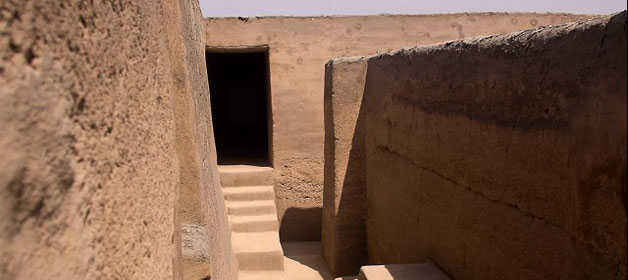
The building is organized around courtyards of different sizes. Ramps and small changes in elevation connected the terraces and separated public areas from restricted ones.
The high outer walls provided privacy, security, and control. Indirect entrances prevented people from immediately seeing the private areas from the entrance.
The palace was built mainly with earth. Adobe bricks and rammed-earth walls were used, a technique in which damp soil was compacted inside molds to form blocks or wall sections.
Earthen architecture is suitable for Lima’s dry climate, but it is vulnerable to heavy rain, humidity, earthquakes, and human intervention.
One of the features associated with Inca influence is the double-jamb doorway. This type of entrance has two stepped frames and frequently appears in buildings of political or ceremonial importance.
At Puruchuco, the double-jamb doorway shows how imperial elements were incorporated into a building that retained local architectural traditions.
The ceremonial area preserves triangular niches, one of Puruchuco’s most recognizable features.
Some interpretations suggest that they may have been used to place products or offerings. Others propose that the shadows they cast may have been related to observing the passage of time. These interpretations should be presented as hypotheses rather than proven functions.
The Ychsma tradition can be recognized in the earthen construction, courtyards, ramps, and indirect circulation. Inca influence is particularly visible in the double-jamb entrance, trapezoidal openings, and certain modifications to the organization of the rooms.
This combination demonstrates that Inca rule did not automatically eliminate local forms of construction and government.
In 1956, during cleaning work on structures near the palace, a rectangular tomb built with dressed stone and mud mortar was discovered.
Archaeologist Ernesto Tabío studied the context at the request of Arturo Jiménez Borja and later published information about the discovery.
Three large funerary bundles were found inside the enclosure. The largest had damaged part of the roof, suggesting that the tomb was used on more than one occasion.
The bundles were wrapped in cotton textiles and secured with plant-fiber ropes. The largest had a false head, an element used in certain burials on the central coast.
This mausoleum should not be confused with the large Huaquerones cemetery, where many additional burials were discovered.
The context contained a cooking pot placed as an offering, two vessels covered with gourd containers, and at least 21 quipus.
Researchers have not been able to determine with certainty in which of the vessels all the quipus were found or which funerary phase they belonged to. Based on their characteristics, the quipus are associated with the Inca administrative tradition.
Funerary bundles were prepared by wrapping the body and various objects in layers of textiles, ropes, and plant fibers. Some people were buried with pottery, tools, food, ornaments, quipus, or objects related to their occupation and social status.
The presence of a false head, elaborate textiles, and numerous quipus suggests that at least one of the buried individuals held an important role. However, the person’s name is unknown, and it cannot be stated with certainty that this was the curaca who lived in the palace.
The Puruchuco Site Museum was founded by Arturo Jiménez Borja and inaugurated on December 24, 1960. It was later named after its founder in recognition of his work in protecting and promoting archaeological heritage.
The museum allows visitors to see archaeological objects associated with Puruchuco before or after touring the monument, helping them better understand its history.
The exhibition explains the history of the Lati chiefdom and the Ychsma and Inca occupations. The institution also preserves materials from other sites investigated by Jiménez Borja.
The headdress is one of the museum’s best-known pieces. It was made with feathers from different birds and other materials and may have been worn by a high-ranking individual.
Although it is commonly associated with the name Puruchuco, information provided by the museum indicates that the piece was recovered in 1958 from the former Rinconada de La Molina cemetery, not from inside the Palace of Puruchuco.
This origin should be explained so that visitors do not assume that all the objects on display were found inside the monument.
The museum preserves an important collection of quipus. These instruments, made from cords and knots, were used to record quantities, organize resources, and transmit certain types of information.
At least 21 quipus were found in association with the mausoleum discovered in 1956. Their presence supports the interpretation of Puruchuco as a center connected with the administration and control of goods.
The collection includes textiles, garments, spinning and weaving tools, vessels, tools, tupus, funerary masks, and objects made of copper, silver, and other alloys.
Textiles make up one of the museum’s largest collections. Many come from funerary bundles recovered at Puruchuco and other archaeological sites in Lima. Because of conservation requirements, the pieces on display may change periodically.
It makes it possible to distinguish the courtyards, ramps, terraces, storage areas, and restricted-access spaces.
It is especially useful because the complete layout of the building is not always easy to understand from ground level.
Puruchuco is located in the district of Ate, in the province and department of Lima. The museum’s official address is:
Prolongación Javier Prado Este Avenue, block 85, no street number, Ate.
It is located near the Monumental Stadium and the Puruchuco tunnel. It should not be confused with the shopping center that uses the same name.
From central Lima, take Javier Prado Avenue east and continue along its extension toward Ate. Travel time depends considerably on traffic.
By public transportation, it is advisable to use routes heading toward Mayorazgo, the Monumental Stadium, or the Javier Prado extension. From the nearest stop, it may be necessary to walk or take a local taxi.
For navigation applications, the most accurate reference is Arturo Jiménez Borja-Puruchuco Site Museum, rather than simply “Puruchuco.”
This is the main attraction of the visit. Its courtyards, ramps, storage areas, entrances, and niches help visitors understand how public, domestic, and ceremonial activities were distributed.
A visit to the museum helps explain who occupied Puruchuco, how its spaces were used, and which objects were found at the site and in the surrounding area. Visitors can see quipus, textiles, pottery, metal objects, funerary materials, and the well-known feathered headdress.
The tour explains the discovery of the three large funerary bundles, vessels, and quipus found near the palace.
The interior of the mausoleum may not always be open to visitors because of conservation and safety considerations.
The quipus are essential for understanding Puruchuco’s administrative function and how authorities recorded products and obligations.
This is a notable piece because of its craftsmanship and its traditional association with the site’s name. Visitors should be informed that it comes from Rinconada de La Molina.
From some elevated areas along the route, visitors can see the surroundings of the Ate Valley and the urban growth that now surrounds the monument. This view makes it possible to imagine the building’s original relationship with farmland, canals, and pre-Hispanic roads.
Before your visit, check the updated opening hours on the official Museums portal of Peru’s Ministry of Culture, as they may change because of activities, public holidays, or maintenance work.
Tuesday to Sunday: 9:00 a.m. to 5:00 p.m.
Last admission: 4:30 p.m.
Monday: closed.
Admission prices and conditions may change, so it is advisable to confirm them on the official portal before your visit.
Admission is usually free for Peruvian citizens and foreign residents on the first Sunday of each month at participating state museums. Confirm Puruchuco’s participation on the official portal before your visit.

Happy passengers