

In this church is found the Virgin of Belén, better known as the patroness of Cusco. According to tradition, the image of the Virgin of Belén was found by fishermen in Callao and sent to Cusco, where it came to occupy a central place in the former parish of Los Reyes. It is one of the richest religious images in jewels, as its processional platform contains an abundant amount of silver and is considered one of the most beautiful and refined works of colonial metalwork.
The church has beautiful altarpieces that have been admirably restored and preserved. The temple stands out for the care of its interiors, the preservation of its altarpieces, and the ornamental richness of its main altar. Its interior preserves a solemn atmosphere, with altarpieces, canvases, and decorative elements of great religious and artistic value.
During the Viceroyalty of Peru, in 1559, the parish of indigenous people known as “Los Reyes” was founded, the oldest of its kind in the city. Shortly afterward, according to tradition, two fishermen from the port of Callao, in Lima, found a box floating in the sea, inside which was the image of the Virgin of Belén, accompanied by a note indicating that it should be taken to the city of Cusco. From then on, the image occupied the main place in the parish, which became known as the “Church of Belén.”
After the earthquake of 1650, the temple was rebuilt following the plan prepared by Juan Tomás Tuyro Túpac. The work was almost completed by around 1696, and the tower and altar were finished in 1715, preserving the form that can still be seen today. Today, this church is one of the most beautiful in the city of Cusco. The Virgin of Belén participates every year in the Corpus Christi festivity.
The temple forms part of Cusco’s religious heritage and was declared Cultural Heritage of the Nation in 1972. As it is located within the city’s historic area, it also forms part of the heritage setting recognized by UNESCO in 1983.
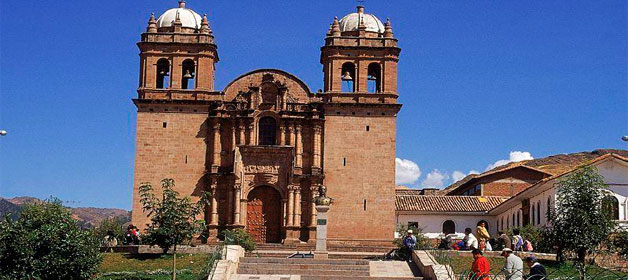
The temple of Belén was founded in 1559 as a “parish of indigenous people.” After the earthquake of 1650, it was rebuilt as a two-towered church with a façade of marked Plateresque style. It has a tall and wide entrance door, crowned by a semicircular arch, with doors typically studded with bronze nails, as seen in many churches and colonial mansions of the city. Above the main entrance, there is a large opening for light, also crowned by a semicircular arch.
Its interior features Baroque decoration, with altarpieces, sculptures, and canvases of religious themes. The main altar, covered with sheets of silver, stands out as the place where the image of the Virgin of Belén is venerated, popularly known as the “Mamacha Belén.” Its main effigy has a crown adorned with precious stones and gold. Some of the canvases that decorate its walls include “The Nativity,” “The Flight into Egypt,” and “The Child among the Doctors.”
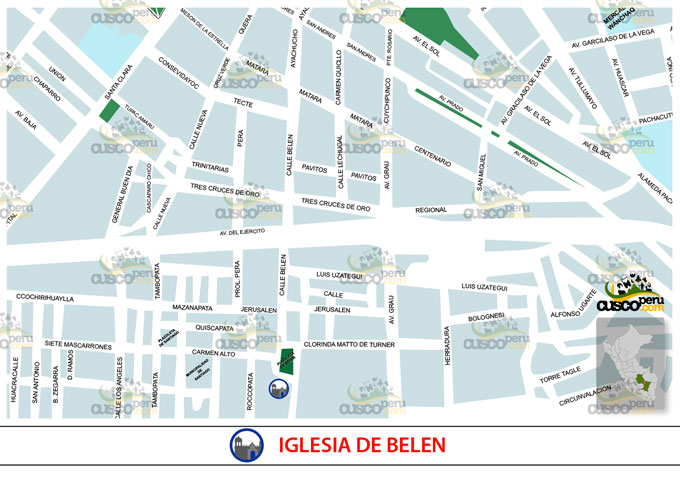
The Church of Belén is located in Belén Square, in the district of Santiago, within the monumental area of Cusco. From the Main Square, the taxi ride takes approximately 15 minutes. It can also be reached on foot from Ayacucho Street, in the historic center; the walk takes around 15 minutes.
The Church of Belén has a Latin cross floor plan and a single nave. Its façade, in mestizo Baroque style, is divided into three sections and flanked by two bell towers. The doorway stands out for its relief decoration, columns, niches, and figures of cherubs. Its door, crowned by a semicircular arch, is wide and tall.
The Church of Belén has Baroque decoration filled with sculptures, altarpieces, and canvases with Christian motifs. Its main altar, covered with silver sheets, is especially notable. The main effigy is the Virgin of Belén, known by her devotees as the “Mamacha Belén.” Her crown is adorned with precious stones and gold details.
The side niches feature canvases such as “The Archangel Gabriel” and “The Guardian Angel.” The church also has altarpieces dedicated to saints and virgins of Christianity, such as the “Virgin of the Milk,” “Saint Anthony of Padua,” “Saint Joseph,” and the “Adoration of the Three Wise Men.” Like many colonial churches, the temple preserves colonial canvases created by artists of the so-called Cusco School of Painting.

Admission is usually allowed during Mass hours. From Monday to Friday, Mass is held in the morning at 7:00 a.m. and in the afternoon at 6:00 p.m. Schedules may vary during Cusco festivities, so it is recommended to check the official updates from the Archdiocese of Cusco.
Tourist visits are usually allowed during Mass hours.

Happy passengers