
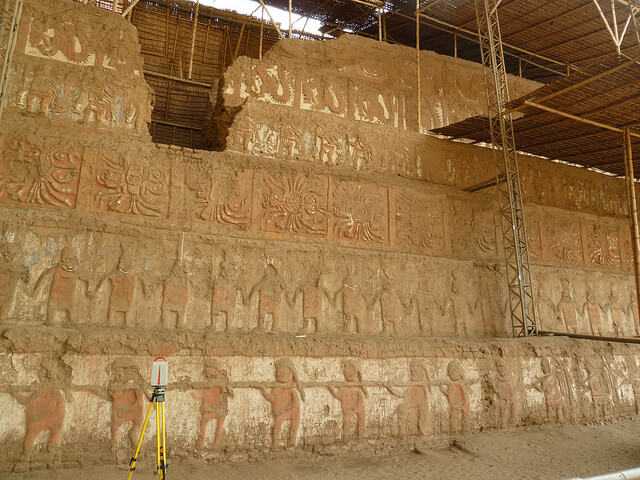
The Huacas of the Sun and the Moon, also known as the Huacas de Moche, form one of the most important archaeological complexes on Peru’s northern coast. They are located in the Moche Valley, near the city of Trujillo and at the foot of Cerro Blanco, within the district of Moche, in the La Libertad region.
The complex consisted of two large monumental adobe structures and an extensive city located between them. The Huaca of the Sun was mainly associated with political and administrative power. Some researchers also suggest that it may have been connected to the ruling elites, while the Huaca of the Moon functioned as a ceremonial center where rituals, religious gatherings, and funerary activities took place.
Today, tourist visits focus on the Huaca of the Moon, the Santiago Uceda Castillo Museum, and several visitor facilities. The Huaca of the Sun can be viewed from the outside, but it is not part of the interior route regularly open to the public.

Moche society developed across several valleys on Peru’s northern coast during the first centuries of the Common Era. In the Moche Valley, the settlement located between the two huacas became especially important between approximately AD 200 and 850, when it was established as one of the main political, religious, and economic centers of Moche society.
Before the Moche occupation, settlements associated with the Salinar and Gallinazo traditions existed at the site. This confirms that the area had been inhabited for centuries, long before the construction of the huacas that can be seen today.
The Moche were renowned for their adobe architecture, irrigation systems, agriculture, fishing, textile production, metallurgy, and technically sophisticated pottery. Their political organization was not necessarily identical throughout the northern coast: archaeological research reveals regional centers and differences between the northern and southern Moche territories.
At Huacas de Moche, monumental architecture was closely linked to the organization of power. The Huaca of the Moon represented the ceremonial sphere; the Huaca of the Sun was associated with political and administrative power; and the city between them contained residences, plazas, workshops, storage areas, streets, and canals.
Systematic scientific research began in 1991 under the direction of the National University of Trujillo. Since then, excavations, mural conservation work, material studies, and development programs linked to the population of the Moche countryside have been carried out.
The complex is located in the Moche countryside, approximately 8 km from central Trujillo. Its visitor address is Campiña de Moche s/n, district of Moche, province of Trujillo, La Libertad region.
The complex is located in the Moche Valley, facing Cerro Blanco and near ancient irrigated agricultural lands. Cerro Blanco was an important feature of the landscape and held considerable religious significance for the site’s inhabitants.
The Huaca of the Moon is the main sector of the tourist circuit. It consists of buildings and platforms constructed during different periods. The Moche ceremonially renovated certain structures by covering an earlier temple and building a new structure over it. Thanks to this process, several decorated walls remained protected for centuries.
Its most remarkable spaces include ceremonial courtyards, plazas, platforms, corridors, and the northern façade. The northern façade preserves several stepped levels with reliefs and paintings depicting victorious warriors, prisoners, dancers, serpents, marine beings, feline-like figures, and various supernatural characters.
The colors were applied over mud plaster and represent one of the finest expressions of Moche mural art. Because adobe is extremely fragile, the surfaces are protected with roofing, windbreaks, drainage systems, and environmental controls.
The Huaca of the Sun is the largest structure in the complex and can be seen from several points along the tourist route. Its original dimensions are estimated at approximately 345 meters long, 160 meters wide, and nearly 40 meters high.
It is believed to have served political, administrative, and possibly residential functions for the ruling groups. Its proximity to storage facilities, administrative spaces, and circulation routes supports this interpretation.
During the seventeenth century, treasure hunters diverted water toward the structure to erode it and make looting easier. This process destroyed a considerable part of the monument, of which approximately one-third remains today.
The Huaca of the Sun does not have a regularly accessible interior visitor route. It can be viewed from exterior areas and from points along the Huaca of the Moon circuit.
Between the two huacas stood a city organized around avenues, streets, alleyways, plazas, canals, residences, workshops, and storage facilities. Artisans, administrators, merchants, and other members of the population lived and worked there.
Excavations have identified workshops dedicated to producing pottery, textiles, metal objects, ornaments, and ritual goods. There were also spaces for preparing food and chicha for gatherings, ceremonies, and communal feasts.
Studies of the urban layout indicate the presence of major circulation routes, eight plazas, numerous residences, and access systems that became progressively more restricted. These features show that the site was not simply composed of two isolated temples, but rather formed a complex and carefully planned city.
Different areas feature figures with frontal faces, fangs, feline attributes, serpents, and ceremonial knives. One of the best-known figures in Moche art is Ai Apaec, a supernatural character represented with fangs, feline features, and ceremonial knives.
However, “Ai Apaec” is a modern name, and its interpretation remains a subject of study. The name is used by researchers because the Moche left no written texts confirming what they called this deity.
The complex’s iconography includes many other figures and scenes, such as warriors, prisoners, dancers, spiders, serpents, marine beings, birds, felines, and elements associated with mountains, water, and fertility.
The Santiago Uceda Castillo Museum opened on June 24, 2010, under the name Huacas de Moche Site Museum. In 2018, it was renamed in honor of archaeologist Santiago Uceda Castillo, who directed research at the complex for several decades.
The museum displays objects recovered during excavations, including pottery, ornaments, tools, textile elements, and materials related to daily and ceremonial life. In addition to the exhibition galleries, the museum has research and conservation areas. Not all of these spaces are open to the public.
Visiting the museum before the monument helps visitors understand the chronology, construction techniques, and meaning of the images they will see during the tour.

The tourist route mainly includes:
The Huaca of the Sun is not open for regular interior tours. Certain sectors of the Huaca of the Moon may also close temporarily because of research, maintenance, or weather conditions.
The complex is usually open from Tuesday to Sunday, from 9:00 a.m. to 4:00 p.m. Before visiting, confirm the current schedule through the official channels of the Huacas de Moche Archaeological Project. The final group entering the huaca departs at 3:30 p.m. The complex is not regularly open on Mondays.
Admission to the Huaca of the Moon
Check the current admission prices before your visit. To receive student, retiree, or school discounts, bring the corresponding identification document.
Admission to the Santiago Uceda Castillo Museum
Tickets are sold at the museum ticket office. According to the published official information, visitors are advised to carry cash because the available payment methods may vary. Confirm this information before your visit. Admission fees for the museum and the huaca are separate.
On the first Sunday of every month, Peruvian citizens may enter the Huaca of the Moon free of charge by presenting their physical national identity card. This free admission does not include the Santiago Uceda Castillo Museum. Special opening hours and visitor capacity apply on these dates, so checking the official regulations in advance is recommended.
By public transportation
From central Trujillo, you can take public transportation toward Moche and get off near the museum entrance. Before leaving, ask your accommodation provider or a local taxi driver which route is most convenient that day. The published journey takes approximately 30 minutes and ends near the museum entrance. Routes may change, so it is advisable to confirm them locally before departure.
With an organized tour
If you prefer to avoid coordinating transportation and schedules, you can book an organized tour from Trujillo with transportation and a guide included through a company such as CuscoPeru.com, a travel and tourism agency that can help you plan a visit to the Huacas of the Sun and the Moon and other major attractions.
The guided visit to the Huaca of the Moon usually takes approximately 1 hour and 30 minutes, although the duration may vary depending on the group and the areas open to visitors.
To also visit the museum, view the Huaca of the Sun from the outside, and explore the visitor facilities, it is advisable to allow approximately 2 hours. The total time may increase on weekends, public holidays, or the first Sunday of the month.
Arrive during the first opening hours to avoid the strongest heat and have enough time to visit the museum. Trujillo’s climate is generally mild and dry. Summer days may be warmer, while cloudy mornings and light drizzle are common in winter. The complex can be visited throughout the year.
Wear light, comfortable clothing, closed shoes or sneakers, a hat, and sunscreen, and carry water. Part of the circuit passes through open areas with paths, ramps, and uneven terrain.
Carry cash to pay the admission fees. Do not touch the walls, reliefs, or painted surfaces, and do not enter restricted areas. The adobe structures and their pigments are extremely fragile.
Begin with the museum and continue to the Huaca of the Moon. This order makes the route easier to understand and helps visitors identify the figures and techniques displayed throughout the monument.
Can visitors enter the Huaca of the Sun?
There is no regular interior tourist circuit at the Huaca of the Sun. The structure can be viewed from the outside and from different points within the complex. The ticket currently sold provides access to the Huaca of the Moon circuit.
Does the visit include a guide?
Visits to the Huaca of the Moon are conducted in groups accompanied by guides. Tours are usually offered in Spanish. If you require service in English, French, or another language, check availability before arriving. Availability in languages other than Spanish must be confirmed either in advance or upon arrival. On free-admission days, the project provides guides subject to availability and does not allow visits without authorized accompaniment.
What is the best time of year to visit the huacas?
The complex welcomes visitors throughout the year. For a more comfortable experience, it is best to enter in the morning. Summer months are usually warmer and sunnier, while during part of the winter, cloudy mornings, fog, or light drizzle may occur.
Are photographs allowed?
Yes. The official tourism resource inventory lists photography and filming as permitted activities during the visit. Visitors must follow the guide’s instructions and the signage in each area, especially inside the museum and near the preserved murals.
Is museum admission included?
No. The Huaca of the Moon and the Santiago Uceda Castillo Museum require separate tickets. To enjoy the complete experience, both admission tickets must be purchased.
Are visitor services available?
The complex provides restrooms, parking, a café, a souvenir shop, an artisan plaza, and areas selling publications and handicrafts. Some services may operate on different schedules from the monument.
Can visitors climb Cerro Blanco?
No. Access to Cerro Blanco may be restricted because it is part of a protected archaeological area. Check the current instructions at the complex before planning any ascent.

Happy passengers