
This is a small museum with five exhibition rooms that explain, in a didactic way, the history of the ancestors who lived in these lands. It houses pre-Inca, Inca, and colonial pieces, most of them recovered from excavations carried out at Qorikancha (in Quechua Qorikancha, “Golden Courtyard”) between 1992 and 1995.

The site museum is located in the same place where, according to the chronicler Pedro Sarmiento de Gamboa, the founders of the Inca dynasty, Manco Cápac and his family, settled in the Cusco Valley. Over time, this place became the Temple of the Sun. In the 15th century, Inca Pachacútec renovated it and covered it with gold; this is where the name Qorikancha comes from, which in Quechua means “Temple of Gold”.
After the Spanish conquest in 1532, the Temple of the Sun was looted and destroyed. During the distribution of lands, Qorikancha passed into the hands of Juan Pizarro. Before his death, Juan Pizarro decided to donate the site to the Dominican Order, who founded the Convent of Santo Domingo in 1534 on the foundations of the original temple.
Today, the site preserves part of the original structure, which still shows Inca architecture. Besides its historical and architectural value, the museum houses a collection of pre-Inca, Inca, and colonial artifacts, many of them recovered from excavations carried out at the site between 1992 and 1995. The museum is located at 3,400 meters above sea level, was inaugurated in 2006, and aims to preserve and share the history of Cusco, showing the transition between the Inca and colonial periods. The Decentralized Directorate of Culture of Cusco is responsible for its management.

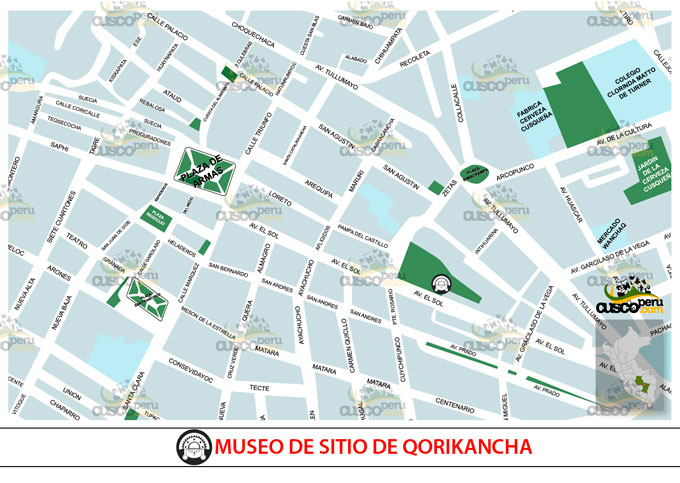
The Qorikancha Site Museum is located beneath the esplanade of the Qorikancha complex, at Av. El Sol No. 526, at the intersection with Santo Domingo Street, only two blocks from Cusco’s Main Square.
The Qorikancha Museum has collections covering different historical periods, from before the Incas to the colonial era. Its exhibitions are organized into several sections displaying artifacts from Inca culture, colonial art, and objects that show how both worlds influenced each other.

Inca Collection: here you can see gold masks, ceremonial textiles, and everyday objects used by the Incas, such as pottery, utensils, and working tools.
Colonial Art: paintings and sculptures created during the evangelization process reflect religious syncretism, where Inca beliefs merged with elements of Catholic tradition.
Archaeological Exhibitions: the museum displays a collection of archaeological objects from pre-Inca civilizations such as the Wari and Tiwanaku cultures. It includes stone tools, pottery, and other artifacts that show how these societies lived in the highlands.
Inca Art: one of the museum’s collections presents Inca art and material culture through pottery, textiles, and everyday tools. It also highlights ceremonial objects such as offerings and “quipus”.
Discover Cusco’s heritage
Explore the Qorikancha Site Museum and learn more about the history, architecture, and traditions that are part of Cusco. See tours in Cusco.

Hours: Monday to Saturday from 8:00 a.m. to 5:00 p.m.; Sundays from 2:00 p.m. to 4:00 p.m.
Entrance fee: Included in the Tourist Ticket.
Visit the underground museum first to learn about the historical context, the models of the Temple of the Sun during its golden period, and the archaeological pieces. Afterwards, visit the convent and the main temple.
Admission to the Qorikancha Site Museum is usually included in the Cusco Tourist Ticket (BTC), but verify the current conditions since entrance to the main Qorikancha temple requires a separate ticket.
It is recommended to spend between 30 and 45 minutes exploring its five exhibition rooms, where you can find pottery, textiles, mummies, and pre-Hispanic tools.
Finally, consider visiting during less crowded hours, such as the morning or midday.
For a relaxed visit, you can set aside between 30 and 45 minutes. If you want to carefully read the information about the exhibits and explore the five rooms without rushing, you may need additional time.
No. They are different spaces, although they are closely related. The museum displays objects and materials connected to the history of Qorikancha, while the temple corresponds to the architectural complex that currently stands over part of the ancient Inca site.
You can visit it at either time, but visiting after seeing Qorikancha can help you connect the pieces, replicas, and museum models with what you observed during your tour of the complex.
Yes. Its five rooms present information in a didactic way and allow visitors to learn about Cusco’s history through objects, replicas, pottery, textiles, metalwork pieces, and musical instruments.
Photography is generally allowed for personal use, although restrictions may apply in certain exhibition areas. It is recommended to follow the instructions provided by the museum staff.
The best time to visit is usually in the morning or early afternoon when there are fewer visitors. This allows you to explore the exhibition rooms more comfortably.
No. The entrance to the Qorikancha Site Museum and the entrance to the main Qorikancha Temple are managed separately. The museum entrance is generally included in the Cusco Tourist Ticket, while access to the temple requires a separate payment.
The museum is located at Av. El Sol No. 526, beneath the esplanade of the Qorikancha complex, just a few blocks from Cusco’s Main Square.
You can see archaeological pieces from different periods of Cusco’s history, including pre-Inca, Inca, and colonial artifacts. The museum displays ceramics, textiles, tools, ceremonial objects, and materials related to the development of Andean cultures.
Yes. The museum is generally included as part of the Cusco Tourist Ticket (BTC). However, conditions may change, so it is recommended to confirm the current information before your visit.

Happy passengers