

The Lord of Huanca is one of the most important festivities in Cusco. Its main date is September 14, when it is celebrated with great devotion, dances, and cultural activities attended by many people from different places.
For devotees, the Lord of Huanca is the doctor of the poor, the comforting father of all sorrows, and the refuge of the afflicted. In this article, we explain how to get there, what to do, and some recommendations to enjoy this experience.
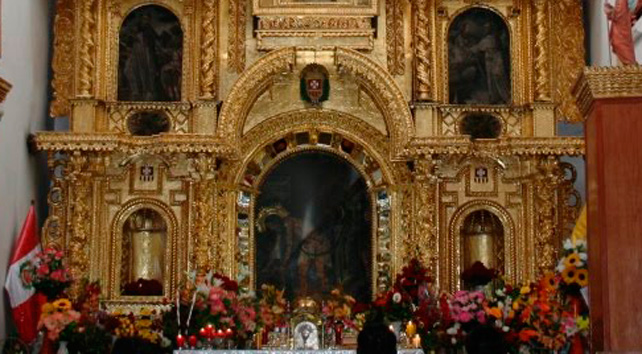
The Lord of Huanca is the image of the martyred Christ that inspires great fervor and devotion among Catholics in Cusco and Peru. The figure is seen as a symbol of protection and miracles. Every year, in September, the faithful travel to Huanca, which devotees consider the place chosen by God to reveal himself.
Many stories have spread about the origin of the Sanctuary of the Lord of Huanca. One of them dates back to the 17th century, when a young man, tired of being mistreated by his Spanish masters, escaped to Huanca and prayed all day so they would not find him. When night fell, the image of a bleeding Christ appeared to him. Moved by the revelation, the young man decided to bring one of the most outstanding painters in the area to that place to paint on a stone the figure he had seen. Later, a chapel was built there, which would eventually become the current sanctuary.
Another version tells the story of a young man who was in very poor health. One day, he met a doctor who managed to heal him. Grateful for the treatment, he asked the doctor how he could repay him. The doctor only asked him to visit his home in the town of Huanca. However, after a couple of years, the young man arrived in the town, and many residents told him that the place was uninhabited and that there was only an abandoned chapel. Surprised, the young man went to the small chapel and found a stone painted with a scourged Jesus Christ. He then realized that the face of the Son of God was the same as that of the person who had healed him.
The festivity is celebrated every September 14 and is marked by a massive pilgrimage of devotees who arrive from different parts of Peru to receive blessings and give thanks.
The Sanctuary of the Lord of Huanca is located about 50 km from the city of Cusco, at an approximate altitude of 3,100 meters above sea level, in the district of San Salvador, province of Calca, in the department of Cusco.
From the city of Cusco, there are two ways to reach the Sanctuary of the Lord of Huanca. The most common route is via the Cusco - Oropesa - San Salvador highway, and the trip takes approximately 50 minutes.
Another way to reach the Lord of Huanca is by hiking, which takes between 4 and 7 hours depending on the pace and the route chosen. This hike usually starts from the district of San Jerónimo, in the city of Cusco.
From Cusco, you can take a shared van or bus bound for the district of San Salvador. Once you arrive, you can take a taxi or walk approximately 2 kilometers to the sanctuary.
The route starts in Cusco and follows the road toward San Salvador, passing through places such as Oropesa and Huasao. The trip takes approximately 1 hour and 30 minutes, and once you arrive, you will find parking areas near the sanctuary for visitors.
To reach the sanctuary from Cusco, the best option is to book a tour with a local travel agency. At CuscoPeru.com, we help you organize your trip. You can contact our travel agents, who will be happy to assist you.
During your visit to the Sanctuary of the Lord of Huanca, you will find places full of spirituality, history, and tradition.
At the sanctuary, the image of the Lord of Huanca is venerated in an atmosphere of peace and reflection. You will also find chapels and secondary spaces for prayer. Here, visitors light candles and make requests or give thanks.
In this place, there are springs considered miraculous, where visitors and devotees collect water to take home or to perform acts of faith and spiritual reflection.
The weather is temperate to cold, with temperatures ranging between 5 ºC and 18 ºC. The best time to visit the sanctuary is during the dry season, between May and September, when the weather is sunny and the sky is clear.
There are no specific opening hours to visit it, as it is open all year round for devotees and travelers who arrive on pilgrimage. However, we recommend visiting during the dry season.

Happy passengers