
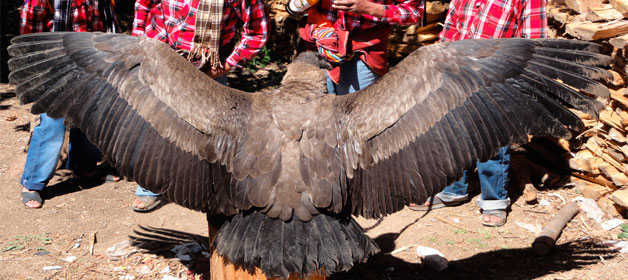
Traditionally, the festival included the symbolic or ritual capture of the condor, a difficult process that required time. The condor is a very cautious bird and only descends toward its prey when it is certain there is no danger. Then, the community members come out of their hiding places and, waving their ponchos like nets, begin chasing the bird, which cannot take flight in such a narrow space. A strong and fierce bull is also captured, although this process is relatively easier.
The condor is ceremoniously taken to the village because it has historically been considered a sacred animal. There, its wings are decorated, it is given aguardiente to drink, and it is fed well in preparation for what comes next. During the ceremony, the condor is placed on the bull’s back and tied there with rings, while both animals try to free themselves during the ritual. The bull attempts to escape its torment and becomes even more furious. At that moment, the cape bearers enter to face both the bull and the condor. The release of the condor is a moving moment: it walks to the edge of the mountain, opens its enormous wings, and launches itself into the air.
If, during the ceremony, the condor is badly injured or dies, it is interpreted as a sign that something bad will happen to the community.
The Yawar Fiesta, which in Spanish means “The Festival of Blood,” is an ancient cultural tradition celebrated in different high Andean areas of southern Peru, especially in Apurímac. However, over the course of this century, it has undergone a process of decline and has disappeared from many towns and communities.
The most widely known story about the origin of this festival explains that, due to the conflict between Andean community members and the power of the former landowners, the people created a symbolic representation in which the landowner is represented by the bull and the community members by the condor.
The Yawar Fiesta is celebrated around Peru’s Independence Day festivities, especially on July 28 and 29 each year.
This festival is celebrated in the town of Coyllurqui, province of Cotabambas, Apurímac region.
To provide a more complete description of Andean traditions, we present some of the best-known festivities. Several of them have been syncretized with Catholic customs and preserve ritual, agricultural, and community elements. Discover each one:

Happy passengers