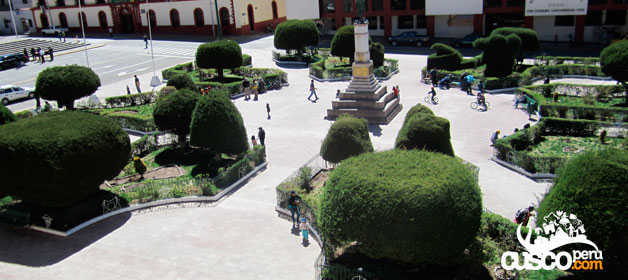
Parque Pino is one of the most representative public spaces in Puno’s historic center. It is located three blocks from the main square and is connected to it by the traditional Jirón Lima, one of the city’s busiest pedestrian streets.
This park stands out for its historic monument, its proximity to the Sanctuary of the Virgin of Candelaria, and its role as a meeting point in downtown Puno. At its center stands a monument dedicated to Dr. Manuel Pino Bedregal, a local hero of the War of the Pacific, accompanied by busts of other figures connected to Puno’s historical memory.
In addition, the Church of San Juan Bautista, now the Sanctuary of the Virgin of Candelaria, patron saint of Puno, stands opposite the park. For this reason, Parque Pino is not only a place for rest and pedestrian transit, but also an important setting for religious celebrations, cultural activities, and traditional city events.
Parque Pino is a historic square and urban meeting space located in the center of Puno. It is one of the most popular places among local residents, students, and travelers exploring the city’s historic center.
Its importance can be explained by three main factors. It has historical value because of the monument to Manuel Pino and the local heroes of the War of the Pacific. It also has religious significance because of its proximity to the Sanctuary of the Virgin of Candelaria. In addition, it is a key location in the historic center because it connects directly with Jirón Lima.
According to Peru’s Ministry of Foreign Trade and Tourism tourism inventory, the origins of Parque Pino date back to an ancient public space in the settlement of Puñuy. During the colonial period, this place formed part of the main square of the town of San Juan de Puno. It later became one of the city’s principal spaces for gathering and pedestrian transit.

Parque Pino is located in the historic center of the city of Puno, in the Puno region of southern Peru. It lies three blocks north of Puno’s Plaza Mayor, or main square, and is connected to it by Jirón Lima, one of the city’s best-known pedestrian and commercial streets.
The distance from the main square to Parque Pino is approximately 300 m, so the walk takes about five minutes. Its central location makes it easy to visit during a city tour of Puno or as part of a route that includes the cathedral, the Balcony of the Count of Lemos, the Carlos Dreyer Museum, and the Sanctuary of the Virgin of Candelaria.
The park is located at approximately 3,844 m above sea level, so it is advisable to walk calmly if you have recently arrived in Puno.
The area where Parque Pino stands today has a long history. According to Peru’s tourism inventory, in pre-Hispanic times it was a public space belonging to the ancient settlement of Puñuy, where ceremonies and product exchanges took place. It also functioned as a qatu, or traditional market and exchange area.
During the colonial period, this site served as the main square of the town of San Juan de Puno. Later, when San Juan de Puno and the Villa of Nuestra Señora de la Concepción y San Carlos were integrated, the space became a second main square within the urban area.
The park was inaugurated on September 24, 1901, during the administration of Intendant Quimper, according to local historical records. At the beginning of the 20th century, residents and authorities promoted its construction as a space dedicated to Manuel Pino Bedregal and the local heroes who died during the War of the Pacific.
Over time, Parque Pino became one of the city’s main meeting points. In 2014, the Provincial Municipality of Puno carried out renovation and improvement work in the park.
The monument to Dr. Manuel Pino Bedregal is the central feature of the park. It was erected in honor of this local hero of the War of the Pacific and represents the city’s civic memory.
Around the main monument are pedestals with busts of other heroes from Puno, including Colonels Belisario Barriga, Buenaventura Aguirre, José Miguel Ríos, and Lieutenant Colonel Manuel E. Roselló.
This group of monuments commemorates Puno’s participation in the War of the Pacific and gives the park significant historical value.
Opposite Parque Pino stands the Church of San Juan Bautista, one of Puno’s most important religious buildings. The church is recognized for housing the image of the Virgin of Candelaria, patron saint of the city.
The church is also known as the Sanctuary of the Virgin of Candelaria. Because of its proximity to the sanctuary, Parque Pino becomes an important gathering point in February, when Puno celebrates the Festivity of the Virgin of Candelaria, recognized by UNESCO as Intangible Cultural Heritage of Humanity.
During these celebrations, the park and its surroundings fill with dances, processions, music, and religious activities that reflect Puno’s cultural identity.
Jirón Lima is a pedestrian street connecting the main square with Parque Pino. It is one of the busiest streets in downtown Puno and is lined with shops, restaurants, cafés, travel agencies, handicraft stores, and tourist services.
Walking along Jirón Lima allows visitors to observe the city’s daily life, try local food, buy souvenirs, and easily reach other attractions in the historic center.
Parque Pino has side gardens, trees, ornamental flowers, and wrought-iron fountains. During the day, the fountains and gardens make a walk through the city center more pleasant. At night, when the lighting is on, the park offers a more attractive setting for photography.
It is a suitable place to rest during a tour of the city center, take photographs, observe the movement of the city, and enjoy a traditional public space.
Parque Pino forms part of Puno’s historic center and is surrounded by institutions, businesses, tourist services, and religious buildings. The Glorioso Colegio Nacional San Carlos, a historic educational institution founded in 1825 during the government of Simón Bolívar, also stands opposite the park.
Because of its location, the park serves as a reference point for visitors and residents. It is also a gathering place for civic, cultural, artistic, and religious activities.
Parque Pino hosts cultural events, religious activities, artistic performances, public gatherings, and celebrations connected to the Festivity of the Virgin of Candelaria.
During festive periods, especially in February, the surrounding area often fills with dance groups, musicians, processions, and local crowds. Outside these dates, the park maintains a quieter pedestrian atmosphere, making it ideal for a short visit in downtown Puno.
Admission to Parque Pino is free. According to the tourism inventory of Peru’s Ministry of Foreign Trade and Tourism, it can be visited throughout the year, from Monday to Sunday, between 7:00 a.m. and 10:00 p.m. Access may vary during special events or maintenance work.
Because it is an open public space, no entrance ticket is required. However, visitors who wish to enter the Church of San Juan Bautista or take part in religious activities should check Mass times and the sanctuary’s opening hours.
A visit to Parque Pino may take between 15 and 30 minutes if you only want to see the monument, take photographs, and walk around the area. If you also include the Church of San Juan Bautista, Jirón Lima, and other nearby attractions, the visit may take between one and two hours.
It is a recommended stop on a walking tour of Puno’s historic center.
Visiting Parque Pino allows you to discover one of the most symbolic spaces in the city of Puno. Here, you can see historical monuments, visit the Sanctuary of the Virgin of Candelaria, and observe everyday life in downtown Puno.
Its proximity to the main square, Jirón Lima, and the Sanctuary of the Virgin of Candelaria makes it an easy and valuable stop for visitors who want to better understand Puno’s identity.
It is also a good place to begin or end a tour of the historic center, rest, take photographs, and observe the city’s daily activity.
Bring a jacket or warm clothing, especially if you visit the park in the afternoon or evening, as Puno has the cold climate typical of the highlands.
Walk calmly if you have recently arrived in the city, as Puno is located more than 3,800 m above sea level.
Keep an eye on your belongings in crowded areas, especially during festivals, fairs, and events.
After visiting the park, enter the Church of San Juan Bautista and walk along Jirón Lima, where you will find restaurants, handicraft stores, and tourist services.
During the Festivity of the Virgin of Candelaria, respect the processions, dances, and religious spaces.

Happy passengers