
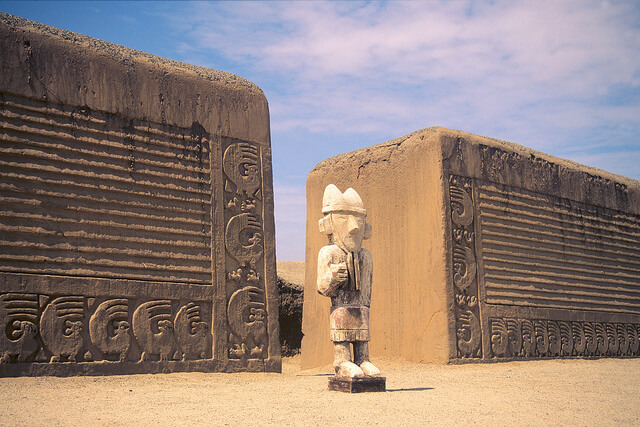
Chan Chan is an ancient pre-Hispanic city built primarily of earth and adobe on Peru’s northern coast. It was the political, religious, and administrative capital of the Chimú Kingdom, one of the most important societies in the Andes before the expansion of the Inca Empire.
The city developed between the 9th and 15th centuries and reached its greatest splendor during the 15th century. At its maximum extent, it covered approximately 20 km², although the central monumental area occupies around 6 km². Its urban planning, high walls, storage facilities, reservoirs, and ceremonial spaces reveal the advanced level of organization achieved by Chimú society.
In 1986, the Chan Chan Archaeological Zone was inscribed on the UNESCO World Heritage List. That same year, it was also added to the List of World Heritage in Danger due to the fragility of its earthen architecture, erosion, rainfall associated with the El Niño phenomenon, urban growth, and other threats.

The Chimú culture developed on Peru’s northern coast beginning around the 9th century. From Chan Chan, its rulers administered a territory that eventually extended across much of the northern and central coastline of present-day Peru.
The city’s organization reflects a highly hierarchical society. The large walled compounds contained plazas, audience chambers, storage facilities, residences, reservoirs, and funerary platforms associated with rulers and members of the elite. Outside these enclosures were neighborhoods inhabited by farmers, fishermen, artisans, and specialized workers.
The Chimú were renowned for their production of textiles, wooden objects, and metalwork. They also developed extensive agricultural and hydraulic systems. The Moche and Chicama rivers supplied an irrigation network that supported productive areas within a desert environment.
Chan Chan reached its peak during the 15th century and was incorporated into the Inca Empire around 1470. After the Inca conquest, it gradually lost its role as an independent political center.
According to the most widely accepted classification, Chan Chan contains nine large citadels or walled compounds. Some sources mention ten because they use different criteria to define the boundaries of the enclosures.
UNESCO describes nine large rectangular compounds, or “palaces,” within the monumental center, while several Peruvian sources count ten walled compounds.
For tourists, the main area open to the public is the Nik An walled compound, where visitors can see plazas, reliefs, passageways, and ceremonial spaces.
Chan Chan is located in the district of Huanchaco, province of Trujillo, department of La Libertad. It lies only a few kilometers from Trujillo’s Historic Center, along the road toward Huanchaco. The drive usually takes between 15 and 25 minutes, depending on traffic, along the highway connecting the city with the seaside town of Huanchaco.
The Chan Chan Site Museum is located on Avenida Chan Chan s/n, on the road to Huanchaco. The Site Museum and the entrance to Nik An are located at different points, so it is advisable to have private transportation, take a taxi, or join an organized tour to travel between them.
By public transportation
Several public transportation routes between Trujillo and Huanchaco pass near Chan Chan. Before boarding, ask the driver whether the vehicle stops at the Site Museum or at the entrance to Nik An. The journey may take around 20 minutes. It is advisable to confirm that the vehicle passes by the Site Museum or the Nik An entrance before boarding.
On an organized tour
Tours from Trujillo often combine the Site Museum, Nik An, and Huanchaco. Some itineraries also include the Arco Iris archaeological site, La Esmeralda archaeological site, or the Temples of the Sun and Moon.
Nik An, formerly known as Tschudi Palace, is the main compound open to tourists. The route allows visitors to observe plazas, corridors, audience chambers, storage areas, ceremonial spaces, and walls decorated with reliefs.
Another notable feature is the huachaque, or ceremonial reservoir, which demonstrates the importance of water within Chimú society. Before your visit, confirm whether the Las Ardillas sector is open to the public, as the route may vary due to conservation work. Its walls feature reliefs of squirrels with their young, an uncommon motif within Chimú iconography.
The Site Museum opened in March 1990 and helps visitors better understand the archaeological complex. Its exhibition rooms explain the pre-Hispanic development of La Libertad, from the earliest stone artifacts to the Moche and Chimú cultures.
The exhibition explores agriculture, irrigation systems, crops grown in the Moche Valley, and the development of the Chimor Kingdom. It also displays archaeological artifacts, models, and representations of Chan Chan’s urban organization.
It is advisable to visit the museum before exploring Nik An, as the information presented in its exhibition rooms makes it easier to interpret the archaeological spaces.
Chan Chan’s walls were decorated with adobe friezes depicting geometric figures, human beings, birds, fish, and other animals. Many of these designs are arranged in repetitive patterns that create compositions associated with the sea, fishing, fertility, and political power.
The plazas and audience halls served ceremonial and administrative purposes and were also associated with the storage and distribution of goods. Ceremonies, administrative meetings, and activities related to the distribution and storage of products are believed to have taken place in these spaces.
The Arco Iris Archaeological Site and La Esmeralda Archaeological Site are nearby archaeological attractions that can be included in a visit to Trujillo, although they are located outside the main Chan Chan archaeological complex.

The Chan Chan Site Museum and the Nik An walled compound are generally open from Tuesday to Sunday, from 9:00 a.m. to 4:00 p.m. Be sure to confirm the opening hours and the last admission time before your visit.
On Mondays, both the Site Museum and the archaeological circuit remain closed. Opening hours may change during public holidays, periods of heavy rainfall, conservation work, or emergency situations.
According to the pricing schedule published by Peru’s Ministry of Culture, admission fees are as follows. Please verify the current rates before purchasing your ticket.
Check the Ministry of Culture’s Tu Boleto platform to see whether tickets for Chan Chan are available online. Also confirm the authorized ticket sales locations before your visit. Since admission fees and conditions may change, it is advisable to verify them again before traveling.
On the first Sunday of each month, admission is usually free for Peruvian citizens and foreign residents. Before visiting, confirm that Chan Chan participates in this program and review the access requirements.
The ideal time to begin your visit is between 9:00 a.m. and 10:00 a.m., especially if you plan to explore both the museum and Nik An at a relaxed pace before closing time. During these hours, temperatures are usually cooler, and you will have enough time to visit both attractions without rushing.
The archaeological circuit features wide open areas with very little shade. Mornings may be foggy, while solar radiation becomes much stronger around midday.
Bring water, a hat or cap, sunscreen, comfortable walking shoes, and lightweight clothing. It is also important to carry a valid identification document and, if applicable, a student ID or other documentation required to qualify for discounted admission.
Visitors should not touch the reliefs, climb on the walls, leave the designated pathways, or remove any material from the site. The earthen architecture is especially vulnerable to contact, wind, and moisture.
It is possible to visit Chan Chan without a guide, but exploring the site with a professional guide provides valuable insight into the purpose of the plazas, audience halls, storage facilities, funerary platforms, and the symbolism of the site's iconography.
How long does the visit take?
To visit both the Chan Chan Site Museum and the Nik An walled compound, it is recommended to allow between one and a half and two hours. If you also plan to visit the Arco Iris Archaeological Site, La Esmeralda Archaeological Site, or travel to Huanchaco, it is advisable to set aside around three hours or join a half-day tour.
Can I visit Chan Chan without a guide?
Yes. The archaeological circuit includes marked trails and informational panels. However, a guide provides valuable context about the city's organization and helps visitors better understand the significance of the reliefs and architectural structures.
Are the Site Museum and Nik An located in the same place?
Not exactly. Both are part of the Chan Chan archaeological circuit, but they have separate entrances. For this reason, it is advisable to plan transportation between the two locations in advance.
Is Chan Chan accessible for visitors with reduced mobility?
The Site Museum offers wheelchair access, restrooms, and parking facilities. At Nik An, accessibility conditions may vary depending on the terrain and ongoing conservation work. Since conditions along the archaeological circuit can change due to maintenance and preservation efforts, it is recommended to check accessibility before your visit.
Why does Chan Chan require permanent conservation?
Its structures are built primarily of earth, a material that is highly vulnerable to rainfall, erosion, and extreme weather events. The site also faces pressures caused by urban expansion, unauthorized occupations, and the accumulation of waste in protected areas of the archaeological zone.

Happy passengers