

In 1601, the land was donated to the Dominican nuns and, under the initiative of Doña Lucía Isabel Rivera de Padilla, the Monastery of Santa Catalina was founded. A few years later, the church was built.
The religious complex was consolidated during the early years of the 17th century. The church preserves Baroque altars and a remarkable pulpit. The altars are attributed to the masters Pedro de Oquendo and Diego Martínez de Oviedo, both linked to the 17th century. Its oil paintings are signed by Juan Espinoza de los Monteros and Lorenzo Sánchez de Medina, artists associated with the Cusco School of Painting.
After the earthquake of 1650, the church and monastery had to be rebuilt. The works were completed around 1669, preserving the solidity and sobriety that characterize the complex. Today, the monastery continues to function as a convent of Dominican nuns, and part of its spaces operates as a museum of monastic life.
The Church and Convent of Santa Catalina is located just a few meters from Cusco’s Main Square. The complex was built mainly of adobe and stone, over the remains of the ancient Acllahuasi, or House of the Chosen Women, a ritual space during the Inca period.
Its Baroque architecture stands out for its high vault, crossing arches, and solid walls. The museum preserves relics, canvases, colonial furniture, embroidery, altarpieces, liturgical objects, and pieces related to monastic life.
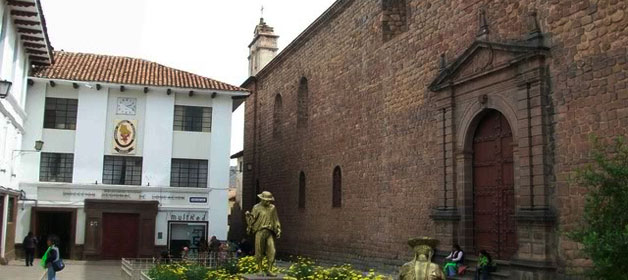
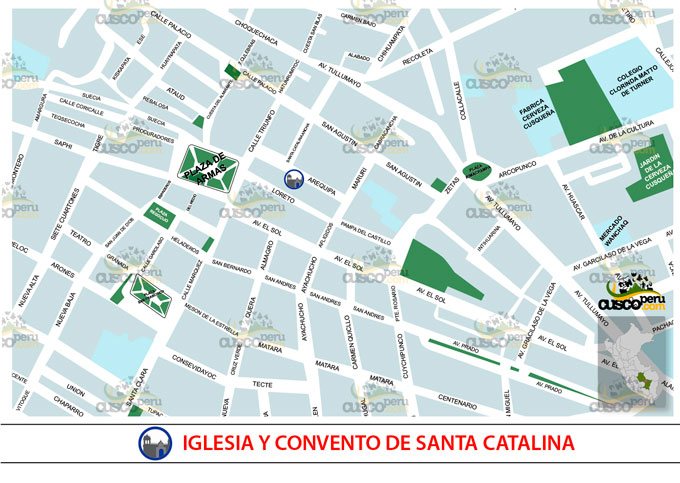
The Church and Convent of Santa Catalina is located 100 meters from Cusco’s Main Square. Its exact address is Santa Catalina Angosta Street, with no street number.
The main altar, carved in gilded cedar, stands out for its Baroque style. In the central section, visitors can see the sculptural image of the Sacred Heart of Jesus and, in other sections, the images of Saint Catherine and Saint Dominic. The temple also preserves a cedar-carved pulpit and smaller gilded altarpieces.
The museum displays various canvases related to the Lord of the Earthquakes, the life and miracles of Saint Rose of Lima, the life of Saint Dominic of Guzmán, and the life of Saint Catherine. It also preserves chasubles embroidered with metallic threads, carvings, gold and silver objects, an organ, and liturgical pieces.
On the second level, a Nativity altarpiece stands out; when folded, it takes the shape of a chest. Visitors can also appreciate the choir, accompanied by an organ and canvases linked to the religious history of the convent.

Reference opening hours: Monday to Saturday, from 8:30 a.m. to 5:30 p.m.
Reference admission fee:
Adults: S/ 8.00
Students: S/ 4.00
Opening hours and rates may vary, so it is recommended to verify the current information before your visit.
Photography is not allowed inside the Church and Convent of Santa Catalina. Visitors are also not allowed to touch the canvases, relics, or exhibited pieces. At the entrance, it is usually possible to hire a guide for an additional cost.

Happy passengers