

Qollqanpata, also known as Colcampata, was one of the oldest and most important sectors of Inca Cusco. Its Quechua name is usually interpreted as “place of deposits” or “site of storage houses,” referring to the ancient warehouses that may have existed in this area during the Inca period.
According to historical tradition, this place was linked to Manco Cápac, considered the first Inca and the mythical founder of Cusco. Several important constructions may have existed in this sector, including the ancient palace of Qollqanpata and ceremonial spaces associated with the surroundings of Sapantiana.
During the colonial period, the area was transformed and occupied by new buildings. After the arrival of the Spaniards, part of this sector was linked to Diego de Almagro and, later, to the urban development of the San Cristóbal neighborhood.
It is located on the slopes of Sacsayhuamán hill, in the current neighborhood of Qollqanpata.
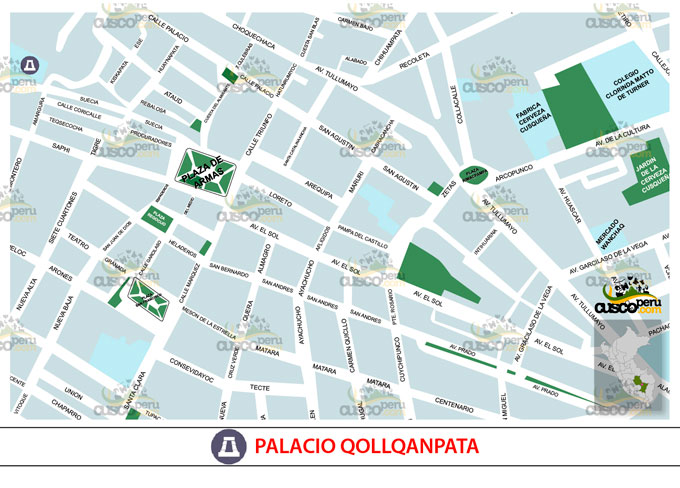
Today, remains of Inca walls and fragments of stone architecture are preserved in the area, allowing visitors to recognize the importance of the ancient complex. One of its most visible elements is an Inca wall integrated into the current urban setting, near the small square of San Cristóbal.
The lower façade of the ancient complex faced a rectangular plaza, now reduced in size and known as the small square of San Cristóbal. From this point, visitors can also enjoy one of the best-known views of the city of Cusco.
Behind one of the preserved walls, there is mention of a lithic representation interpreted as a human figure that appears to be carrying a load on its back. This type of element requires specialized explanation to better understand its possible symbolic or ceremonial function.

Qollqanpata does not operate as an independent archaeological complex with regular visiting hours. Its visible remains can be appreciated during a walk through the San Cristóbal neighborhood and the Historic Center of Cusco. With CuscoPeru.com, you can enjoy a more detailed visit or historical interpretation of the site, helping you organize your visit in a simple and safe way.

Happy passengers