

In addition to being a key stop for those traveling by train to Machu Picchu, Ollantaytambo invites visitors to stay longer, explore its traditional corners at a relaxed pace, visit its impressive archaeological park, and enjoy the tranquility of a town that keeps its identity alive. Because of its history, its still-inhabited Inca streets, and its proximity to the train station to Machu Picchu, Ollantaytambo is a highly recommended stop in the Sacred Valley.

Ollantaytambo is one of the most representative towns in the Sacred Valley of the Incas. It is located in the district of Ollantaytambo, province of Urubamba, department of Cusco, and preserves one of the finest examples of Inca urban planning that is still inhabited today. Its importance lies in the fact that it brings together still-inhabited Inca streets, an impressive archaeological park, Sacred Valley landscapes, and one of the most used train stations for traveling to Machu Picchu.
The present-day town of Ollantaytambo was built over an ancient planned Inca city. Its urban layout preserves narrow streets, water channels, stone walls, and spaces organized around interior courtyards. The traditional blocks, known as kanchas, were made up of groups of houses that shared access to a central courtyard.
During the Inca period, Ollantaytambo had agricultural, administrative, religious, and defensive functions. According to the Decentralized Directorate of Culture of Cusco, Ollantaytambo preserves important constructions from the Inca period.
Ollantaytambo was also an important setting during Manco Inca’s resistance against the Spanish. After the arrival of the conquistadors, the fortress served as Manco Inca’s refuge. Between 1536 and 1537, Ollantaytambo was the scene of an important episode in Manco Inca’s resistance against the Spanish troops of Hernando Pizarro.
Ollantaytambo is considered a “living Inca town” because it is not only an archaeological site: it is also an active populated center, where daily life coexists with streets, walls, canals, and spaces inherited from Inca urban planning. This continuity makes it a special place within the Sacred Valley, together with other historic destinations such as Pisaq, Chinchero, Moray, and Urubamba.
In addition, its strategic location made it a control point between the Sacred Valley, the route to Machu Picchu, and the transition zones toward the high jungle.
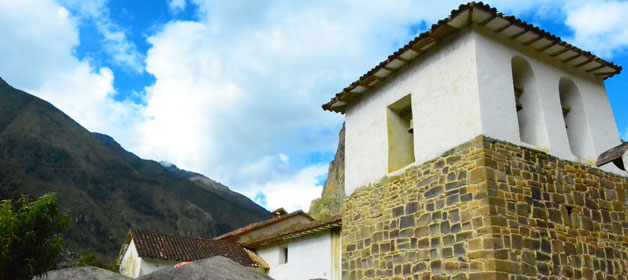
Ollantaytambo is located in the Sacred Valley of the Incas, northwest of the city of Cusco. The town is near the Vilcanota or Urubamba River and the Patacancha River, surrounded by mountains, Inca terraces, and farmland.
The road distance between Cusco and Ollantaytambo usually varies depending on the chosen route. On tourist routes, it is considered an approximate journey of 70 to 80 kilometers from the city of Cusco. The most commonly used route passes through Chinchero, Urubamba, and Ollantaytambo.
From Cusco, you can arrive by two main routes: Cusco–Chinchero–Urubamba–Ollantaytambo or Cusco–Pisaq–Calca–Urubamba–Ollantaytambo. Both routes are commonly used to reach Ollantaytambo and have paved roads.
From Urubamba, the trip to Ollantaytambo is shorter and follows the road along the Vilcanota River valley. It is a convenient option for those already staying in the Sacred Valley.
The town of Ollantaytambo is divided by the Patacancha River and includes traditional sectors such as Qosqo Ayllu and Araccama Ayllu. In Qosqo Ayllu, you will find narrow, straight streets, water channels, and stone walls that form part of the town’s daily life.
Among its traditional streets are Patakalli, Chaupikalli, and Hornokalli, where Inca walls, water channels, and the old urban layout of the town can still be appreciated. These streets form part of the ancient urban design and allow visitors to understand how Inca blocks or kanchas were organized.
One of the most valuable elements of Ollantaytambo is its system of canals. Water flows through the town through stone channels that are still part of the urban landscape. In the archaeological park, ritual and everyday-use fountains are also preserved; one of the best known is the Bath of the Ñusta, associated with ceremonial water management.
Inca architecture is distinguished by the use of worked stone, well-fitted walls, agricultural terraces, and ceremonial spaces. In the upper areas of the complex, the large terraces, the Temple of the Sun, ceremonial enclosures, and structures linked to territorial control stand out.
The main square is the center of the town’s social life. Around it, you will find restaurants, accommodations, shops, travel agencies, and visitor services. From the square, you can walk to the traditional streets, the local market, the entrance to the archaeological park, and the train station.
Ollantaytambo Archaeological Park is the destination’s main cultural attraction. It is made up of terraces, enclosures, stairways, fountains, ceremonial walls, and sectors associated with agricultural, religious, and administrative functions. The Decentralized Directorate of Culture of Cusco indicates that the park is located in the district of Ollantaytambo, province of Urubamba. If its extension is mentioned, it is advisable to confirm whether it refers to the entire protected area or only to the tourist sector open to visitors.
Among its best-known sectors are the Temple of the Sun, the monumental terraces, the Bath of the Ñusta, and the structures located in the upper part of the complex.
The train station is located just a few minutes on foot from Ollantaytambo’s main square, near the Vilcanota or Urubamba River. It is one of the most used stations for taking the train to Machu Picchu Pueblo, especially by travelers exploring the Sacred Valley.
Punku Punku, also called Llaqta Punku, is related to the idea of a doorway or entrance to the town. Its name is associated with the idea of an entrance gate to the ancient town of Ollantaytambo. This sector is located at the access to Ollantaytambo and forms part of the archaeological landscape associated with the control of entry into the ancient settlement. Today, it can be visited as part of the archaeological landscape that marked the entrance to the old settlement.
Ollantaytambo is one of the main boarding points for traveling by train to Machu Picchu Pueblo, also known as Aguas Calientes. The railway station is located near the town center and receives travelers arriving from Cusco, Urubamba, or other points in the Sacred Valley.
Tourist train services to Machu Picchu Pueblo operate from Ollantaytambo. PeruRail and Inca Rail offer departures from this area, although there are also services from other stations such as San Pedro, Wanchaq, or Poroy, depending on the season, availability, and type of service. Ollantaytambo is one of the most important stations for traveling by train to Machu Picchu, although it is not the only available option.
Spending a night in Ollantaytambo allows you to explore the town more calmly, visit its traditional streets early in the morning or at sunset, reduce fatigue before taking the train to Machu Picchu, and enjoy the atmosphere of the Sacred Valley. It is also a good option for resting after the trip from Cusco and better adapting to the pace of the Sacred Valley before continuing to Machu Picchu or doing nearby hikes.
Best time to explore the town
The best time to walk around the town is early in the morning or late in the afternoon, when there is less tourist movement and the light makes it easier to appreciate the streets, canals, and stone walls. The dry season, between May and October, usually offers better conditions for outdoor visits; however, Ollantaytambo can be visited throughout the year.
What to Bring During the Visit
It is recommended to bring comfortable shoes, a cap or hat, sunscreen, water, a light jacket, cash, and a camera or phone with enough battery. If visiting during the rainy season, it is advisable to bring a poncho or waterproof jacket.
Recommended Visit Time
To walk through the town and its traditional streets, it is recommended to set aside between one and two hours. To visit the Ollantaytambo Archaeological Park calmly, it is best to consider an additional two to three hours. If you are taking the train to Machu Picchu, it is advisable to arrive at the station at least 30 to 45 minutes before departure.

Happy passengers