

The Festival of the Sun, better known by its Quechua name, Inti Raymi, is one of the main festivities in the city of Cusco. This celebration is filled with Quechua chants, traditional dances, and colorful costumes from the Inca period.
This annual festival takes place during the winter solstice and is one of the most anticipated dates in Peru.

Inti Raymi is an ancient Inca religious celebration in which the Sun god, or Inti, was worshipped in Cusco. During the Inca period, the celebration lasted about 15 days, during which sacrifices, dances, and other rituals were performed to honor Inti. The last Inti Raymi celebrated in the presence of the Inca emperor took place in 1535, one year before the Spanish conquest.
The Sun was and remains the central object of worship in Inti Raymi, representing its essence and source of life. For the Inca Empire, it was the supreme god and one of the most important celestial bodies in the Andean world. During this festival, the Sun marked the beginning of a new annual cycle, so offerings and rituals were dedicated to it to ensure prosperity for the Inca kingdom throughout the year.
The name Inti Raymi comes from Quechua; Inti means sun in English, while Raymi means festival or celebration. Therefore, Inti Raymi can be translated as “Festival or Celebration of the Sun.”
Inti Raymi was the largest and most important festival held during the time of the Tahuantinsuyo Empire. Its religion was based on the worship of the Sun, which was established in the 15th century by the Inca Pachacutec as part of a religious reform. The acllas, ayllus, the Inca imperial army, representatives from each suyo, and other authorities took part in this ceremony, bringing together nearly the entire population of the Tahuantinsuyo.
The entrance of the Inca into the Plaza de Armas or the Sacsayhuamán esplanade was a solemn moment. The ceremony was preceded by the acllas, who scattered flowers, and by the pichaq, men who used straw brooms to drive away evil spirits. During his public appearances, the Inca was accompanied by his kumillo (a hunchbacked dwarf), who carried the achiwa, a colorful feather parasol. During the conquest, Inti Raymi continued to be celebrated in secret. Later, the mestizo Inca Garcilaso de la Vega recorded the memory of this festival in his work Comentarios Reales.

The staging of Inti Raymi began with a proposal by Humberto Vidal Unda, an initiative to reenact an Inca ceremony, which until then had only been presented as a small theatrical representation of an Inca festival.
Thus, in 1944, the first reenactment took place, which is what we now know as “Inti Raymi.” June 24 was also established as Cusco Day.
The first Inti Raymi held after the Spanish conquest featured Don Faustino Espinoza Navarro as its main performer, the first actor to portray the Inca. He was a writer and actor from Cusco and the founder of the Academia Mayor de la Lengua Quechua.
In 2001, Inti Raymi was declared Cultural Heritage of the Nation and an Official Act of National Identity.
| Inti Raymi | Inca Inti Raymi | Modern Inti Raymi |
|---|---|---|
| Description | A colorful festival filled with dancing and devotion, as well as rituals and offerings to the Sun God. | A festival that revalues the traditions and customs of our Inca ancestors. |
| Duration | 15 days before the winter solstice | 1 day, June 24 |
| Year | 1430–1532 A.D. | 1944–Present |
| Attendance | 50,000 inhabitants of the Tahuantinsuyo | 100,000 to 150,000 attendees from different parts of the world and approximately 1,000 performers, including musicians, dancers, and others. |
Inti Raymi is celebrated every June 24. This day not only represents the celebration of the Sun, but is also Cusco Day. Throughout the month, numerous performances take place, especially on the main day, June 24, when the Inti Raymi reenactment is held and hundreds of performers prepare to showcase their best artistic performances.
Everything begins early in the morning, when the Inca and the Qoya (his wife) leave in procession. In the garden of Qorikancha, a ceremony to greet the Sun takes place with the music of quenas and drums. This is the most spiritual moment, as the Sun rises over the mountains.
They then head to the Plaza de Armas, where the Inca arrives carried by his warriors, accompanied in the same way by the Qoya, the Inca's wife. From an elevated platform, the Inca delivers a speech to the people in Quechua, asking the Sun for protection and announcing prosperity. The traditional dances of Cusco then begin.
The most anticipated moment of the day takes place at Sacsayhuamán, the main setting where the Inca, the Qoya, priests, warriors, and regional delegations gather for the main ceremony in honor of the Sun, featuring a procession of the four suyos with traditional costumes, feathers, and dances.
Remember that this ceremony is conducted in Quechua, the indigenous and ancestral language of the Incas.
| Location | Time | |
|---|---|---|
| First part: | Qorikancha – Temple of the Sun | 9:00 a.m. |
| Second part: | Huacaypata – Plaza de Armas of Cusco | 10:30 a.m. approx. |
| Third part: | Sacsayhuamán Fortress | 1:00 p.m. approx. |
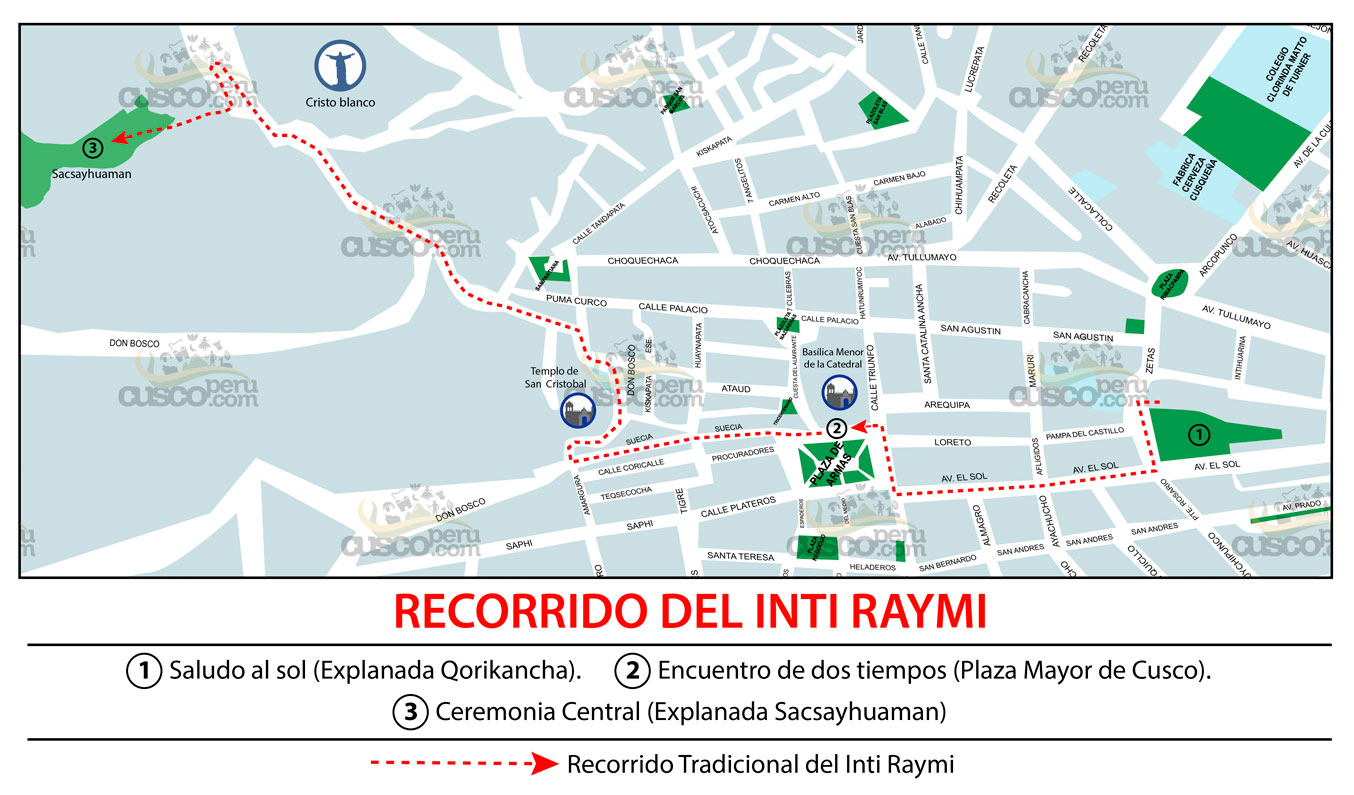
The traditional Inti Raymi route takes place at three historic locations in Cusco.
This is where the “Salute to the Sun” ceremony takes place. Everything begins with the sound of pututus and the entrance of the acllas, musicians, and dancers, followed by the appearance of the Inca. This first part lasts approximately 45 minutes.
Here, the ceremony known as the “Meeting of the Times and Coca Leaf Ceremony” takes place, during which the Inca and his entourage stand on the great ushnu, or ceremonial platform. Most of the audience watches while standing, and this part lasts approximately 1 hour.
The main Inti Raymi ceremony takes place here. Most of the reenactment is concentrated at this location. It begins with the entrance of the Qoya and the Inca accompanied by dances, music, and chants, followed by the main ceremony. The Inca leads the offering ritual, represented by the symbolic sacrifice of a llama. This part lasts approximately 2 hours.
It is known that the role of women in the Inca Empire was very important and necessary, as women were a symbol of abundance and fertility. The central female figure in the Inca Empire was the Qoya, a figure who represented leadership and the ability to manage situations of crisis in the Tahuantinsuyo. She was the Inca's companion, adviser, and right-hand person in government. When the Inca died, she was responsible for leading the Panaca, the “noble descendants of the Inca.”

The Qhapaq Ñan was a network of interconnected Inca roads that passed through huacas, forming a transportation and communication system between all the peoples that made up the Tahuantinsuyo. This system was extremely important because, during the Festival of the Sun, it was used to reach Cusco.
If you are interested in attending Inti Raymi, remember that the performances at Qorikancha and the Main Square are free, so arriving early is recommended due to the large crowds. However, for the ceremony at Sacsayhuamán, admission tickets must be purchased.
The VIP area consists of three grandstands, which offer the best views for watching this festival.
All three grandstands offer a unique view of Inti Raymi because the Sacsayhuamán esplanade is a large and open space; therefore, there is no need to worry too much about your location.
At CuscoPeru.com, with the assistance of our sales agents, you can not only get your tickets but also receive recommendations to help you make the most of the ceremony. You can also enjoy the route at a comfortable pace, with all the necessary arrangements, transportation, and a box lunch.
Come and discover the incredible and traditional Inti Raymi in the historic capital of Peru!
Book your Inti Raymi experience and enjoy the ceremony at Sacsayhuamán with admission, transportation, and arrangements included Inti Raymi.
The best location to watch the ceremony at Sacsayhuamán is the Orange Grandstand, as it is located directly in front of the stage, although it also has a higher cost.

It is recommended to organize your trip several months in advance, especially if you want to attend the ceremony at Sacsayhuamán.
The performances take place throughout much of the day. If you want to follow all three ceremonies, it is recommended to set aside practically the entire day of June 24.
Since some of the activities take place outdoors, especially at Sacsayhuamán, it is recommended to be prepared for changes in weather conditions.
The date coincides with a period close to the winter solstice in the Southern Hemisphere, which is associated with the ancient Andean agricultural calendar. Today, June 24 is also a central date in the celebrations marking the anniversary of Cusco.
Yes. Various cultural and artistic activities take place in Cusco during the Inti Raymi celebrations, connected to Andean traditions and the festivities honoring the city.
Yes, you can take photographs during the reenactment. If you are attending from the grandstands, it is advisable to follow the staff's instructions and avoid interfering with the ceremony.

Happy passengers