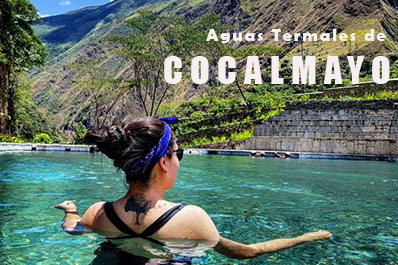
The thermal springs of Cocalmayo, also known as the Santa Teresa hot springs, are the perfect place to relax after a demanding visit to Machu Picchu.
The district of Santa Teresa was created by Law No. 12849. The Provincial Municipality of La Convención also confirms that every October 11, the political creation of the district of Santa Teresa is commemorated. Santa Teresa is one of the districts of the province of La Convención and is known at both regional and national levels for the production of fruit, coffee, coca leaves, and other products that grow abundantly thanks to its warm and humid climate.
In 1998, an alluvium associated with the Aobamba basin severely affected the old town of Santa Teresa and almost completely destroyed both the town center and the hot springs. Later, the town was relocated.
The town of Santa Teresa is located in the Urubamba River valley, in the district of the same name, province of La Convención, department of Cusco. Cocalmayo is located near the alternative route between Hidroeléctrica, Santa Teresa, and Machu Picchu Pueblo.
The Santa Teresa hot springs are surrounded by a beautiful subtropical jungle landscape, with an average annual temperature of 21 °C. The rainy season, as in much of the department of Cusco, begins between November and December and usually ends in April. It is characterized by heavy rains that, in some cases, may cause landslides and road blockages. During the winter season, the weather is usually dry, and at night the temperature can drop to 11 °C. This season runs from May to October and is considered one of the best times to travel.
The district of Santa Teresa is located at an altitude of 1,511 meters above sea level and has a population of 5,972 inhabitants, according to the 2017 National Census.
There are several ways to reach this destination. The best option will depend on the traveler’s budget, physical condition, and willingness to hike. Below, we list the main alternatives:
You must take a bus at the Almudena bus stop, located in the district of Santiago, in Cusco. After approximately five hours of travel by road, you will arrive in the town of Santa María. From there, you must take a shared van or taxi to Santa Teresa. This section takes around one hour along an unpaved road until you finally arrive in this town. The thermal pools are located approximately 10 minutes by car from Santa Teresa, or about one hour on foot, along a route of around 4 kilometers.
The cost varies depending on the type of transport chosen —bus, private taxi service, or minivan— but traveling from Cusco to Santa Teresa by land usually costs between S/ 70 and S/ 100, one way.
After visiting Machu Picchu, you can continue toward the Cocalmayo hot springs. The usual route consists of traveling from Machu Picchu Pueblo to Hidroeléctrica. There are two ways to reach the hot springs: by train and by bus. The walking trip takes approximately 20 minutes and costs S/ 5 for Peruvian nationals and USD 31 for foreign visitors. Then, in Hidroeléctrica, you must continue toward Santa Teresa by car or on foot. The walking section to Hidroeléctrica takes around 2 hours. After that, the route continues by car to Santa Teresa.
In the town of Santa Teresa, you can find everything from budget hostels, with prices around S/ 50, to lodges that offer more comfortable services, with prices that can reach S/ 200. It is important to mention that there are no five-star hotels in Santa Teresa; however, in Machu Picchu Pueblo, there is a wider range of higher-category accommodations.
The entrance fee for foreign visitors is S/ 10, while the fee for Peruvian visitors is S/ 5. Opening hours may vary, although they are usually from 5:00 a.m. to 10:00 p.m. Therefore, it is recommended to confirm the schedule before traveling.
The complex has three or four pools, depending on the facilities available at the time of the visit. Its clear and transparent waters come from underground sources, and their temperature varies between approximately 38 °C and 44 °C. The complex has changing rooms for men and women, showers, camping areas, soccer fields, restaurants, bars, swimwear rental stands, and parking. These medicinal waters are believed to have beneficial properties for skin problems, rheumatism, and joint pain. They also serve as a natural source of hydromassage and relaxation. If you wish to cool down, you can access the cold-water cascades that come from the Uripata Lagoon, located next to the hot pools.
Entering the Cocalmayo hot springs at night is an unforgettable experience, as it is important to keep in mind that many of the animals and insects that live in the jungle become active at this time. This creates an environment filled with the sounds of cicadas and many other unusual natural sounds, forming a very special atmosphere that invites visitors to relax, enjoy the hot water, and forget about everything else. An important tip for travelers who decide to visit Cocalmayo is to bring mosquito repellent, as this is a cloud forest area with an abundant presence of insects.
A recommendation for those visiting Cocalmayo is to bring mosquito repellent, since it is located in a cloud forest area where insects are commonly found.
Where is Cocalmayo?
The Cocalmayo hot springs are located in the town of Santa Teresa, province of La Convención. They are located around 202 kilometers from the city of Cusco and 20 kilometers from Machu Picchu.
How much is the entrance fee to the Cocalmayo hot springs?
The entrance fee is 10 soles for foreign tourists, 5 soles for Peruvian tourists, and 2.50 soles for tourists from Cusco. The rate may vary.
How do I get from Santa Teresa to Cocalmayo?
From the town of Santa Teresa, you can reach Cocalmayo by taxi, which takes about 20 minutes, or on foot, which takes approximately 1 hour. The hot springs are only 4 kilometers away.
When should I avoid visiting Cocalmayo?
It is not recommended to visit the Cocalmayo hot springs during the months of heavy rain: January, February, and March.
What is the weather like in Cocalmayo?
Cocalmayo has a warm, temperate climate that ranges from a minimum of 10 °C to a maximum of 26 °C. Rainfall is heaviest in January, February, and March.
What should I bring for my visit to Cocalmayo?
During your visit, it is recommended to bring swimwear, a towel, a hat, sunscreen, sandals, mosquito repellent, and personal hygiene items.

Happy passengers