Pucará is a town and district in Lampa Province, in the Puno Region. It is known for the Pukara Archaeological Complex, the Pukara Lithic Museum, the Church of Santa Isabel and its pottery tradition, particularly the well-known Pucará bulls.
The town is located along the overland route connecting Puno, Juliaca, Ayaviri, Sicuani and Cusco. Its location makes it possible to include Pucará in tours departing from Puno as well as in road trips between Puno and Cusco.

The Pukara culture developed in the northern Lake Titicaca basin approximately between 500 BC and AD 300 or 400, during the Formative Period. It was one of the most important regional societies of the Andean highlands and was notable for its ceremonial architecture, polychrome pottery, stone sculptures and economy based on agricultural and pastoral activities.
The Pukara settlement has been interpreted as an urban, ceremonial and political center, and possibly as a pilgrimage destination. Its layout included a monumental core, public spaces, residential areas and zones dedicated to productive activities.
The exact relationship between Pukara and Tiwanaku continues to be studied. Peru’s Ministry of Culture notes that several specialists consider Pukara an important predecessor of Tiwanaku, particularly because of its architectural forms, iconography and stone art. It should not be stated categorically that Pukara “gave rise” to Tiwanaku, since the relationship between the two societies was complex and remains under investigation.
Pucará belongs to Lampa Province in the Puno Region. The archaeological complex is located west of the town, approximately 700 meters from the bus stop and urban area.
According to the route registered by Peru’s Ministry of Foreign Trade and Tourism, the journey from the city of Puno covers approximately:
The total distance along this route is approximately 108 km.
From the city of Puno, visitors can take public transportation to Juliaca. From there, vehicles continue along the highway toward Ayaviri and Pucará. According to the official tourism information sheet, the journey between Puno and Juliaca may take approximately 45 minutes, while the section between Juliaca and Pucará takes around one hour. However, actual travel times depend on traffic, stops and road conditions.
For visitors who are unfamiliar with the bus stops or have limited time, organized tourist transportation can simplify the journey. The visit can also be included as part of the overland route between Puno and Cusco.
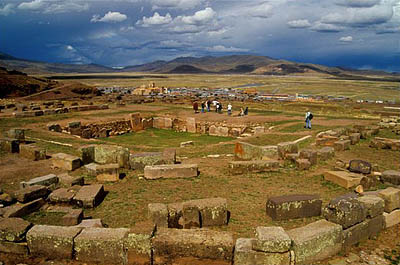
Qalasaya is the main monumental structure at the site. The building rises above the central plain through a series of terraces, platforms and stone walls. A central staircase connects the different levels and leads to the upper platform.
The highest platform contains three sunken courtyards aligned approximately from north to south. These spaces vary slightly in shape, orientation and dimensions and were associated with ceremonial activities carried out during different stages of the Pukara occupation.
The central courtyard is the best-documented area of the complex. It measures approximately 15 by 16 meters and is nearly 2.2 meters deep. Its walls were built with carefully worked stone slabs placed vertically.
The entrance was located in the eastern wall and included a small staircase descending into the courtyard. Rooms or enclosures once stood around three sides of the courtyard and, when viewed from above, formed a structure resembling the letter “U.”
For this reason, it should not be stated that all the courtyards are “U-shaped” or “horseshoe-shaped.” This description mainly refers to the arrangement of the structures that surrounded the central courtyard.
A stone-lined funerary chamber was identified in the center of each of the four walls of the central courtyard. Excavations conducted in 1939 recovered human burials and various objects associated with ceremonial practices.
The chambers were integrated into the courtyard’s architecture and should not be presented as four separate mausoleums. There is also insufficient evidence to state in a general visitor guide that all of them opened through double-jamb doorways or necessarily contained gold and copper objects.
Archaeological work identified stone-lined channels in different areas of Qalasaya. An underground reservoir associated with the central courtyard was also documented. These installations may have been used to channel, store or drain water during activities carried out within the complex.
The exact function of each channel should be described with caution, since some elements have been reconstructed and others remain subject to archaeological interpretation.
Pukara was not composed exclusively of temples. Excavations carried out on the central plain and near the river identified enclosures, residential areas, production spaces, kilns, food remains and pottery used in everyday life.
This evidence shows that the settlement had a complex organization and that domestic, artisanal, ceremonial and community activities took place there.
Qalasaya is located beside a large outcrop of pink sandstone known as San Cayetano Rock. Its presence dominates the landscape and forms part of the visual and symbolic configuration of the archaeological complex.
The official tourism inventory mentions the possibility of hiking toward the rock. Access conditions may vary, so visitors should respect all signs, restricted areas and instructions provided by the site staff.
In one area of the esplanade, visitors can see the remains of a Catholic structure built in 1678 using materials taken from the ancient complex. The official tourism information sheet associates it with the colonial process of replacing or prohibiting Andean religious practices.
This structure should not be confused with the present-day Church of Santa Isabel, located across from the town’s main square.
The museum is located in the urban area of Pucará, approximately 700 meters from the archaeological complex. It was established in 1999 and preserves cultural objects recovered mainly during archaeological and restoration work carried out in the 1970s.
Its collection includes stelae, monoliths and granite sculptures featuring anthropomorphic and zoomorphic representations. A visit to the museum helps visitors understand the architecture, iconography and ceremonial practices of the archaeological site.
Reference admission fees:
| Visitor category | Admission fee |
| Adult | S/ 15 |
| Student | S/ 5 |
| Schoolchild | S/ 2 |
| Senior citizen | S/ 7.50 |
| Local residents with a Peruvian national ID card | Free admission |
Pucará and the archaeological complex are located at a high altitude. Visitors are advised to walk slowly, stay hydrated and avoid strenuous physical activity during their first few days in the Andean highlands.
Bring sun protection, a hat, water and a waterproof jacket or windbreaker. Solar radiation can be intense, and weather conditions can change quickly.
Wear footwear with good traction. The route includes uneven terrain, steps and surfaces made of earth or stone.
Do not climb on the walls or move any stones. Some structures have been restored, while others preserve delicate archaeological elements.
Check the applicable conditions before using drones, tripods or professional equipment. The official tourism information sheet permits visitors to take photographs and record videos, but professional productions may require authorization from the Ministry of Culture.
Carry cash in Peruvian soles, preferably in small-denomination banknotes. Card payments may not be available at the ticket office, workshops or small local businesses.

Happy passengers