
The temple stands out for the simplicity of its façade that contrasts with its magnificent rococo style tower. In its interior are preserved several remarkable sculptures such as the image of Santa Rosa, by Melchor Caffa (XVII century), a Christ from the school of Juan Bautista Vásquez and the Virgin of the Rosary by Roque de Badulaque (XVII century).
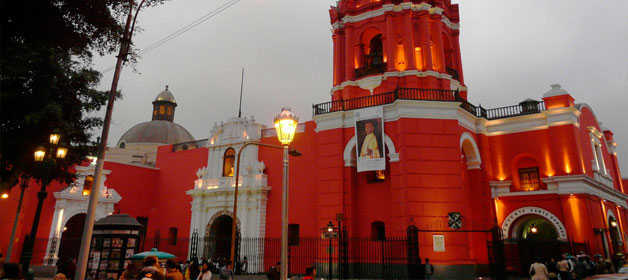
Located at the intersection of Jirones Conde de Superunda and Camaná.
The first one was destroyed during the earthquake of October 28, 1746. The current tower was conceived and designed by Viceroy Manuel Amat y Junient in 1766 in the rococo style, being octagonal in the lower part. It is divided into a lower body called cube and two high bodies with small balconies on corbels. At the top is the sculpture known as the Angel of Fame. The total height is 46 meters. Its original color is white and pink, becoming the most characteristic and striking element of the religious complex.
In the choir of the church is what is considered the oldest choir stalls in the country. Worked entirely in cedar wood brought from Nicaragua, it is of Renaissance style, with mannerist elements. It has two sets of chairs: the one on the first level was sculpted at the same time, with the design based on the old one. The originals are in the back, with carvings of saints and other biblical characters on the back. In the central part of the choir stalls is the main seat of the Prior of the convent, with carvings of Saint Dominic of Guzman and Saint Francis of Assisi, founders of the Dominicans and Franciscans, respectively. The choir stalls were carved by several artists.
The enclosure is formed by three naves, of which the lateral ones are composed by chapels in which several altarpieces are located. By the lateral cover from left to right we find the following altarpieces or altars: On the side of the Gospel, the altarpieces of San Jacinto de Polonia, San José, Santo Domingo de Guzmán and Nuestra Señora del Rosario; and on the side of the Epistle those of the Peruvian Saints, the Aminas, Santo Tomás de Aquino, the Sacred Heart of Jesus, Chapel of the Señor de la Justicia and the Chapel of the Cofradía del Rosario.
The altar is in neoclassical style with turquoise and gold decoration.
Hours of operation:
Every day from 10:00 a.m. to 12:00 noon and.
The church of San Pedro was built by the Society of Jesus from the sixteenth century, has become, by the beauty of its architectural ensemble as for its valuable iconography, one of the pillars of the Peruvian cultural heritage. Likewise, as a parish, San Pedro has also become an important center of spirituality for the people of Lima. Dozens of people go there every day in search of a space for reflection and the enrichment of their faith.
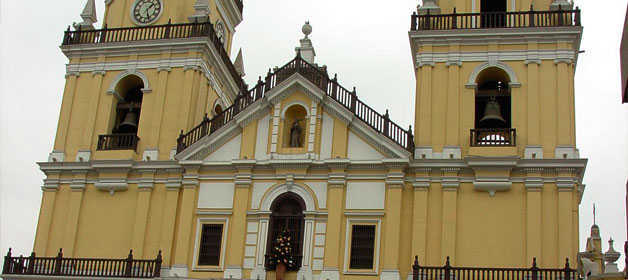
Located at the intersection of Jiron Azángaro and Jiron Ucayali.
"The facade is very majestic, carved in stone and by the border some letters that say "Invocatumest Supernos". On the 3 covers there are 3 windows that serve both proportion and clarity, on whose sides rise 2 towers, in one of them were put 7 bells. It has in front of the cemetery a small square that authorizes it and is the place where the floats were accommodated.
It is approximately 67 m. long and 35 m. wide up to the transept, which is very beautiful and spacious; 10 chapels, 5 by band which communicate by their beautiful arches. The main altar and the lateral altars (except for "San Ignacio" and "Las Reliquias") are gilded.
In the Church of San Pedro we can find the following styles: Renaissance, Plateresque, Baroque, Churrigueresque and Neoclassical.
The San Pedro art gallery is made up of a large number of canvases that the Jesuit community has treasured over the centuries.
Their headquarters in Lima was, precisely, the Colegio Máximo de San Pablo, today San Pedro. With great speed they built three successive temples there, always in search of greater amplitude and magnificence for the cult. The third, built between 1634 and 1636, has come down to us. By skilfully adapting the plans of the Gesú of Rome, they managed to build this spacious church with three naves. It was a peculiar evolution towards the basilica plan that the great orders established in Lima were adopting. Unlike the Roman prototype with a large single nave and closed side chapels, San Pedro de Lima narrows the central area, while the chapels open and communicate with each other by means of arches. Thus, two adjacent naves were configured, which were used for the movement of processional processions or other liturgical ceremonies.
The Penitentiary Chapel, with its three harmoniously designed naves, rises on the foundations of what was the second church. Its construction was the work of the Italian Fr. Jerónimo Pallas (SJ., Rector of St. Paul's College). Finished in 1659, it has access through the main church, but its entrance was always through the porter's lodge. This church was destined for penitential exercises. In general, only men were allowed to enter. Here the various congregations established in San Pedro held their meetings, such as the famous School of Christ of Father Alonso Messio Bedoya, the congregation of students of the faculty, the congregation of the waiters, merchants and craftsmen, etc.
The Marian Congregation of Our Lady of the Expectation of Childbirth, known as Our Lady of the O, originally held their meetings in the second church (today the Penitentiary). With time, when Father Juan de Córdova was the Director of this group, the sodalists decided to build their own chapel, which today is known as the Chapel of the O.
From 10:00 a.m. to 12:00 p.m. and from 4:00 p.m. to 4:00 p.m.
The temple boasts a rich decorative richness of Lima's baroque, highlighting the work of moldings and its baroque, rococo and neoclassical altarpieces, including the altar of St. Jude Thaddeus, completely made of silver.
Plazuela San Francisco, corner of Ancash and Lampa Streets.
In the Convent lived many years San Francisco Solano, there is preserved his post-mortem portrait and the Chapel-Shrine in which he died on July 14, 1610. During the visit you can appreciate its cloisters, its patios adorned with Sevillian tiles and the library. Under this complex there is a network of subway galleries or catacombs that were the main cemetery in colonial times and can also be visited. This convent is in charge of the Franciscans of the Twelve Apostles.
From 10:00 to 12:00 hours and from 16:00 to 19:00 hours.
The building that can be appreciated today is not the same of previous centuries, of it only some vestiges remain, such as: the lateral walls and the frontispiece. The whole building was transformed, and its last reform was in the XX century, where the whole interior was ornamented, in which can be appreciated canvases of the Italian school; the beautiful decoration of the chapter house, which houses the old carved cathedra; and the sculpture of Death that was created in the XVIII century by Baltasar Gavilán.
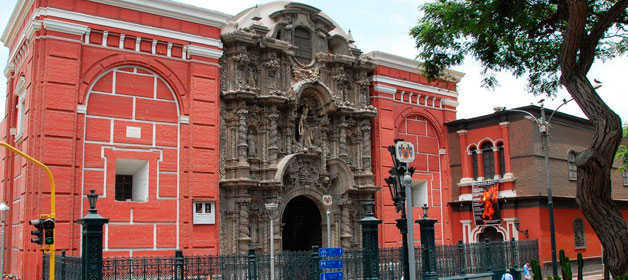
Located at the intersection of the fourth block of Jiron Camana with the second block of Jiron Ica.
The facade is an architectural work of Churrigueresque baroque style, overloaded with ornaments, carved in stone, which was completed in 1710, consists of three streets and three bodies, being the central street of the first body which houses the door where you enter the enclosure. On this one there is a cornice of vertical arch, determining characteristic for being original of the architecture of the Peruvian baroque. In the niches of the facade there are ten images besides the one of San Agustín that is to the center. Its importance also lies in the fact that it is one of the two remaining Churrigueresque style façades in Lima, together with the façade of the Basilica of La Merced. The interior of the Temple has been transformed at the beginning of the XX century and in it there are works of great value as the choir stalls, the coffered sacristy, the coffered ceiling of the antechristy, its pictorial collection and the courtyard of the main cloister with beautiful portals.
From 10:00 a.m. to 12:00 noon and from 4:00 p.m. to 4:00 p.m.
It was built in the second half of the eighteenth century in what was the old neighborhood of Pachacamilla. Two fluted and gilded Tuscan columns support the baroque style façade. Inside, as an urn, lies an image of Jesus crucified, which was painted in oil on a rough adobe wall by a black Angolan slave.
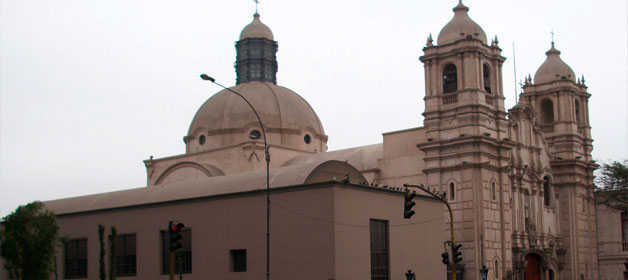
It is located in the perimeter formed by Tacna Avenue and Jiron Huancavelica, in the old Pachacamilla area.
The Temple or Sanctuary of Las Nazarenas, in whose Main Altar is the Sacred Image of the Lord of Miracles, has its origins in this ancient representation of Christ on the Cross, painted on a humble wall of a shed in 17th century Lima.
Every year the Sanctuary receives countless devotees of the Moreno Christ, who animated by faith wish to admire the original image that the slave painted more than 359 years ago and that remains intact to this day, as a miraculous sign of a divine gift to the city of Lima.
Every day from 6:00 am to 12:00 noon and from 4:00 pm to 8:00 pm.
The precinct, erected in 1687, contains in its interior a neoclassic main altar in which the image of the Virgin of Mercy predominates, as well as a carving of San Miguel Arcángel. Also there is the chapel of Fray Pedro Urraca and the rough wooden cross that, according to the stories, he used to flee from the devil.
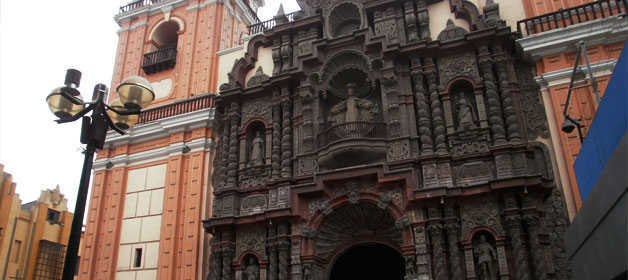
Located at the intersection of Jiron de la Union and Jiron Antonio Miro Quesada.
The facade is a finished sample of the churrigueresque baroque style of Lima and in its central part the image of the Virgin of Mercy appears in a niche, around which others are arranged. After the earthquake of 1746 the church was partially restored; at that time it was also rebuilt the remarkable cover, which adorns the front with its Solomonic columns, which is considered a historical and artistic relic of great aesthetic quality. It was made of a special quality of original granite from Panama, which the galleons that came to load minerals in Callao brought as ballast, a stone used as a weight that was placed at the bottom of the ship, to favor its balance. This so fine cover artistically carved in three bodies, was built using gray and pink stones, forming a combination that is not found in other Lima temples. Its only tower, begun in 1539, was supposed to be higher but was lowered after the earthquake of October 20, 1687.
In the interior it keeps altarpieces of diverse styles and sculptures and paintings considered jewels of the viceroyal art. The main altar is less ornate than the other, completely gilded with fire. In the central part stands the effigy of Our Lady of Mercy image that since 1615 was invoked as celestial protector of the City, in 1730 the Civil Cabildo named her "patroness of the fields of Lima" See Hotels, following his intercession against the sterility of the fields, in the Republic was named patroness of the Arms of Peru by the Constituent Congress in 1823. The Virgin carries in her hands the shackles and scapular of her Order, as well as a rich golden scepter and the highest military decorations, as well as other distinctions that demonstrate the great devotion to Mary. This image goes out in procession on September 24th, escorted and carried on silver platforms by the cadets of the Peruvian Armed Forces and numerous public.
Hours of operation:
Every day from 10:00 a.m. to 12:00 noon and from 4:00 p.m. to 7:00 p.m.
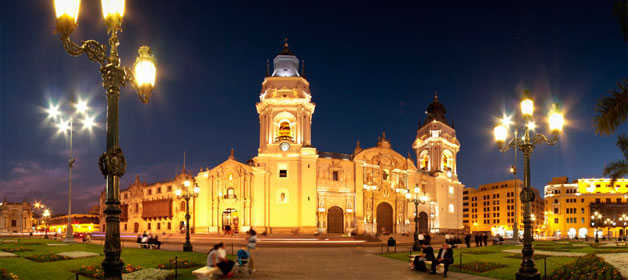
The facade of the Cathedral of Lima is of Renaissance style with plateresque decorations. Its high towers with slate spire are neoclassical with stylistic influences of the Escorial school and northern Europe. It has 3 doors, as in most cathedrals. The main one (the one in the center) is called the Main Door, the right side is called the Baptistery Door and the left side is called the Door of Forgiveness. There are also 2 side doors, one facing the Calle de Judíos (right side) and the other facing the Patio de los Naranjos (inner courtyard annexed to the Cathedral). At the back of the temple (Calle de Santa Apolonia) there are two other doors: the door of Santa Apolonia and the door of San Cristobal.
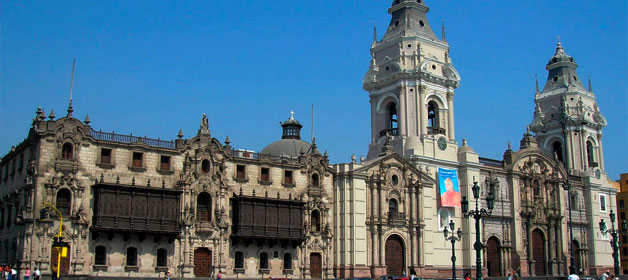
Located in the Plaza Mayor, in the historic center of the city of Lima.
The Cathedral of Lima has 3 naves and 2 additional naves that open to the lateral chapels. Along the lateral naves there are large paintings of the Way of the Cross. Twelve paintings alluding to the twelve Apostles and the twelve articles of faith of the Apostolic Creed were recently placed on the columns.
Hours of operation:
Monday - Friday from 9:00 a.m. to 8:00 p.m.
Saturday from 10:00 a.m. to 10:00 p.m.
Sunday from 1:00 p.m. to 7:00 p.m.
Cost:
Peruvians and residents: S/. 20.00 (showing DNI and CE)
Foreigners: S/. 30.00
Children from 6 to 12 years old, senior citizens, and students with a valid card: S/. 10.00
Children under 6 years old: free
School groups: S/. 5.00 (prior coordination required at museo@catedraldelima.org.pe)
Note: Optional guide service. The guides are fully

Happy passengers