
Once the Franciscans arrived in Arequipa in 1551, the church was erected poorly and provisionally, because in the place of the first church was the refectory. The neighbors of Arequipa requested the construction of a religious complex for the Franciscans. In 1569 a contract was signed with the architect Gaspar Baéz and the work began immediately, its walls were built of ashlar and its vaults of brick, of a single nave, like all the first churches of Arequipa, later the presbytery was added and finally the collateral naves at the expense of the canon D. Ignacio Gregorio de Adriazola.
The Convent, like the church, dates from the XVI century with large cloisters and silver jewels of religious art. An on-site museum, an interesting art gallery and a library with more than 20,000 volumes.
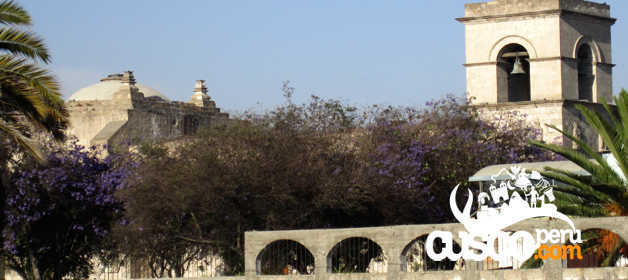
Located in the first block of Zela Street in Plaza San Francisco.
The church has a baroque pulpit decorated with a shortened relief and the front of the main altar is entirely embossed in silver, today it has been converted into a commercial center for handicrafts.
The part of the site museum has an interesting art gallery and a library with more than 20,000 volumes.
Monday to Saturday: 7:00 to 9:00 hrs and 17:00 to 20:00 hrs
The Augustinian Fathers arrived in Arequipa in 1572 and two years later founded the convent. The construction began in 1575, but was delayed for several years, being concluded in the seventeenth century. In the construction the architects Nicolás Alonso, Andrés de Espinoza, Francisco Flores Flores and Nicolás Alonso were successively involved. Andrés de Espinoza, Francisco Flores and Juan de Aldana.
The architectural complex of San Agustín is composed of the church and the cloisters, both of which form the convent. Architecturally they are of the same conception and the same original design. It belongs to the mestizo baroque with a predominance of ashlar, the front of two bodies has floral motifs and foliage with carved angels with skirts holding a branch of flower.
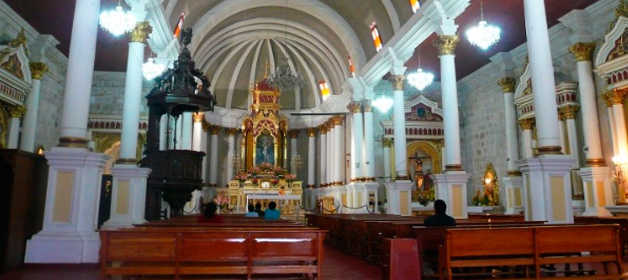
Intersection of San Agustin and Bolivar streets, Arequipa Metropolitana (one block from the main square).
In the interior of the temple the dome and the neoclassical altars stand out and especially the high altar for its carving and its applications in gold leaf and its antero-christy is small with a barrel vault all of ashlar.
Consult with your travel agency.
It was built by Gaspar Báez in 1578, which collapsed in the earthquake of 1582. Eight years later the Jesuit Diego Felipe began the second construction of the temple, following the plans of Gaspar Baez. It was later damaged by the earthquake of 1687, whose restoration was completed in 1698. The earthquake of 1868 demolished the tower; the new bell tower, made according to a different design, was demolished in the earthquake of 1960.
This complex is composed of several buildings erected by the Jesuits for religious purposes as well as for housing, with a Latin cross plan and consists of three deep naves, side chapels, a transept and a dome on pendentives. The temple and the facade, like the rest of the colonial monuments of the city of Arequipa, are made of ashlar stone.
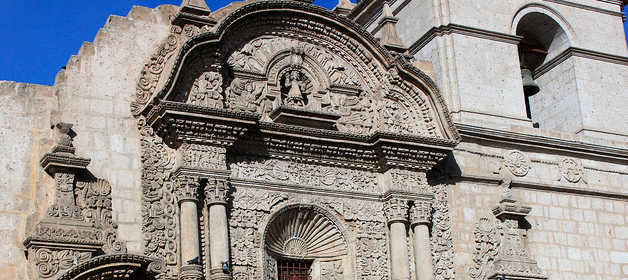
Located in the Plaza de Armas, between the Portal de la Municipalidad and the Portal de Flores.
This church has a façade of two bodies. The inferior body has three streets between double and paired columns, The superior part of the great facade, has a single central street, presents double columns and finishes in a frontispiece of three lobes lodging a niche where a San Miguel sculpted in ashlar is seen.
A pulpit carved in fine wood gilded in gold leaf, shows a fine carving that looks like gold filigree, in the parapet and the turnstile.
The main altar in baroque style is monumental, all in gold leaf. It houses in its niches images of saints like San Ignacio de Loyola, founder of the Company, San Francisco de Borja, Duke of Gandia and Great of Spain. In this altar there is also an image of the heart of Jesus.
Monday to Sunday: 9:00-11:00 hrs and 15:00-18:00 hrs
Its construction began in 1540, the same year that the city of Arequipa was founded. It was built in ashlar (stone of volcanic origin) and brick vaults, reflecting an eclectic style that includes neoclassical, neo-renaissance and gothic styles.
Throughout its history it was destroyed by fires, earthquakes and volcanic explosions. It has been restored after each destruction, the last of these in 2001.
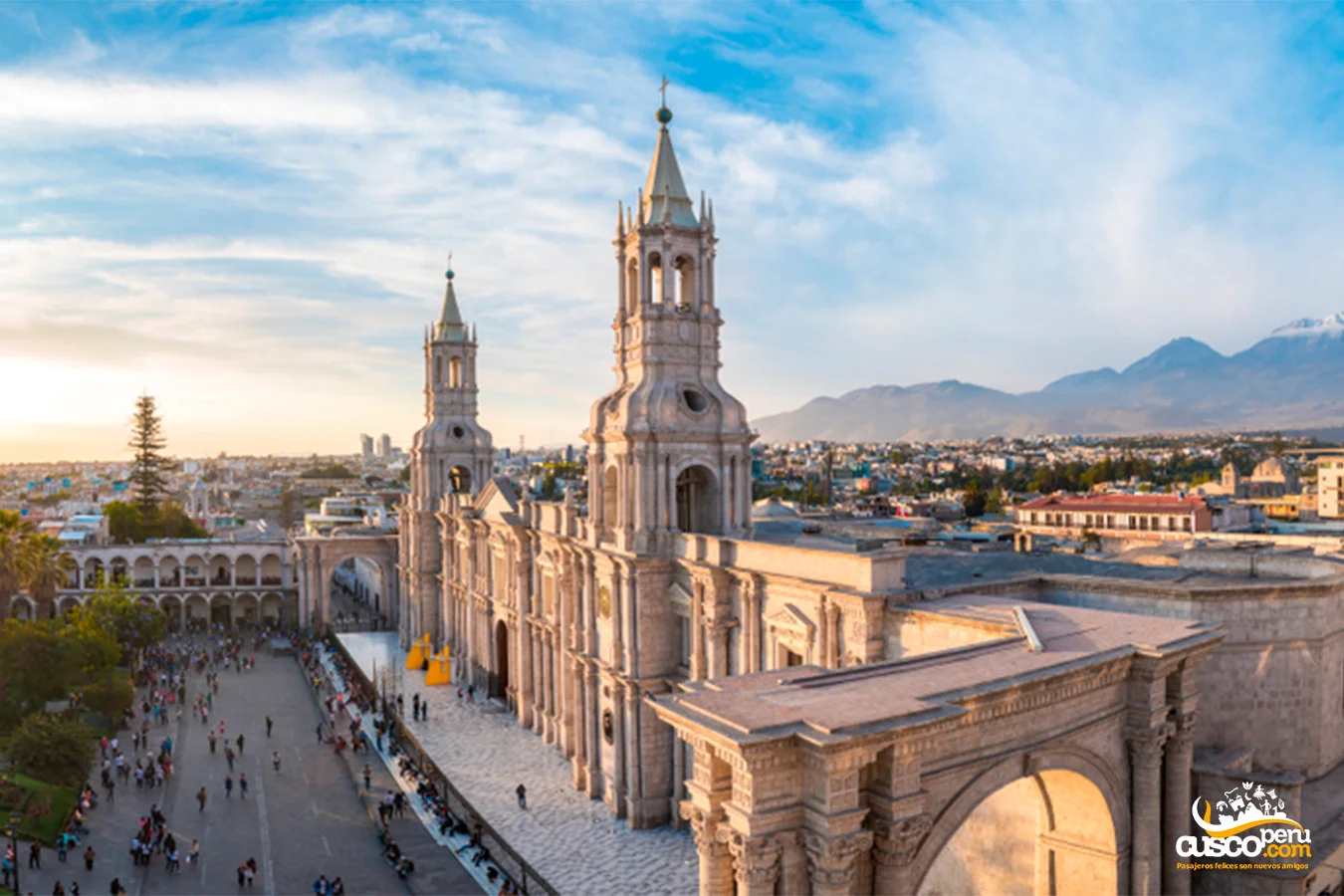
Located on the north side of the Plaza de Armas.
On the façade there are two bronze medallions symbolizing the Peruvian-Bolivian confederation.
It has three large portals and inside it houses a high altar of marble carrara Italy made by Felippo Moratilla; The pulpit carved in wood work of the French master Rigot.
The museum has a room called Treasures of the Cathedral, where visitors can admire a collection of monstrances, crowns and other liturgical objects of high artistic quality and goldsmithing technique.
The room of Ornaments, Cloths and other religious objects shows ecclesiastical vestments, some of which are no longer used in current liturgies.
In the room of Religious Paintings of the Republic five works of the painter Francisco Laso tacneño are exhibited, this environment is complemented with informative panels that relate the history of the art of painting in Peru in the viceroyalty and republican time.
The museum is open from Monday to

Happy passengers