
The Plaza San Martin is not in honor of a Christian saint, it was erected in honor of the liberator Don José de San Martin, who with a coalition of South American armies confronted and defeated the Spaniards.
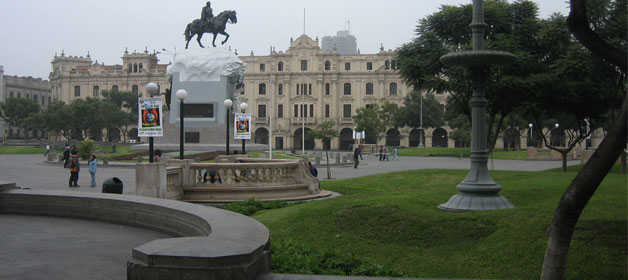
It is located in the heart of downtown Lima, 700 meters southeast of the main square.
This beautiful Plaza expresses the greatness and solidity of independent Peru and for that reason, each element that composes it has a monumental aspect. With colorful gardens, bronze lanterns, marble benches, granite floor, four water fountains in the corners of the square and in the central space the monument to Don Jose de San Martin. Among the large buildings surrounding the square are: The Colon Theater, the Giacoletti building, the Bolivar Hotel, the Zela and Pumacahua portals and the Metro cinema, among other buildings that make it one of the most beautiful squares in Lima.
Consult with your travel agency.
The Plaza de Armas of Lima, like the cathedral, was established by Francisco Pizarro in 1535, although since then it has undergone numerous transformations. The Plaza de Armas has fairly large dimensions and offers a sense of freedom and tranquility thanks to the amplitude that has no ornamental elements.
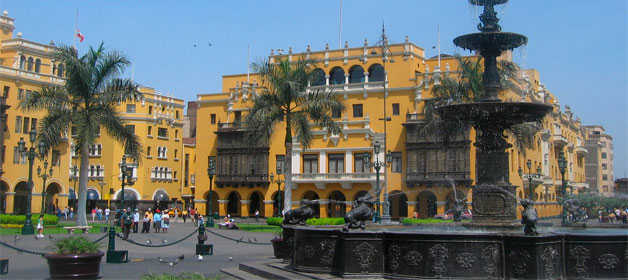
Located in the historic center of the city, between Junín, de la Unión, Huallaga and Carabaya streets.
Around it are the following buildings: the Government Palace of Peru, the Cathedral of Lima, the Sagrario Church, the Archbishop's Palace, the Municipal Palace and the Union Club.
Consult with your travel agency.
Peru is one of the most biologically diverse countries in the world. In this zoo you can appreciate a sample of the great variety of animal and plant species existing in Peru. Apart from the native Peruvian species, the park has an area called International Zone where we find a great diversity of animals from the rest of the world.
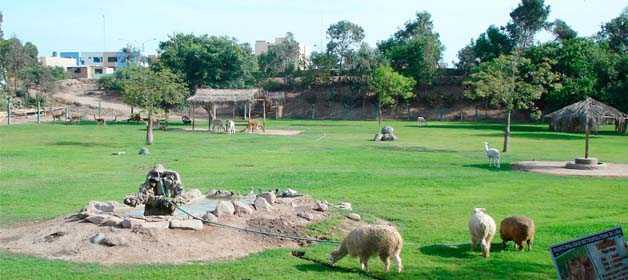
It is located at Av. la Marina Cuadra 24, 7.7 Km from Lima's main square.
The park is divided into 4 zones according to the characteristics of the animals they present, which are:
In this area there are species belonging to the Peruvian Andean zone. There are 118 species of mammals and 93 of birds. Among the main ones: Harrier, Eagle Owl, Condor, Kestrel, Swan, Creole Duck, Chinchilla, Guanaco, Spectacled Bear, Vicuña, Alpaca, Llama, Andean Fox, Andean Puma, Donkey, Taruca, Deer, Sheep.
There are species belonging to the Peruvian Amazon such as: Anaconda, Otorongo, Sajino, Jaguar, Tapir, Parrot, Lion Monkey, Marmoset, Macaw, River Otter, Pava Aliblanca, Tuca neta Brown Jaw, Cock of the Rock, Spider Monkey, Ocelot, Majás, Two-toed Sloth, Yellow-tailed Choro Monkey.
Several of the world's most important species are present in this area, including: Giraffe, Lion, Bengal Tiger, Hippopotamus, Zebra, Mandrill, Buffalo, Brown Bear, Black Bear, Peacock, Silver Fox, Chimpanzee, Ostrich, Water Buffalo, Galapagos Tortoise.
Visitors can also visit the following museums: Model Mine Petro Peru Oil Museum, Site Museum (Maranga culture), Replica of the tomb of Mr. Sipan (Moche culture) The park also has the following Huacas: Huaca La Palma, Huaca San Miguel, Huaca Tres Palos, Huaca La Cruz, Huaca Cruz Blanca.
Monday to Sunday (Including holidays)
Rates: S/. 5.00 Children from 3 to 12 years old and S/. 10.00 From 13 years old and up.
The Exposition Park was built during the government of José Balta shortly after the collapse of the Lima Wall (bastion of the Pacific War). It was inaugurated next to the Palace of the Exposition (today Museum of Art) in 1872. During the celebration of the Centennial of the Independence (1921), the beautiful Chinese Fountain was inaugurated, a gift of the Chinese colonists settled in Lima.
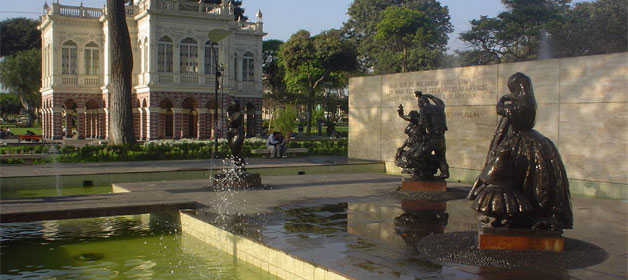
Located in downtown Lima, it is bounded by Paseo Colón, Wilson, Paseo de la República and 28 de Julio avenues in the heart of the Santa Beatriz neighborhood.
The traditional Parque de la Exposición is one of the most beautiful parks in Lima and in its interiors you will find the Museo de Arte de Lima, the Parque Japonés and the Museo Metropolitano de Lima. Also in this park we will find:
The "Nicomedes Santa Cruz" amphitheater, in homage to the Afro-Peruvian poet and essayist. The capacity of this amphitheater is close to 4 thousand people. Its facilities are required for presentations of national and international level.
The "La Cabaña" Theater, which performs theatrical presentations and cultural shows for children and adults. It has large and beautiful gardens, which are conditioned for family and social events such as weddings and anniversaries as well as business and institutional celebrations.
This park also has: A parking esplanade that is used for craft fairs, mechanical games, a lagoon for pedal boats, and puppet islands.
Monday to Sunday from 09:00 - 20:00 hrs.
Admission: Free
The Magic Water Circuit, recently inaugurated in the Parque de la Reserva, has become one of the new and most visited tourist attractions of this city. Awarded with the Güines Record and unique in America, this circuit surprises us with thirteen impressive fountains that combine movement, lights, sounds and images. A show full of fun, a place to visit with the family.
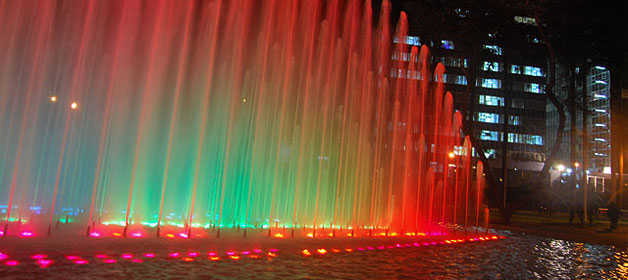
It is located 3.8 km south of Lima's main square.
Magic fountain, fantasy fountain, illusion fountain, visitable dome fountain, tianguis fountain, harmony fountain, rainbow fountain, tunnel of surprises fountain and five other small fountains.
It is the maximum expression of the Art Deco style, with a decorative trend of the 20's and La Belle Époque where geometric figures and zigzags stand out, its style is Neoclassical.
The design of the Loggia has Italian influence, it is a gallery or portico that is at ground level and is open on both sides, being supported by columns and arches. It is the main architectural element of the Reserve Park and the 80 m high Magic Fountain.
Also known as the Inca house, because the pre-Columbian figures are depicted there, it represents the maximum expression of Indigenism in the Reserve Park.
Sculpture of a boy playing marbles, a very popular game "El Jugador de Ñocos".
It consists of a building constructed by the Peruvian architect, sculptor and urban planner Manuel Piqueras.
It is an equestrian monument of Marshal Antonio José de Sucre in the Plaza of the same name.
Wednesday through Sunday and holidays from 3:00 p.m. to 10:30 p.m. Fantasy Fountain Show: 7:15 p.m./ 8:15 p.m./ 9:30 p.m.
Admission to the Parque de la Reserva is free from 6:00 a.m. to 1:00 p.m. During these hours the fountains are under maintenance.
Services and rates: General admission: S/. 4.00 Children under 5 years old have free admission. Internal parking:
S/.10.00 per car.
Other free services: wheelchairs for disabled and elderly people, external and internal security, dressing rooms, guided tours for groups.
It is a large park located in the district of Jesus Maria, in the metropolitan area of Lima. Around it are located important public institutions and sports organizations. The so-called Avenida de La Peruanidad, divides the park between east and west, and is the scene of the Great Military Parade, which takes place on July 29th of each year.
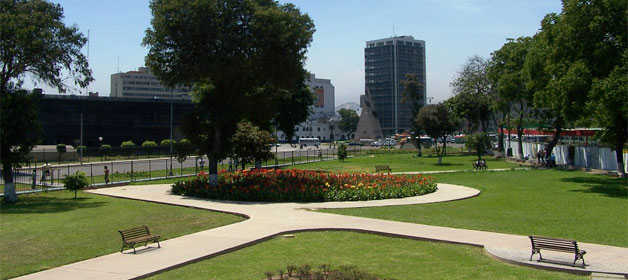
It is located 3.3 km southeast of the main square of Lima, in the district of Jesus Maria.
The attractions of the place are:
This monument represents the defenders of the homeland in the Peruvian-Ecuadorian War of 1941.
Made in homage to the mother, by the Municipality of Jesús María, the work made in bronze and granite represents a woman with two children, one in her arms and the other squatting around her in an attitude of asking her to raise him in her arms.
In this mural, the most characteristic features of each Department are captured, with the sole purpose of leaving an impression of John Paul II's apostolic visit to Peru from February 1 to 5, 1985.
Made in memory of the Promoter of Peruvian Aviation, who flew over the Swiss Alps in a heroic feat that would cost him his life, it is considered among the precursors of international aviation.
Planted by the then President of the Republic Augusto B. Leguía and a delegation of the Venezuelan Republic, on December 9, 1924 in the first block of 28 de Julio Avenue, was held on the occasion of the centenary of the Battle of Ayacucho.
The work belongs to the Peruvian sculptor Carlos Huertas and was inaugurated on April 24, 1932.
On the east side, there is a monument (in the form of a monolith) to the victims of internal violence suffered by terrorism in Peru during the 1980s and 2000s.
Consult with your travel agency.

Happy passengers