
The Torre Tagle Palace is one of the most representative viceregal mansions in the Historic Center of Lima. It was built in the 18th century, approximately between 1733 and 1738, by order of José Bernardo de Tagle Bracho, the first Marquis of Torre Tagle.
The property belonged to the Torre Tagle family and its descendants for several generations. In 1918, the Peruvian State acquired the building from the heirs of Ricardo Ortiz de Zevallos y Tagle, the sixth Marquis of Torre Tagle. Since the early decades of the 20th century, the palace has served as the main headquarters of the Ministry of Foreign Affairs of Peru.
Between 1954 and 1956, the building was restored by the Spanish architect Andrés Boyer, with the aim of preserving its architectural, historical, and artistic value.
This two-story building stands out for its carved wooden balconies, its Baroque-style oratory decorated with mirrors and colonial paintings, as well as its carefully carved stone doorway. It was built by order of the Marquis of Torre Tagle, who served as treasurer of the Royal Spanish Navy. The materials used in its construction were brought from Spain and Central America. The final result was a mansion that became a symbol of Lima for its style, elegance, and richness. After several years of deterioration, it was restored between 1954 and 1956 by the Spanish architect Andrés Boyer.

It is located at Jirón Ucayali No. 363, in the Historic Center of Lima, two blocks southeast of the Main Square.
The façade of the Torre Tagle Palace is Andalusian Baroque in style and features carved stone porticos and arches, as well as two artistic Moorish wooden balconies carved in cedar and mahogany. Regarding the architectural style of this house, architect Héctor Velarde Bergmann noted that Andalusian, Moorish, Creole, and even Asian influences come together with remarkable charm. The exterior presents a notable and asymmetrical façade, a feature that gives it movement and harmony, with a carved doorway made of stone on the lower section and stucco on the upper section.
The entrance hall leads to the first courtyard, a spacious, bright area surrounded by elegant balustrades, arcades, and Moorish-style columns. This courtyard was conceived as the vital center of the entire architectural complex. The style is mainly Andalusian Baroque, with a clear Mudéjar influence on the two floors surrounding the central courtyard. The upper floor is reached by a spacious and imposing staircase, whose entrance features a remarkable stone doorway with trilobed arches, which, like those on the upper floor, show Andalusian Mudéjar influence.

Visiting hours should be confirmed before going. According to recent information from the Ministry of Foreign Affairs, guided visits take place on Saturdays and Sundays, between 4:00 p.m. and 7:00 p.m., with prior registration and an identity document. Admission is free.
Construction began on January 18, 1535, the same day the Spanish conquistadors founded the city of Lima. However, a second construction was carried out in 1926 because more than one fire destroyed the original design. This second construction ended in 1938. It is located in the Plaza de Armas of Lima, also called Plaza Mayor, on the banks of the Rimac River.
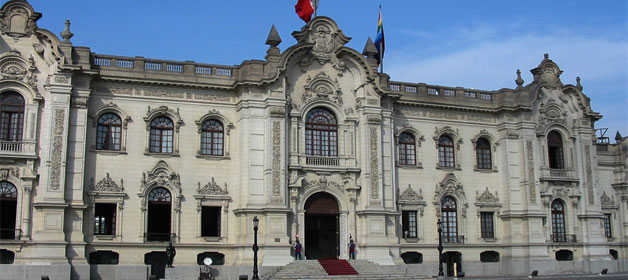
Located in the Plaza Mayor, in the historic center of the city of Lima.
The Government Palace of Peru has beautiful ceremonial rooms and halls, some of them, such as the Golden Hall, were built on the basis of those existing in the Palace of Versailles in France; its facilities, for the most part, were built in a French style.
In this room are the Four Seasons of the Spanish sculptor Ramón Mateu Montesinos, valuable and sensual nudes of maidens emptied in bronze, placed in four niches of the room, in the superior part of them there are reliefs in plaster with Inca motives work of the Peruvian sculptor Daniel Casafranca.
In the Basadre Hall, two carriages are exhibited, a landau-type carriage and a sedan-type carriage, which were used to take presidents to official ceremonies.
Its wide vault is supported by two pairs of jasper marble columns. Brocade panels, mirrors and four Louis XIV style chandeliers give an atmosphere of sumptuousness that adds to the plaster covered with gold leaf. This room is very effective because protocol ceremonies such as the swearing in of the members of the Council of Ministers of Peru or the imposition of the Order of the Sun of Peru are held here.
The Mariano Santos Mateos Hall, formerly known as the Ambassadors Hall, is a room where ambassadors present their credentials to the President of the Republic upon being officially recognized. It is also the scene of official meetings with high dignitaries from other nations.
The Peace Hall is the great dining room of the palace and is so called because on October 30, 1980 the peace treaty between El Salvador and Honduras was signed there, thanks to the mediation of former president José Luis Bustamante y Rivero.
The presidential residence has an 18th century Frenchified air. At the entrance there is a two-story oval salon, wrought iron on the upper floor. Important rooms in the residence are the White Salon and the Golden Salon (this is the ceremonial center of the residence furnished exclusively in the Louis XV style). Upstairs is the large and simple presidential bedroom. The windows overlook the back garden of the palace, limited by huge grilles that join the two arms of the facade.
Hours of operation are from 09:00 a.m. to 8:00 p.m.
At the end of the viceregal period and during the early years of the 19th century, Lima’s architecture began to show a transition between traditional colonial forms and new neoclassical influences. In this context, the Casa de Osambela was built, also known as the Casa de Oquendo, one of the most representative mansions in the Historic Center of Lima.
The property was built on land that once belonged to the Santo Domingo Convent, partly over the former novitiate of the Dominican friars, which had been destroyed by the earthquake of 1746. Later, the land was sold to the Spanish merchant, banker, and shipowner Martín de Osambela, who ordered the construction of this remarkable Lima mansion between the late 18th century and the early years of the 19th century.
The Casa de Osambela stands out for its wide façade, its enclosed wooden balconies, and its particular blend of styles. Although it preserves elements typical of Lima’s viceregal architecture, it also incorporates neoclassical influences and decorative details associated with the Rococo style.
The building was completed between 1803 and 1805. Its layout is unusual among Lima’s historic mansions, as several of its rooms are arranged parallel to the street, allowing for a broader façade and the presence of its characteristic five balconies.
The house is also linked to important episodes in Peruvian history. José de San Martín stayed there after proclaiming Peru’s independence in 1821. In later decades, the property became known as the Casa de Oquendo, after the family that acquired it in the 19th century.

The Casa de Osambela is located at Jirón Conde de Superunda 298, in the Historic Center of Lima.
The façade of the Casa de Osambela is neoclassical in style, with Rococo reminiscences. It features five balconies in the Louis XVI style, ornamented with garlands and accompanied by three open balconies. At the top, it has a lookout tower covered by a small dome with Moorish-inspired lines.
Unlike most Lima viceregal houses, the rooms of the Casa de Osambela are arranged parallel to the street, which makes its façade wide enough to hold five enclosed balconies in the Louis XVI style. Likewise, the layout of its patios was different from that of other buildings from the viceregal period, which usually organized their spaces “in depth” rather than along the façade.
Visiting hours and admission fees should be confirmed directly with the Casa de Osambela, as the property has undergone changes in its operation and may have access restrictions.
The Naval Museum Casa Grau of Lima is a historic space dedicated to preserving and sharing the memory of Miguel Grau Seminario, one of the most important figures in Peruvian naval history. The mansion is located in the Historic Center of Lima and was the home where Grau lived with his wife, Dolores Cabero Núñez, and their children for several years before leaving for the War of the Pacific.
The property was restored and enhanced as a house museum in 1984, when the Pontifical Catholic University of Peru ceded the second floor to the Peruvian Navy. Later, in 1997, the first floor was also ceded, consolidating the space as a museum dedicated to the family, political, and naval life of the Peruvian hero.
The Naval Museum Casa Grau is located at Jirón Huancavelica 170-172, in the Cercado de Lima district, within the Historic Center.
The museum exhibition recreates the rooms of a Lima house from the second half of the 19th century, with period furniture and pieces related to the life of Miguel Grau. Among the most notable elements are a replica of the congressional seat he used when he served as deputy for Paita, a scale model of the monitor Huáscar, family portraits, historical documents, and objects connected to his naval and public career.
The visit allows travelers to discover not only the Hero of Angamos, but also the husband, father, and citizen who lived in this house before becoming one of the most remembered figures in Peru’s republican history.

Opening hours and entrance fees should be confirmed before visiting, as they may vary. According to current tourism information, the museum is open Tuesday to Sunday, from 9:00 a.m. to 1:00 p.m. and from 2:00 p.m. to 4:00 p.m.
House of true traditional Lima category. It is deduced by the shield, as year of the inauguration 1771, by its owners, the gentlemen Cavero and Vásquez de Acuña who were related to the Counts of the Vega del Ren, data that were consigned by Don José de la Riva Agüero y Osma.
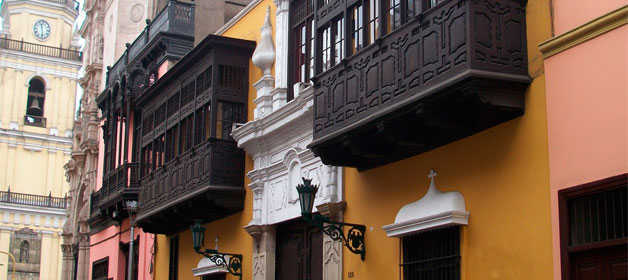
Located at Jiron Ucayali 358, in front of the Torre Tagle Palace.
By the time the building was built, the baroque style had been imposed as the architectural structure and design par excellence, in contrast to this, the Casa de Goyeneche was one of the first architectures to show its French influence. Both its portal and its balconies incorporate decorative elements of the rococo style, which can also be seen in the interiors of the house.
Today, La Casa de Goyeneche houses in its interior an exquisite collection of colonial and republican art, the rooms have been decorated with furniture and valuable objects of the time.
In May 1971 the Banco de Credito del Peru acquired La Casa Goyeneche, and by R.S. N° 2900 of December 28, 1972 it was declared Cultural Patrimony of the Nation.
All Year - Sat - Sun 9:00 a.m. to 6:00 p.m.

Happy passengers