
Ceramics, textiles, metals, organic and lithic material related to priceless human remains make up the legacy of our pre-Hispanic past. Objects of historical-artistic value and documentary, photographic and bibliographic collections give an account of Peru's colonial and republican periods.
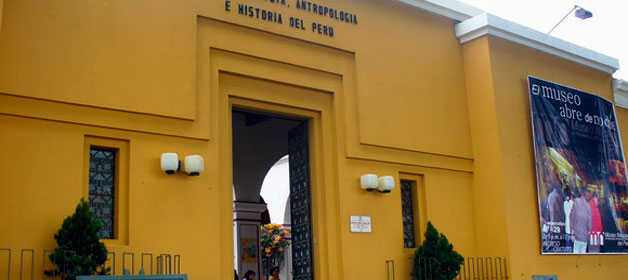
Plaza Bolivar s/n Pueblo Libre…
Among its most important treasures are the Crossed Hands of Kotosh, the Raimondi Stela, the Tello Obelisk, the Mantos de Paracas, and paintings from the viceroyalty period, mainly from the Cusco School.
Cuenta con talleres de conservación de objetos arqueológicos destacando los textiles y metales; al igual que taller para niños y adolescentes. Ceramios, textiles, metales, material orgánico y líticos relacionados a invalorables restos humanos conservados con técnicas que aún sorprenden a los especialistas, conforman el legado de nuestro pasado prehispánico. Objetos de valor histórico-artístico y fondos documentales, fotográficos y bibliográficos dan cuenta de los períodos colonial y republicano. Todos ellos hacen de este espacio un lugar de encuentro con la historia del Perú. Su histórica arquitectura se constituye en el lugar ideal donde todos, sin importar su edad y procedencia, pueden descubrir, revivir y cuestionar las vivencias de nuestros antepasados.
Hours of operation:
Tuesday through Saturday 9:00 a.m. - 5:00 p.m.
Sundays and holidays 9:00 a.m. - 4:00 p.m.
Admission fee:
Adults: S/. 11.50 nuevos soles
Children and school children: S/. 1 nuevo sol
Students of higher education, teachers an
Military relics such as a cannon brought by Pizarro or a cannon used in the war of independence.
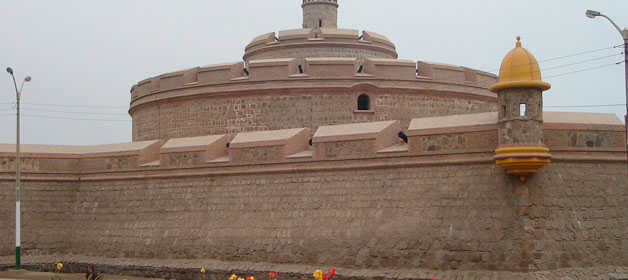
Plaza Independencia, Callao.
Spanish military fortress, built between 1747 and 1774, bastion of defense of the port of El Callao from pirate and corsair attacks. It was the last Spanish stronghold during the independence of Peru. Designed by Luis Godín according to the plans of the Vaudan School that dominated the military art of the time. It has 70 thousand square meters of area and it has pentagonal form; 5 bastions, walls, cordon, parapet, embankments and escapes. It had 188 bronze cannons and 124 iron cannons. Part of this fortress currently constitutes the Military Historical Museum.
Attention Tuesday to Sunday from 9 to 13 hrs.
Admission fee: S/. 18.00 nuevos soles.
The convent was founded in the 16th century and is the restored "jewel" of the old churches of Lima. In its interior it has Sevillian tiles and carved wood in its halls, such as the Choir, the Library and also the famous Catacombs.
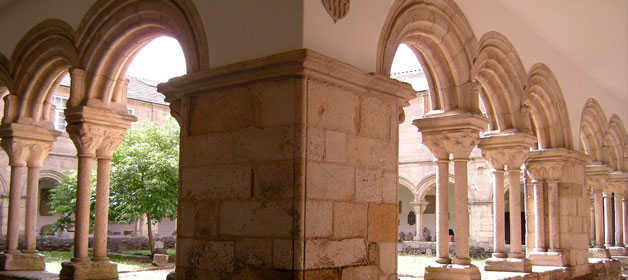
Plazuela San Francisco, corner of Ancash and Lampa Streets.
The attractions of the place are:
The Sacristy of the main temple is one of the jewels of the Franciscan complex. The works of the sacristy were completed in 1730, highlighting its cover, executed in 1729 by Ensign Lucas de Meléndez.
Crossing the door of the convent, a spacious environment is located, with baseboards adorned by tiles, which presents as main attraction a triptych of the Crucified Lord, whose lateral paintings are works of Angelino Medoro. We also find paintings of the Lima school, of great value.
Here, we will find a wooden sculpture of Jesus Crucified; paintings of saints of the Catholic Church, of the Lima school of the XVII century; as well as paintings of the Cusco school, and two paintings in the form of medallion, representing passages of the life of San Francisco Solano, made on the occasion of celebrating his canonization.
It is a large room with a carved wooden ceiling and Sevillian tile baseboards. Here are four paintings by famous artists, depicting Catholic saints.
It is a beautiful quadrilateral patio, surrounded by galleries in the form of semicircular arches, eleven per side, all of them supported by pilasters. The walls are decorated with Sevillian tiles on the baseboard, dating from 1620, the theme of the decorations being Franciscan saints.
Environment where the Franciscans met to celebrate their conventual chapters and to elect a new superior or to deal with matters of main importance. There are two rows of seats with raised backs that surround the room and have in the center, as a union of the two rows, the main chair or tribune, which is crowned by the coat of arms of the Order; In the center is a wood carving in high relief with the image of Fray Juan Duns Scoto, as well as the image of the Immaculate Conception, Patroness of the Franciscans, before whom they prayed before holding their meetings, in which many times there were various problems among them, so it was necessary the presence of the viceroy's guard.
Environment where different platforms are preserved for the processions of the saints of the Catholic Church, where we can distinguish the following: one of embossed silver, which is used on the first Sunday of November every year for the procession of the image of St. Jude Thaddeus, another, carved in wood, and covered in gold leaf of fine fretwork and a third, for St. Francis of Assisi, also worked in wood and coated in gold leaf.
This room is dedicated to the exhibition of a collection of eleven canvases of approximately three meters; each one represents the "Passion of Christ" (belonging to the workshop of the great Flemish master Pedro Pablo Rubens), all of them of great execution, color harmony and great expression in their characters.
This room was formerly used as a dining room. Here you can find the famous collection of fifteen canvases representing the Twelve Apostles, Christ the Redeemer, the Virgin Mary and St. Paul, imposing paintings that belong to the Spanish master Francisco de Zurbarán.
Here, we appreciate an immense canvas of five by six meters, that represents the genealogical tree of the Franciscan Order, work that dates from 1734.
The most impressive part of this building are the catacombs, which impress more than one as they were the cemetery in colonial times.
Hours of operation Monday to Sunday: 9:30 am to 5:30 pm
Admission fee
General public: S/ 7.00 Nuevos soles
Students: S/ 3.50 Nuevos soles
Children: S/ 1.00 Nuevos soles.
The Huaca Pucllana Site Museum was created in 1984, as a result of research work begun in 1981 to safeguard the archaeological objects recovered and maintain a presence at the site to ensure their conservation. Since then, work has been carried out at this site, thanks to an agreement between the then National Institute of Culture and the Municipality of Miraflores.
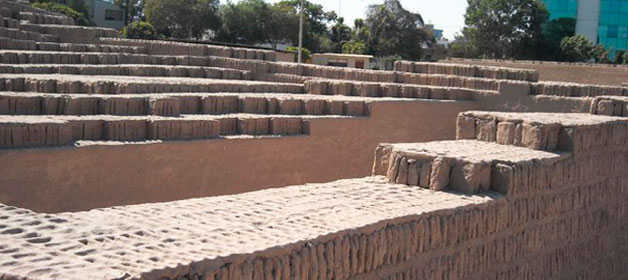
General Borgoño 700, Miraflores.
The attractions to visit are:
The third part of the pyramid and the integrity of the lower part are conditioned with a tourist circuit that allows to know closely the diverse spaces used when the site was a ceremonial center. In some enclosures and patios there are life-size recreations of Lima culture settlers performing various activities, accompanied by photographs of the excavation process; this allows a clearer understanding of the past of this place.
The site has a small exhibition hall, inaugurated in 1984, which displays part of the findings made at the site. Most of the objects correspond to the Lima culture, highlighting the ceremonial jars, miniature mortuary offerings, ceramic sculptures of sharks and implements used in the sacrifices.
It is considered an important objective to show that aspects of the ancient cultures that inhabited Pucllana remain today, this is achieved by showing how the plants and animals that were cultivated and raised at that time are still an important part of the life of a Limeño or Peruvian today. Various plants such as corn, pacay, guava, tuna, tara, guarango, etc. are exhibited along with South American camelids, Creole ducks or "jokes" in the Muchik language, guinea pigs and Peruvian hairless dogs. These canids are now Cultural Patrimony of the Nation, but in the Huaca Pucllana they have been bred since before this, constituting a pioneering site in the conservation and revaluation of this native species.
The site has an exhibition and sales room for handicrafts made from various materials such as vegetable fiber, gourds, ceramics, wood and metals, as well as products made from native foods. Every weekend there are exhibitions and craft demonstrations where you can interact with the artisans.
Wednesday through Monday from 9:00 a.m. to 5:00 p.m. Tickets
Adults: S/. 7.00
Students, university students and professors S/. 3.00
Schoolchildren, children and senior citizens S/. 1.00
The Museum of the Nation was created in 1988 as an integrating entity of the diverse cultural expressions of the country. It is today one of the two largest museums in Peru and an important cultural center.
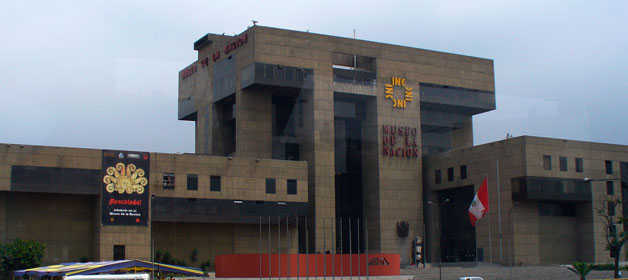
It is located at the intersection of Av. Aviación and Av. Javier Prado.
The Museum, as a great curator of Peruvian heritage, has thousands of original pieces corresponding to the different periods of Peruvian history. These have been obtained through archaeological research and the recovery of goods that had been illegally trafficked. This great collection is made up of more than 12,500 pre-Hispanic pieces, including collections of ceramics, metals, and textiles from the Paracas, Moche, Wari, and Lima cultures, among others; and more than 2,500 historical pieces of art from the colonial and republican periods, including collections of colonial, popular, and contemporary art.
The Museo de la Nación also serves as the great cultural center of the country, therefore, in its halls are held various activities, such as lectures and educational workshops, and in its auditoriums are presented the national casts of Ballet, Folklore, the National Symphony Orchestra, the National Choir, among others.
From mondays to sundays from 9:00 a.m. to 5:00 p.m.
Founded in 1926, the Larco Museum exhibits impressive chronological galleries that show an exceptional panorama of 3000 years of development of the history of pre-Columbian Peru.
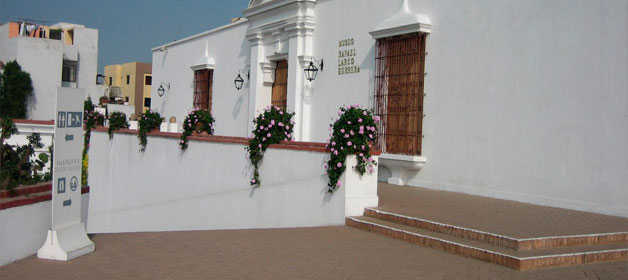
Bolivar Av. 1515, district of Pueblo Libre.
It presents the finest collection of gold and silver of ancient Peru, as well as the famous collection of erotic art, one of the most visited tourist attractions in Peru.
The Larco Herrera Museum is one of the few museums in the world where visitors can walk through its storage room and appreciate the 45,000 archaeological objects properly classified, which is an unforgettable experience. The Larco Museum's works of art have been exhibited in the most prestigious museums in the world and are considered icons of pre-Columbian art worldwide. The museum has seven rooms: the gold and jewelry room, the lithic room, the vault, the ceramic room, the metals room, the cultures room, the textiles room, the erotic room, and the storage rooms.
Hours of operation:
Monday to Sunday: 09:00 - 18:00 hrs.
Admission fee:
General: S/. 30.00 soles.
Reduced: S/. 25.00 soles.

Happy passengers