
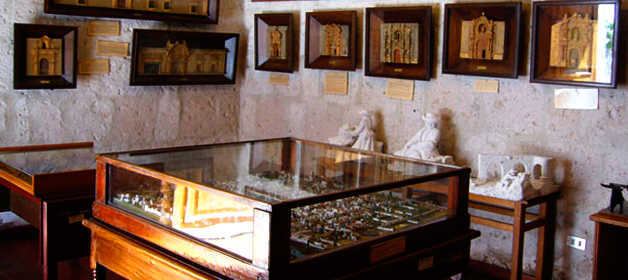
The Municipal Historical Museum of the city of Arequipa, since its creation has fulfilled a preponderant role: to inform the visitors of certain aspects occurred in this part of the country, some data have to do with the architecture, others with the ethnology, others with the plastic arts, but much more with the history in its wider meaning.The exhibition is distributed in seven rooms:
Pre-Hispanic Hall, Emancipation Hall, Republic Hall, Vinatea Reynoso Hall, Naval Hall, Architecture Hall, Illustrious Arequipeños Hall and the Art Gallery.
The attractions are:
It is a main environment of the Museum, the portraits of the most conspicuous Arequipa citizens who through their effort, work, study and their morality left high the image of Arequipa as the second city of Peru are exposed. They are pedagogues, historians, scientists, priests, poets and jurists, among others.
Teodoro Núñez Ureta (1914 - 1988), until now, the most important Peruvian muralist, whose full mastery of watercolor and the human figure, led him to naturally develop his muralist work in fresco.
Alejandro Nuñez-Ureta (1920 - 1974), Teodoro's brother, is the greatest watercolorist of Arequipa's painting, the most genuine and passionate of the cross country watercolorists, of spontaneous resolution and wise tonal balance.
Pablo Nuñez-Ureta, (Arequipa 1954-2001), has exhibited individually since 1965 in the most important galleries of Arequipa, Tacna and Lima (Peru) and in countries such as Chile and the United States.
His works have been exhibited in group exhibitions in the United States, Canada, Chile, Argentina, Brazil, Venezuela, China, Scotland, India and Morocco.
There are 20 paintings that evoke not only the religiousness and the natural landscape, but also the daily life of the city.
Hours (all year round), from Tuesday to Sunday from 9:00h to 17:00h.
General entrance fee
Foreign tourists: S/. 2 nuevos soles.
Students: S/.0.50 cents of sol.
Its origin is linked to the donation of a collection of archaeological pieces made by Monsignor Leonidas Bernedo Málaga. Over time, the museum expanded its collections thanks to archaeological research, donations from scholars, and contributions related to the regional history of Arequipa.
Today, it preserves thousands of cultural objects, including ceramics, wood, textiles, mummies, lithic objects, metals, weapons, furniture, and paintings of great historical and cultural value. Its permanent exhibition, titled “The Cultural Development of the Pre-Hispanic Arequipa Region,” presents archaeological materials linked to different periods of regional history, as well as viceregal and republican-era objects.
The museum preserves archaeological objects from research carried out in the Arequipa region, as well as donations from collectors and researchers interested in Peruvian culture. Its collection offers insight into the cultural development of the southern Andes, from the earliest human settlements to later pre-Hispanic periods.
Among its collections are ceramic pieces, pre-Hispanic textiles, mummified remains, lithic objects, metals, viceregal furniture, and paintings from the Cusco School. It also exhibits materials associated with cultures such as Paracas, Nazca, Tiwanaku, Wari, Chuquibamba, Churajón, and Inca, according to classifications presented by tourism and university sources.
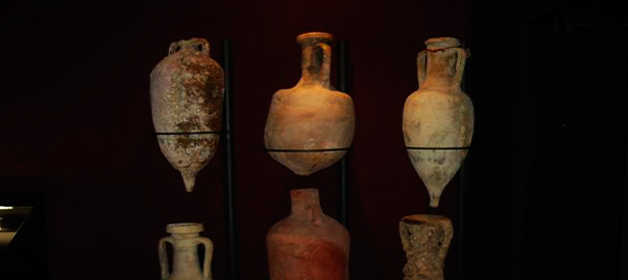
The José María Morante Maldonado Archaeological Museum is located at Álvarez Thomas 200, in the historic center of Arequipa, just a few minutes on foot from the Main Square. Thanks to its central location, it can be easily visited during a walk through the historic center.
The museum currently holds around eight thousand cultural objects, including ceramics, bones, pre-Hispanic textiles, mummies, lithic objects, metals, and more. One of its most valuable collections is the group of keros, or ceremonial vessels, known as the Yábar Collection. Below are some of the most impressive collections that can be found in the museum:
Visiting hours are Monday to Friday from 8:30 a.m. to 3:15 p.m.
Admission fees vary for adults, students, and children. Updated prices can be checked on site.
Adults: S/ 5.00
University / higher education students: S/ 2.00
Schoolchildren: S/ 1.00
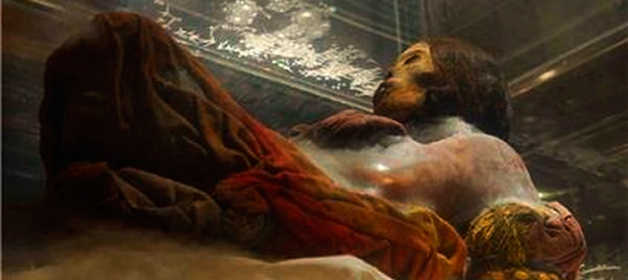
It was founded in 1969 by the Marianist Brother Doctor Roberto Wood, who gathered a group of teachers for the specialty who at the same time organized the Institute of Pre-Columbian Studies, which was born with the museum in 1970, thus initiating the professional career of Archaeology at the university, constituting the first outside of Lima.
The museum has 8 rooms that present the cultural development of the Arequipa region from the high Andean hunter-gatherers (10,000 B.C.) to the arrival of the Europeans in the 14th century and ending with the Republic.
Calle Cruz Verde 303 Cercado Arequipa
Pre-agro-Pottery Period: Represented by the pre-ceramic rock shelter of Pintasayoc, a stage where the lithic stage is developed (projectile points, knives and scrapers), Early Intermediate Period: From Nazca influence reaches Arequipa along the coast to near its capital. They are farmers, ranchers, fishermen and seafood gatherers.
Late Intermediate Period. Local Kingdoms Churajon Lordship: Occupies the provinces of Islay (Arequipa) and Sanchez Cerro (Moquegua), dedicated to livestock, agriculture developing the infrastructure of andenería of Arequipa and tricolor ceramics (red, black and cream) with geometric decoration.
Chiribaya Kingdom. They occupied the land of Moquegua, their major developments were: Ceramics (geometric decoration and use of 5 colors) and textiles (simple fabrics to tapestries).Aruni Kingdom: Corresponds to Condesuyos (Arequipa), its most representative ceramics: bases and dishes characterized by being modeled, representations of camelids, suris, snakes, geometric decoration with 8-point star.
Late Intermediate Period. Colla Kingdom: It develops in the Altiplano on the shores of Titicaca. There was a Colla presence up to the coast of Arequipa for crop production.
Late Horizon Tahuantinsuyo Kingdom. It developed in the valley of Cusco occupying almost all the Coast and Highlands of South America. Its territory was equivalent to 3 times the Roman Empire. They developed all the agricultural, architectural, hydraulic, etc. techniques. The most characteristic pottery was called Aribalo.
The Incas managed to organize the Tahuantinsuyo in less than a century. They stand out for the funeral bundles that are woven in Ichu, we also find textiles, metallurgy, ceramics.
Andean Textiles. The production of textiles was made of cotton, camelid wool (vicuña, alpaca and llama) and feathers. The uses of textiles were: as clothing, fishing nets, bags, sashes, blankets, hats, turbans, among others.
Colonial Period: Period since the arrival of the Spaniards to Arequipa. The best testimonies are the glassware, earthenware and iron objects brought from Europe.
Hours (all year round). Monday to Friday from 09

The Monastery of Santa Catalina de Siena was founded on September 10, 1579, and over time became a true convent city within Arequipa. Its origin was linked to Viceroy Francisco de Toledo and Doña María de Guzmán, recognized as the monastery’s first resident and prioress.
The complex covers an area of approximately 20,000 square meters, and its layout recalls the early neighborhoods of the city of Arequipa. Its interior streets, patios, cloisters, cells, gardens, and religious spaces reflect the cloistered life that developed here for more than four centuries.
For a long time, the monastery remained surrounded by an aura of mystery due to the closed nature of convent life. In 1970, an important part of the complex opened its doors to the public, allowing visitors to discover one of the most unique religious complexes in Peru.
The monastery’s architecture is mainly colonial and mestizo, built with sillar, the volcanic stone characteristic of Arequipa. The complex includes cloisters, portals, towers, domes, narrow streets, patios, gardens, and spaces that preserve the atmosphere of an old religious city.
Among its main spaces are the monastery entrance, the Patio of Silence, the Cloister of the Orange Trees, the Main Cloister, the kitchen, the laundry area, the bell tower, the church, and the art gallery. Its rooms display religious paintings, works linked to the Cusco School of Painting, and pieces of historical, artistic, and devotional value.

The Monastery of Santa Catalina is named after Saint Catherine of Siena, a 14th-century Italian mystic linked to Dominican spirituality and recognized as one of the most important saints of the Catholic Church.
The Monastery of Santa Catalina is located at Santa Catalina Street 301, in the historic center of Arequipa, just a few blocks from the Main Square.
From the Main Square, you can walk there in just a few minutes. It is also possible to take a taxi from any point in the historic center.
When visiting the Monastery of Santa Catalina, visitors can:

The regular visiting hours are Monday to Sunday, from 9:00 a.m. to 6:00 p.m. On Tuesdays and Wednesdays, the monastery is open from 9:00 a.m. to 7:00 p.m., with last admission until 6:00 p.m.
The monastery is closed to the public on Good Friday, December 25, and January 1. Opening hours may vary, so it is recommended to verify the current information before your visit.
Tickets can be purchased online or at the monastery ticket office. Payments can be made by card or in cash. Guided service is optional and is not included in the ticket price.
Promotional day for Peruvians: it takes place on the 10th day of each month and on the last Sunday of the month. It does not apply during Peruvian Independence Holidays. A DNI must be presented.
The promotional day for Peruvians takes place on the 10th day of each month and on the last Sunday of the month. It does not apply during Peruvian Independence Holidays. A DNI must be presented.
The La Recoleta Convent Museum was founded in 1648 by the Franciscan order, within the context of the evangelizing work carried out during the colonial period. Some sources indicate that it was founded by Father Pedro de Mendoza and that its plans were designed by Father Pedro de Peñaloza.
By around 1651, a church and two cloisters had already been built. Over time, the architectural complex came to include four cloisters built in sillar, the volcanic stone characteristic of Arequipa. During the colonial period, this place served as a space for training and retreat for missionaries who prepared to bring Catholicism to remote Indigenous communities.
Throughout its history, the convent has undergone several restorations and modifications, but it still preserves much of its original character. Since 1978, it has also operated as a museum, with rooms dedicated to pre-Columbian art, the Amazon, religious art, and a valuable library with more than 20,000 ancient volumes.
The La Recoleta Convent features sober colonial architecture, characterized by cloisters with arches, sillar walls, and peaceful spaces for reflection. Its design is organized around inner courtyards, following the typical structure of colonial convents.
The complex includes cloisters, gardens, narrow corridors, cells, a sacristy, and the chapter house, spaces that allow visitors to imagine monastic life during the 17th and 18th centuries. The convent church stands out for its simple façade and austere interior, reflecting the Franciscan spirit.
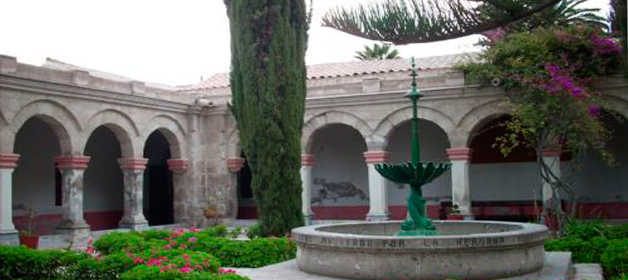
It is located at La Recoleta Street 117, in the traditional neighborhood of Antiquilla, just a few blocks from the historic center of Arequipa. From the Main Square, visitors can walk there in approximately 15 minutes, crossing a quiet area with a local atmosphere, ideal for those who wish to get away from the tourist bustle for a while.
The convent museum is distributed across several areas:
Located in front of the Chapel of the Wake, this space displays archaeological pieces from pre-Hispanic cultures such as Chimú, Mochica, Inca, Churajón, and Chancay. It also features textiles related to traditions such as Wari, Paracas, and Inca.
Two solid sillar rooms contain an interesting collection related to Amazonian wildlife, including birds, mammals, snakes, arachnids, reptiles, butterflies, and insects. Objects from the daily life of Amazonian peoples such as the Shipibo, Asháninka, Machiguenga, Huitoto, and Yagua are also displayed.
This space preserves representative works of religious art, miniature sculptures made of wax and Huamanga stone or alabaster, as well as monstrances, sacred vessels, and ornaments finely embroidered with gold, silver, and silk threads.
These rooms are a clear reflection of the austerity of convent life. One of the great figures linked to this house, Monsignor Fray Mariano Holguín, the first archbishop of Arequipa, spent several years of his life here.
The current library space dates back to 1926. Its shelves hold approximately 20,000 volumes, many of them printed in the 16th, 17th, and 18th centuries.

Reference opening hours:
Monday to Saturday
9:00 a.m. to 1:30 p.m.
2:30 p.m. to 5:00 p.m.
The entrance fee may vary for adults, students, and children. Updated prices can be checked directly at the museum.

Happy passengers