
The Casa del Almirante, now home to the Museo Inka, is one of the most important colonial mansions in the historic center of Cusco. It is known by this name because of the Spanish admiral Francisco Alderete Maldonado, who was linked to the history of the building during the 17th century.
The building stands on an ancient Inca plot traditionally associated with the palace of Huáscar. After the Spanish conquest, the property passed through different owners and uses. Over the centuries, it served as the headquarters of the Archbishopric of Cusco, the temporary residence of the last viceroy of Peru, José de la Serna, and the Government House of Andrés de Santa Cruz during the Peru-Bolivian Confederation.
In the 20th century, the mansion became property of the National University of San Antonio Abad of Cusco and was later designated as the headquarters of the Museo Inka, an institution dedicated to preserving, researching, and sharing the archaeological and historical heritage of Andean cultures.
The Museo Inka preserves an important collection of ceramics, textiles, stone and wooden tools, gold and silver objects, human remains, mummies, and evidence of ancient medical practices, such as cranial trepanations.
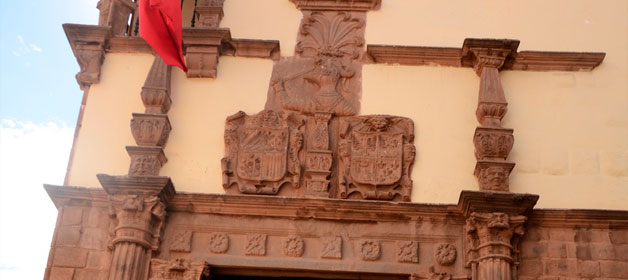
On the exterior of the building, an original Inca wall and a Renaissance doorway stand out, the latter considered one of the most notable in the city. The entrance is flanked by Plateresque-style decorative elements and fluted Corinthian columns. Above the door, two stone coats of arms linked to the Alderete and Maldonado families can be seen.
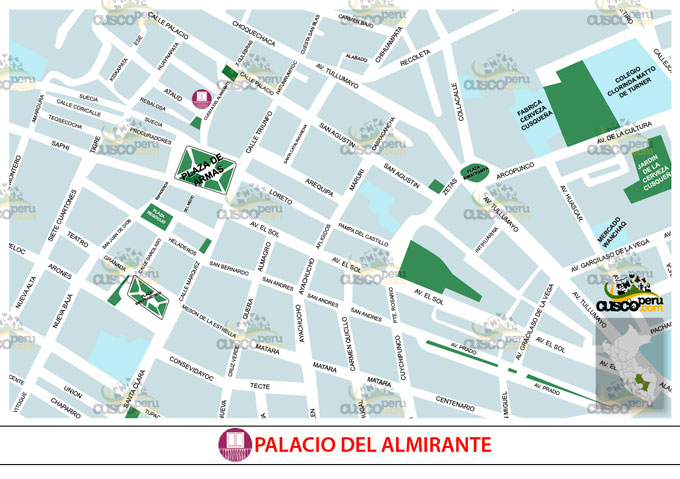
It is located in the historic center, just a few steps from the Main Square. At Cuesta del Almirante No. 103, visitors will find the Museo Inka, also known as Casa del Almirante.
Its exhibitions are organized into thematic rooms, arranged chronologically from pre-Inca cultures to the Inca period and the colonial era. Visitors can see ceramics from different ethnic groups, ceremonial objects, sculptures, and textiles.

These are the exhibition rooms:
The visit also allows visitors to learn about ceramics, textile techniques, stonework, architecture, agriculture, medicine, and ritual practices of Andean cultures.
Monday to Friday: from 8:00 a.m. to 6:00 p.m.
Saturdays and holidays: from 9:00 a.m. to 4:00 p.m.
Foreign adult: S/. 20.00
Foreign student: S/. 10.00
Peruvian adult: S/. 10.00
Peruvian student: S/. 5.00
Opening hours and rates may vary, so it is recommended to verify the current information before your visit.
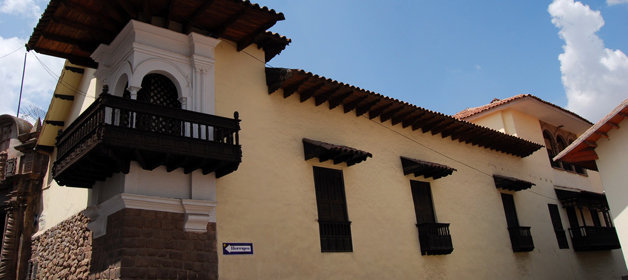
The Museum of Religious Art of Cusco is located inside the Archbishop’s Palace, on Hatun Rumiyoc Street, in the heart of the city’s historic center. The building stands on the remains of the ancient palace of Inca Roca, and on one of its exterior walls is the famous Twelve-Angled Stone.
The museum was inaugurated on June 24, 1969, thanks to the initiative of Monsignor Ricardo Durand Flórez and the contribution of Cusco collector José Orihuela Yábar, as well as other religious institutions that contributed canvases, sculptures, altarpieces, colonial furniture, and valuable ornaments.
In Inca times, this space formed part of the palace of Inca Roca. After the Spanish conquest, part of the ancient Inca complex was reused to build a colonial mansion linked to the Valverde Contreras y Xáraba family, Marquises of Rocafuerte. Later, the building became the Archbishop’s Palace of Cusco.
In 1966, Monsignor Ricardo Durand Flórez decided to turn the palace into a museum. To do so, he invited collector José Orihuela Yábar, whose collection of colonial Cusco paintings became one of the foundations of the current Museum of Religious Art. The museum was officially inaugurated on June 24, 1969.
The building preserves walls of Inca origin around its perimeter and a colonial-style inner courtyard with stone arches, tiles, and a central fountain. Its rooms display canvases, sculptures, altarpieces, colonial furniture, liturgical ornaments, and pieces related to viceregal religious art.
Among its collections are works from the Cusco School, the Corpus Christi series from the Church of Santa Ana, canvases linked to Diego Quispe Tito, pieces from the San Antonio Abad Seminary, and works donated by the José Orihuela Yábar Foundation.
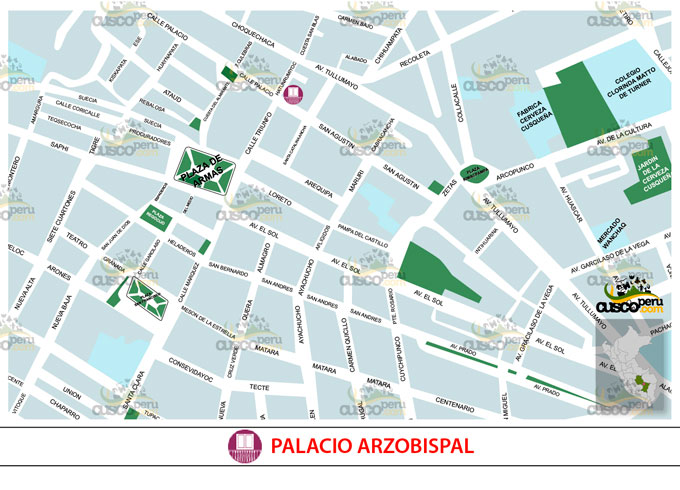
It is located on Hatun Rumiyoc Street, in the historic center of Cusco, just a few minutes on foot from the Main Square.
The museum preserves an important collection of colonial religious art, with canvases, sculptures, altarpieces, colonial furniture, and liturgical objects distributed throughout different thematic rooms.
One of its main exterior attractions is the Twelve-Angled Stone, located in the Inca wall of the ancient palace of Inca Roca. This stone is considered one of the most representative examples of the precision of Inca architecture and can be seen freely from the public street.

Reference opening hours: Monday to Saturday, from 8:00 a.m. to 7:00 p.m.
Reference rate:
Individual admission to the Archbishop’s Museum: approximately S/ 15.00
Student: approximately S/ 7.50
The best option is to purchase the Religious Circuit Ticket, with an approximate price of S/ 30.00 and S/ 50.00.
Rates, opening hours, and included sites may vary, so it is recommended to verify the current information before your visit.
Photography is not allowed inside the museum. It is recommended to visit it with a specialized guide in order to better understand the historical and artistic value of its pieces.
Após a conquista espanhola de Cusco, foi realizada a divisão dos terrenos entre conquistadores e autoridades coloniais. O espaço onde hoje se ergue a Casa do Marquês de Valleumbroso teria pertencido ao conquistador Pedro Luis de Cabrera, que construiu uma primeira edificação utilizando pedras de origem incaica.
Posteriormente, o imóvel ficou vinculado ao marquesado de San Lorenzo de Valle Umbroso. Durante essa etapa, foram desenvolvidos elementos importantes da casona, como o corpo principal, os arcos do primeiro e segundo níveis, e os pátios internos.
No início do século XX, a casona foi adquirida por César Lomellini, que realizou modificações sem perder completamente a estrutura original nem as obras de arte existentes. Na segunda metade do século XX, o imóvel passou a ser utilizado como sede da instituição artística que hoje corresponde à Universidade Nacional de Arte Diego Quispe Tito de Cusco.
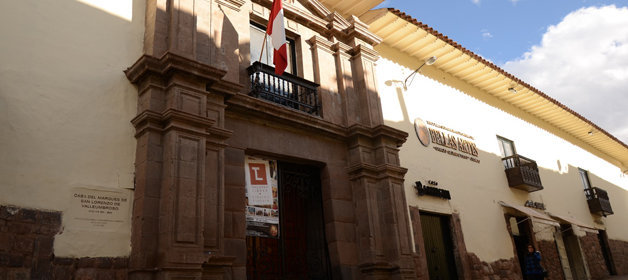
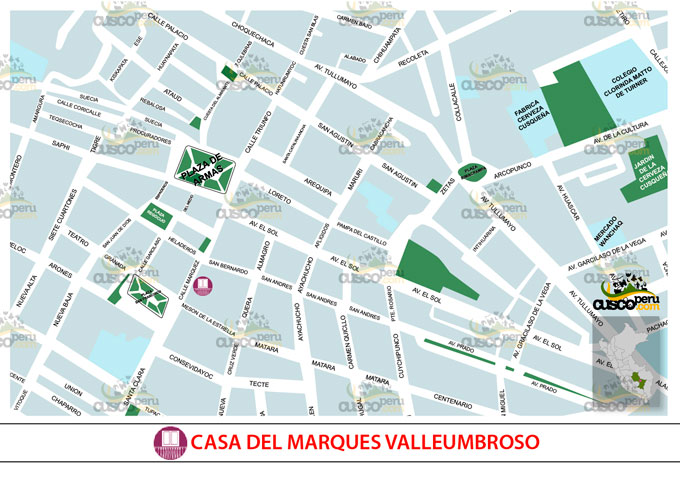
A casona está localizada na rua Marqués 271, no centro histórico de Cusco, a poucas quadras da praça de Armas.
A Casa do Marquês de Valleumbroso se destaca por seu valor arquitetônico e histórico. Conserva elementos próprios da arquitetura civil colonial cusquenha, como pátios internos, arcos, muros de pedra e ambientes adaptados para atividades acadêmicas e artísticas.
Atualmente, faz parte da sede central da Universidade Nacional de Arte Diego Quispe Tito de Cusco.
Horário de atendimento: de segunda-feira a domingo, das 8h às 18h. Vale esclarecer que, por funcionar como sede universitária, o acesso pode variar conforme as atividades acadêmicas, exposições ou disposições internas da instituição. Recomenda-se consultar diretamente a Universidade Nacional de Arte Diego Quispe Tito de Cusco antes da visita.
Tarifas: A entrada está incluída no Bilhete do Circuito Religioso.
Por ser uma sede universitária, o acesso depende da instituição.
The House of the Marquis of Picoaga is one of the most representative mansions in the historic center of Cusco. Its construction dates back to the 18th century and is attributed to José de Picoaga y Arbiza, who is believed to have arrived in Cusco by order of the viceroy, the Count of Superunda.
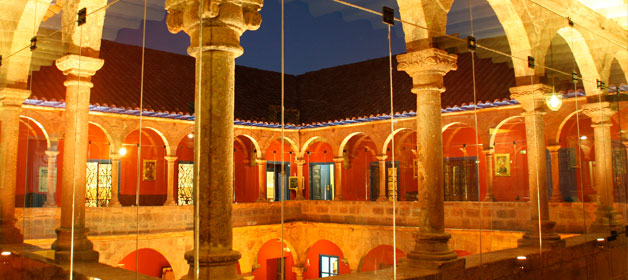
The new mansion is believed to have been built between 1745 and 1751. Its architecture preserves characteristic elements of Cusco’s colonial residences, such as stone arches, a central courtyard, a stone doorway, Republican-style balconies, and interior rooms decorated with mural painting.
As a result of the earthquakes that affected the city, especially the one in 1950, the building suffered significant damage. In 1976, a restoration process began with the aim of preserving its architectural and historical value.
Since 1972, the building has formed part of the Monumental Zone of Cusco, declared Cultural Heritage of the Nation. In addition, as it is located within the historic center of Cusco, it is part of the area inscribed by UNESCO as a World Heritage Site in 1983.
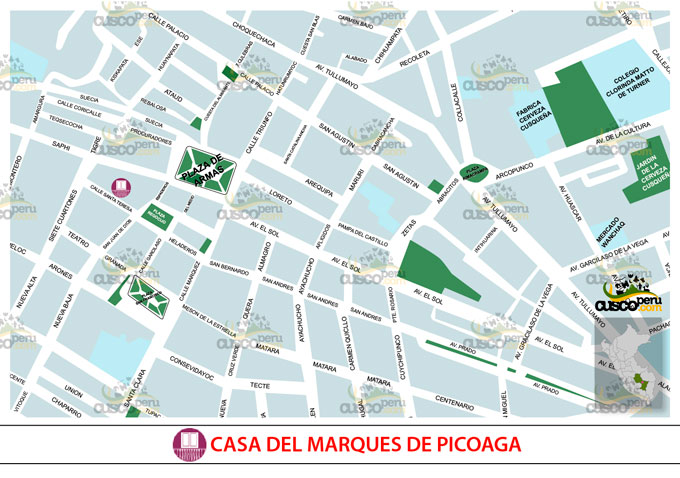
It is located at 344 Santa Teresa Street, in the historic center of Cusco, next to the Municipality of Cusco and just a few steps from the Main Square.
The mansion has two levels and preserves architectural elements of great value, such as its stone doorway, windows with stone jambs, metal grilles, semicircular arches, a central courtyard with a fountain, stone stairways, and Republican-style balconies. In the main hall, a 19th-century mural painting stands out, featuring decorative motifs, still lifes, and marble-like effects.
Today, the mansion is part of the Costa del Sol Wyndham Cusco hotel, which preserves stone arches, a central courtyard with a fountain, and murals linked to 18th-century architecture.
As it is part of a functioning hotel, access to its interior spaces may be subject to the establishment’s internal policies. It is recommended to contact the Costa del Sol Wyndham Cusco hotel directly before your visit.
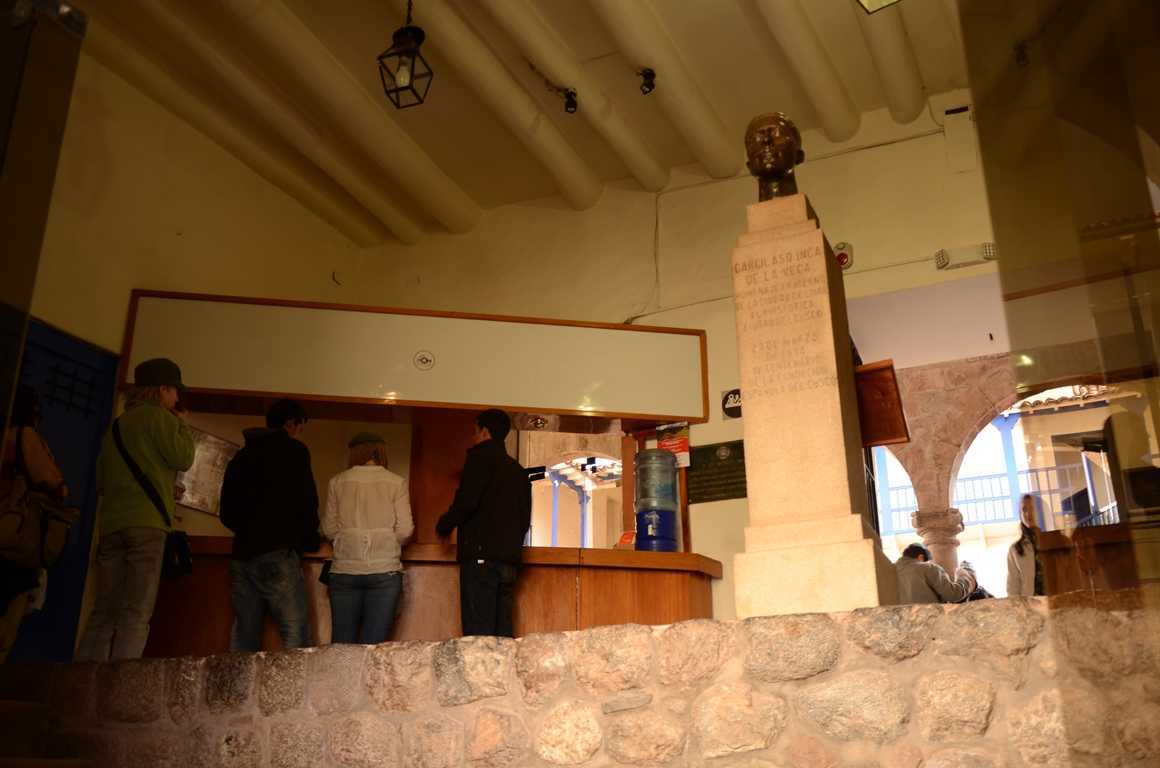
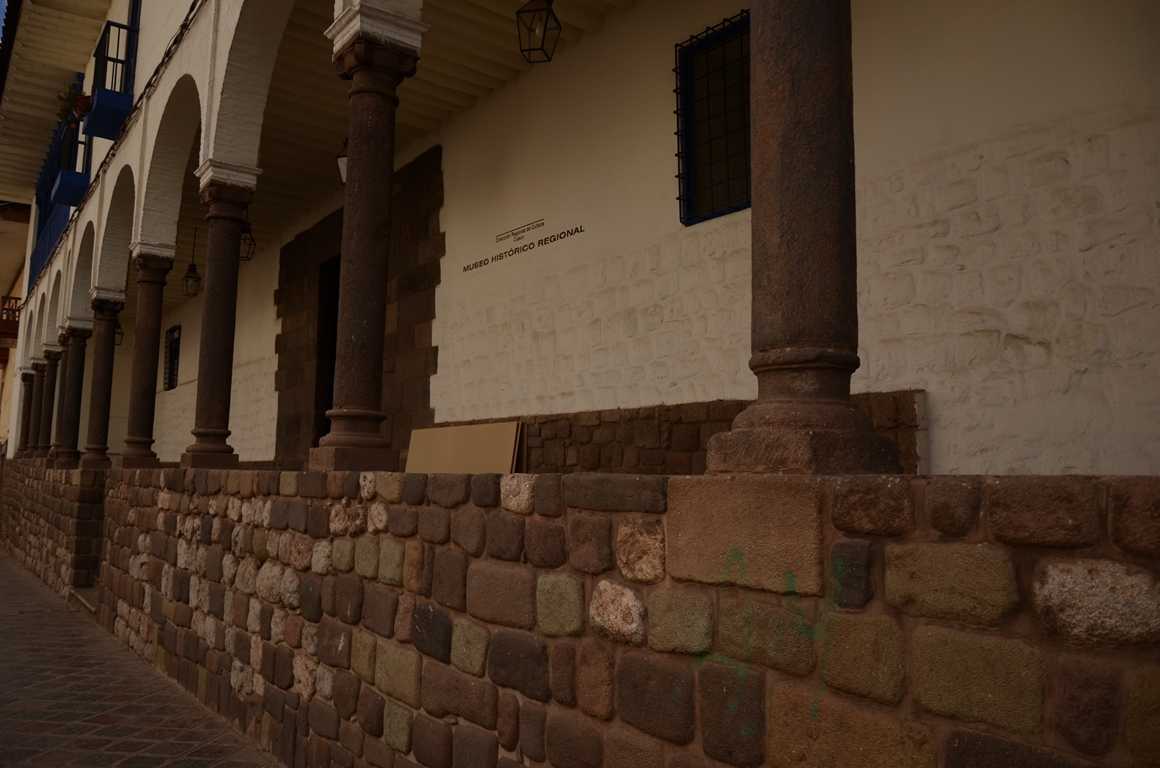
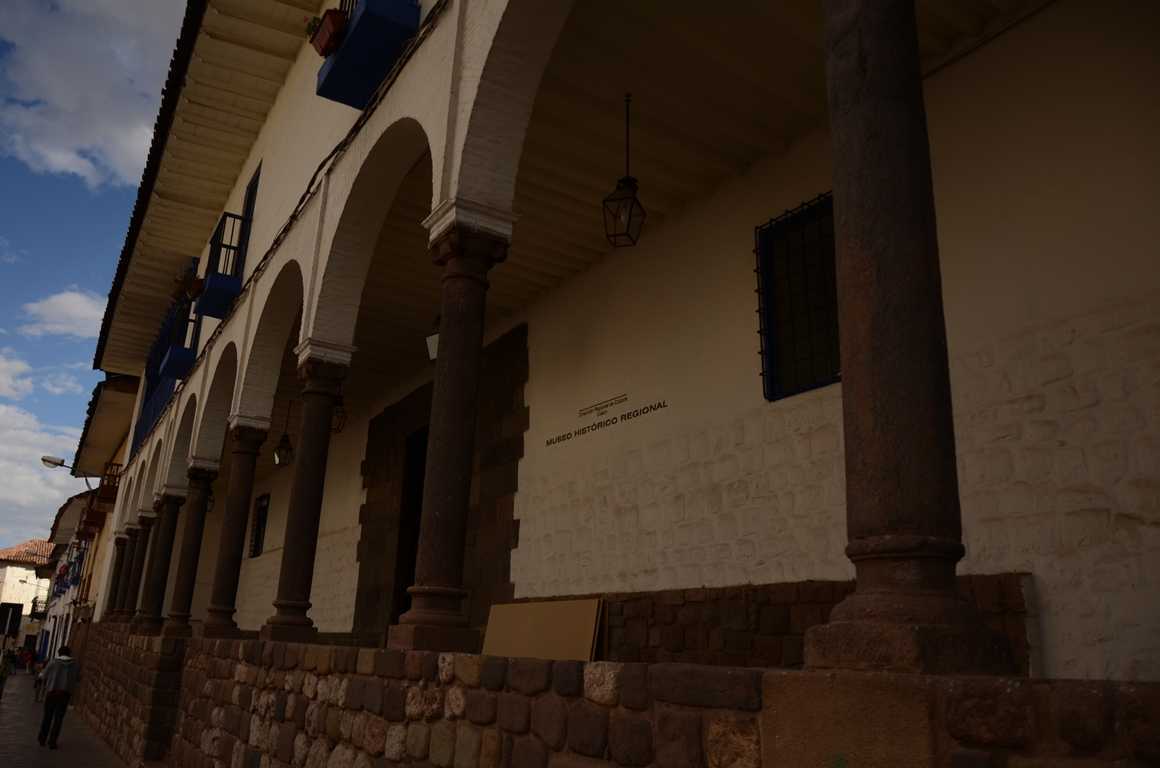
The House of Inca Garcilaso de la Vega is a 16th-century colonial mansion built on Inca-period terraces that formed part of the ancient plaza of Kusipata. According to the chronicler Bernabé Cobo, this site was home to the fourth huaca of the eighth ceque toward Chinchaysuyo, established during the rule of Inca Huayna Qhapaq.
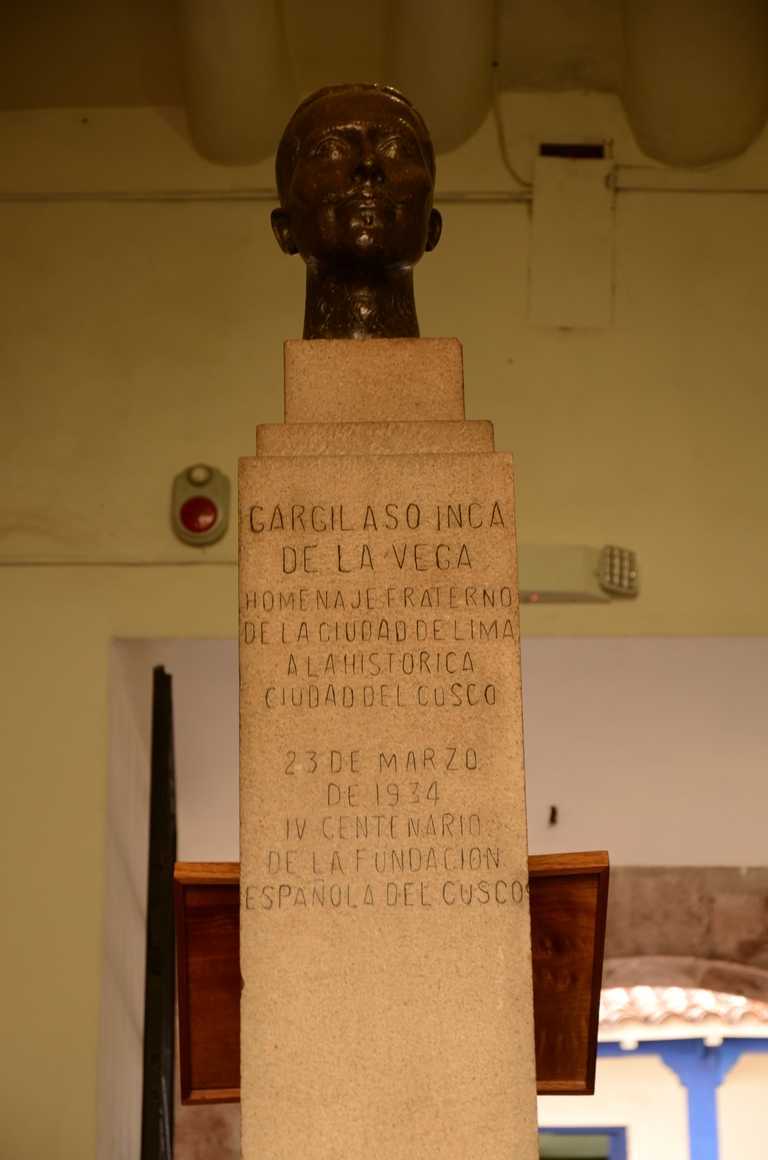
The building was constructed by Pedro de Oñate and later passed into the hands of Captain Sebastián Garcilaso de la Vega, father of the renowned mestizo chronicler Inca Garcilaso de la Vega. The writer was born under the name Gómez Suárez de Figueroa and was the son of Sebastián Garcilaso de la Vega and the ñusta Isabel Chimpu Ocllo.
The mansion is organized around a central courtyard, which connects the main areas of the building. Its rooms open onto the patios and are linked to one another through corridors, preserving both colonial and Inca architectural elements.
Today, the House of Inca Garcilaso de la Vega is the headquarters of the Regional Historical Museum of Cusco, created on March 1, 1967. The museum has thirteen permanent exhibition rooms and one temporary exhibition room, distributed over two levels. Its galleries display archaeological, historical, artistic, and ethnographic collections related to the history of Cusco.
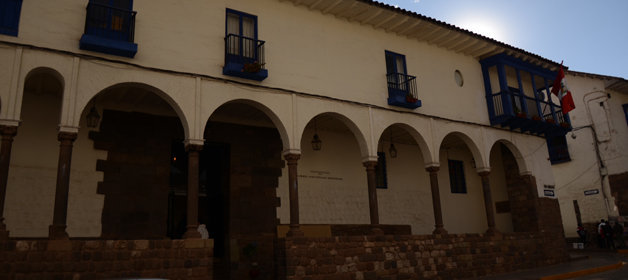
It is located on Garcilaso Street and Heladeros Street, with no street number, just a few blocks from Cusco’s Main Square.
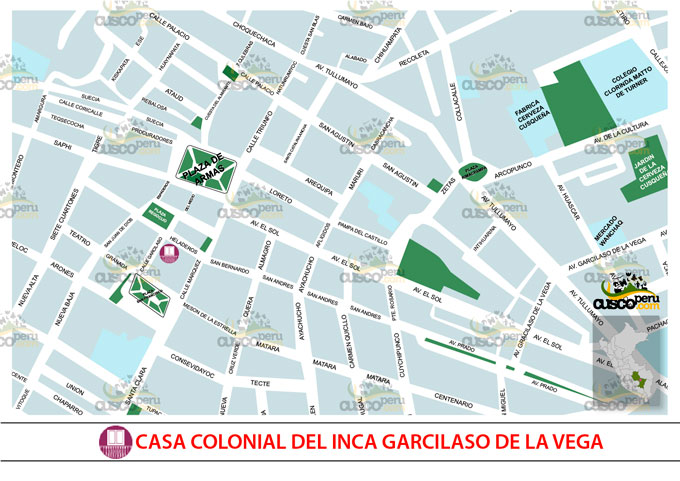
The Regional Historical Museum of Cusco currently operates inside the House of Inca Garcilaso de la Vega. On the first level, archaeological material from different periods of cultural development in the Cusco Valley is displayed. On the second level, visitors can find historical, artistic, and ethnographic objects.
Opening hours: Monday to Sunday and public holidays, from 8:00 a.m. to 5:00 p.m. Closed on January 1 and December 25. On December 24 and 31, it operates on reduced hours.
Prices or rates: admission is included in the Cusco Tourist Ticket, Circuit II.
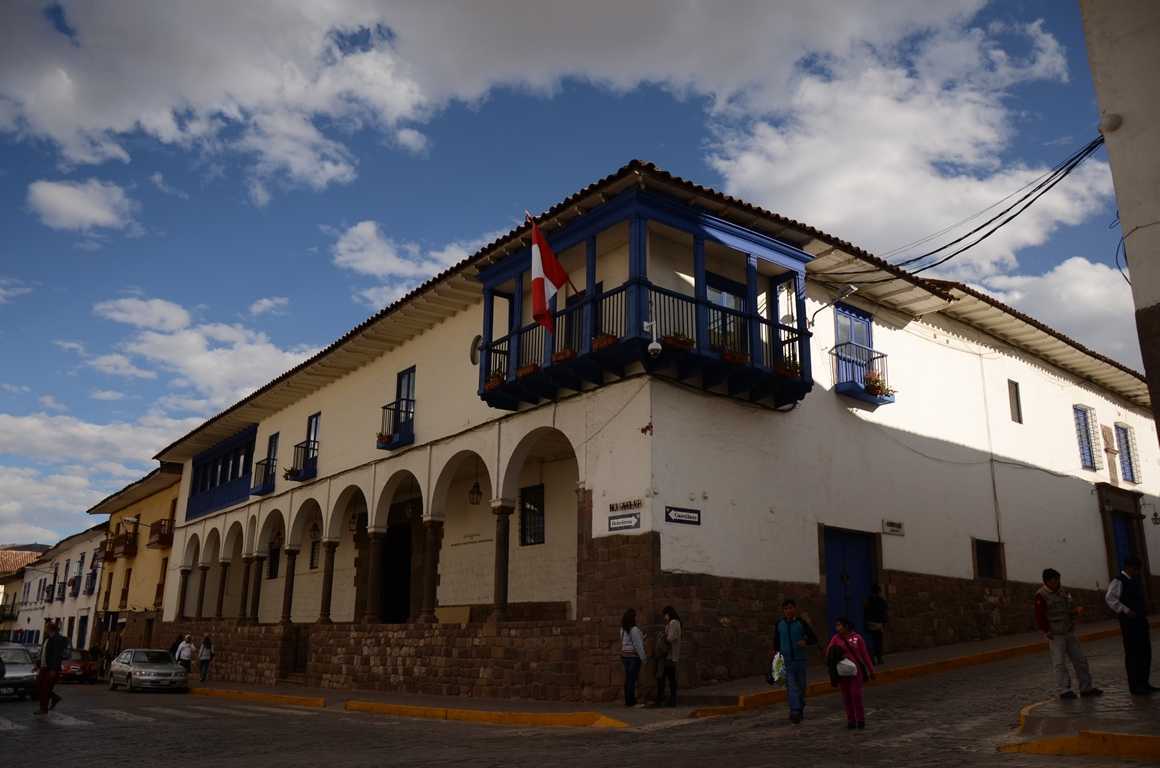

The Casa de los Cuatro Bustos is one of the most representative colonial mansions in the historic center of Cusco. Its architecture combines viceregal elements with walls of Inca origin, allowing visitors to appreciate the city’s historical layering.
During the Inca period, the area where the Casa de los Cuatro Bustos now stands may have formed part of the ceremonial setting linked to the Qorikancha and the ancient Plaza del Sol, known as Intipampa. After the arrival of the Spanish, the most important plots of land in Cusco were occupied by conquistadors and colonial authorities.
According to some historical accounts, the plot was taken by Gonzalo Pizarro, brother of Francisco Pizarro. Later, the property passed into the hands of Juan de Salas y Valdés, who ordered the four busts that give the mansion its name to be carved on the main doorway.
The busts represent Juan de Salas y Valdés, his wife Usenda de Bazán, his eldest son Fernando de Valdés Bazán, and his daughter-in-law Leonor de Tordoya y Palomino. These Renaissance-style sculptures were created in the early years of the 17th century and are located on the lintel of the main entrance.
The doorway is decorated with rosettes, relief columns, a noble coat of arms, and a lintel carved from a single stone piece. Today, the building is part of Palacio del Inka, a Luxury Collection Hotel, Cusco, and preserves architectural elements of great historical value.
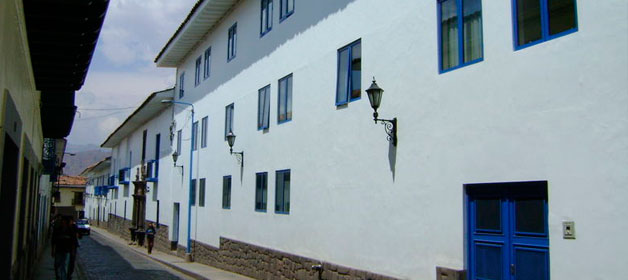
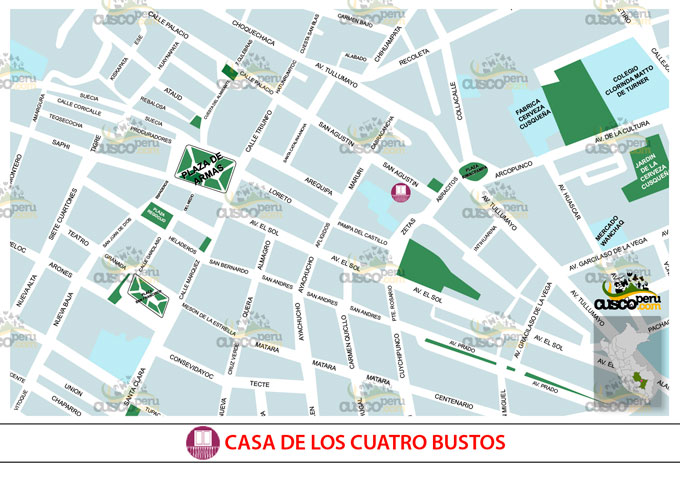
It is located at 400 San Agustín Street, in the historic center of Cusco, just a few minutes on foot from the Main Square.
From the outside, visitors can appreciate its colonial doorway, where the four carved busts, the noble coat of arms, and the ornamental details of the façade stand out. Inside, the mansion preserves patios with stone arches and architectural elements that reflect the union between Inca tradition and viceregal architecture.
As it is part of a functioning hotel, access to its interior spaces may be subject to the establishment’s policies. It is recommended to contact Palacio del Inka directly before your visit.
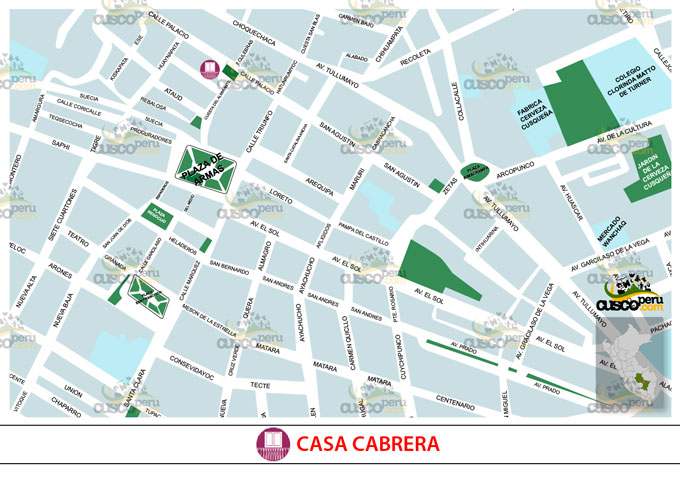
Casa Cabrera, the current home of the Museum of Pre-Columbian Art - MAP Cusco, is located in Plaza de las Nazarenas, very close to Cusco’s Main Square. According to studies cited by the museum, the space where the mansion now stands may have functioned during the Inca period as a yachaywasi, a school intended for the education of the children of the nobility.
After the Spanish foundation of Cusco, the plot was granted to Don Alonso Díaz. In 1558, the mansion was converted into the Monastery of Santa Clara. Later, in the 17th century, the property came into the possession of Don Gerónimo Luis de Cabrera de la Cerda, whose noble coat of arms is still preserved on the stone entrance.
In 1981, Banco Continental acquired the property to restore it and turn it into a cultural venue. Finally, in 2003, the BBVA Peru Foundation, in alliance with the Larco Museum in Lima, inaugurated the current Museum of Pre-Columbian Art - MAP Cusco there.
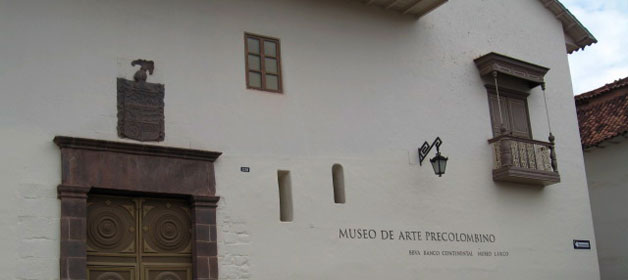
It is located at Plaza de las Nazarenas 231, in the historic center of Cusco, just a few minutes on foot from the Main Square.
Through modern museography, MAP Cusco exhibits 403 pre-Columbian and Inca pieces from the collection of the Larco Museum in Lima, selected for their aesthetic value. The exhibition brings together objects made of stone, clay, wood, marine shells, and metals, distributed across ten rooms.
In the different rooms, visitors can discover objects from various pre-Columbian cultures.
The Origins Room: a space that shows how the first inhabitants began to organize themselves to live in the Peruvian territory. Among their works, they left stone objects and ceramic pieces linked to cultures such as Paracas and Virú.
Wood Room: in this room, visitors can appreciate carved wooden works with ancestral representations of great value. These pieces were used to create oars, containers, benches, and other objects, including those belonging to the Chimú culture.
Shells Room: this section features pieces made of shell or bone, intended to preserve or reproduce mythical stories. Access to shells from distant warm seas is evidence of long-distance exchange networks and alliances.
Silver Room: this room allows visitors to learn about the symbolic value of silver, used to make ceremonial vessels, silver ear ornaments, and spiral-shaped nose ornaments worn by leaders and high-ranking figures.
Gold Room: gold held great importance within the Andean worldview, especially for its ceremonial and symbolic value. This room exhibits pieces that help visitors understand the role they played within their cultural context.
The South Room: this room presents the Paracas and Nazca cultures, which developed on the southern coast of Peru. Here, visitors can observe some of their most representative ceramic works.
The North Room: the Moche people lived on the northern coast of Peru and were recognized for their great mastery of ceramics and metalwork.
The Center Room: this space displays ceramic pieces from the Wari State, located in the southern highlands of Peru. This culture expanded through ideological influence, alliances, and military strengthening.
Before the Incas Room: before the consolidation of the largest empire of ancient Peru, the Chimú State, recognized for its black ceramics, was located on the north-central coast. On the central coast, the Chancay State developed and stood out for its white ceramics.
The Incas Room: this room presents artistic objects belonging to the Inca period, one of the most important stages in Andean history. This civilization left a great historical legacy and had Cusco as its main political, religious, and administrative center.
Opening hours: Monday to Sunday, from 8:00 a.m. to 10:00 p.m.
Prices or rates:
General admission: S/ 20.00.
Students: S/ 10.00.
Opening hours may vary, so it is recommended to check the official MAP Cusco channels before your visit.
*Admission is not included in the Cusco Tourist Ticket.

Happy passengers