DESCRIPTION
The Nazca Lines, also known as geoglyphs in the scientific community, are among the most remarkable legacies of Peru's ancient pre-Inca civilizations. Located in the Palpa and Nazca valleys in the Ica region of southern Peru, these massive designs stretch across the desert plains, forming perfectly aligned drawings of animals, plants, objects, human figures, and deities.
The purpose and meaning of the Nazca geoglyphs remain a mystery. Over the years, archaeologists and even paranormal researchers have proposed various theories. Some believe the lines functioned as a giant astronomical calendar, while others suggest they served as sacred water worship sites created by the Paracas and Nazca cultures.
LOCATION
The Nazca Lines are located on the Jumana Pampa, in the Ica region of southern Peru, South America. The nearby city of Nazca lies about 500 kilometers (310 miles) south of Lima, at an altitude of approximately 600 meters (1,970 feet) above sea level.
The name "Nazca" comes from the ancient and mysterious pre-Inca Nazca culture, known for its advanced knowledge of engineering, astronomy, and art.
ATTRACTIONS
- The Figures
Numerous figures are found in Nazca, particularly in the Pampa de San José: geometric figures, meanders, animal, plant and human representations, labyrinths, and other geometric drawings.
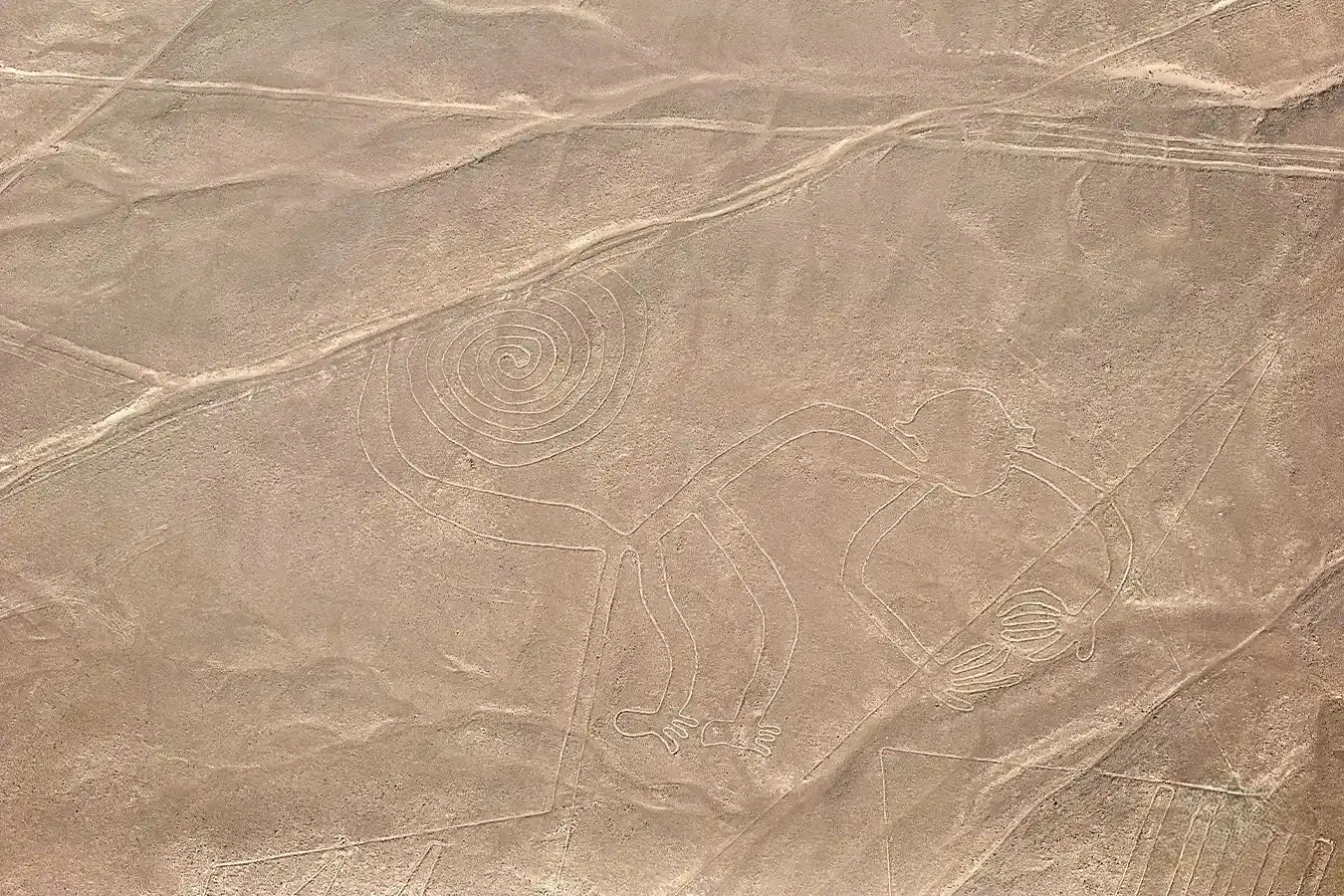
The most representative are the drawings of animals: birds between 25 and 300 meters long (giant hummingbirds, condors, the heron, the crane, the pelican, the seagull, the parrot and others), a monkey, a spider, a snail, a lizard, a 27-meter killer whale, a dog with long legs and tail, two llamas, etc. In the reptile category, a lizard, which was cut down when the Panamerican Highway South was built, an iguana and a snake. Many of the drawings are mixed with lines and spirals.
Almost all the drawings were made on the flat surface; there are only a few on the hillsides. Almost all the figures that are placed on the slopes represent men. Some are crowned by three or four vertical lines that perhaps represent the feathers of a ceremonial headdress (some Peruvian mummies wore headdresses of gold and feathers).
The figures on the slopes appear less well defined than those in the desert, perhaps because the stones that have rolled down the slope have blurred the details.
- Astronaut figure
More than thirty geoglyphs have been found to date in the Nazca Pampas. The drawings are smaller in quantity compared to the geometric designs that consist of hundreds and hundreds of lines, triangles and quadrangles that occupy large extensions of land. Their construction technique was careful, the surveyors of the past took the lines to hills and ravines without deviating from their original direction.
- Layout
Technically the Nazca lines are perfect. The straight lines enclose a perfection with a few small deviations along kilometers. The drawings are well proportioned, especially if we think about the dimensions of his drawings. "The depth of the lines never exceeds 30 cm and some are simple scratches on the surface, but they can still be recognized when the sun is low and the relief is accentuated", explains Dr. Reiche in one of the many testimonies she left to the world.
Among the largest geoglyphs are: a bird of almost 300 m, a lizard of 180 m, a pelican of 135 m, a condor of 135 m, a monkey of 135 m and a spider of 42 meters. These dimensions are a constant source of admiration for visitors to the area.
Appreciable only from the air
- Spider figure
From the ground, these designs go unnoticed. These lines can only be observed in all their immensity from the air, when flying over the desert at least two hundred meters high. This demonstrates a great geometric knowledge of the ancient Peruvians.
SCHEDULE
Monday to Sunday: 8:00 a.m. to 3:00 p.m.
Tour (light aircraft or helicopter): $40.00 to $50.00
DESCRIPTION
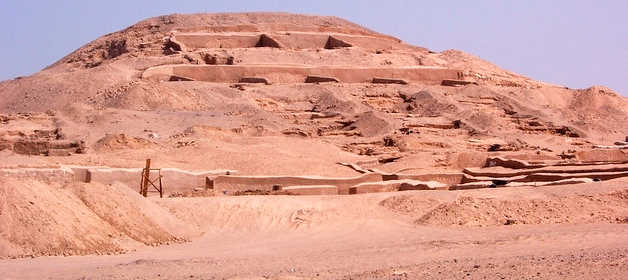
It is said that this complex was one of the oldest religious centers in America (400 B.C. - 400 A.D.). Cahuachi means "place where the seers live" and is located 28 kilometers from the city of Nazca. It occupies an area of 24 km² and is a citadel built in adobe, where ceremonial pyramids stand out: the Great Pyramid (28 m high and 100 m long), the Great Temple, the Step Temple and the Mounds. It is located on a sloping terrain facing the Nazca lines, and the whole complex is surrounded by a great wall.
It was the most important habitation and ritual center of the Nazca culture that developed between 400 years after Christ and was used to make offerings related to agriculture, which was its main activity. For many researchers, Cahuachi sets the standard for housing expansion in the South Coast.
LOCATION
It was built on the left bank of the Nazca River, which flows into the Pacific Ocean. It is currently within the jurisdiction of the province of Nazca, department of Ica, in southern Peru. It is 42 kilometers from the sea and 28 kilometers from the actual city of Nazca. It is 360 meters above sea level.
ATTRACTIONS
Among the most representative attractions of Cahuachi we have:
- The Great Pyramid
One of the most imposing buildings in the city of Cahuachi is the "Great Pyramid" which is 110 m long, 90 m wide and 28 m high, and is composed of 7 stepped platforms. In the "Great Pyramid" archaeologists found a deposit of 200 textiles, several of them hand-painted, which is a rarity in the Nazca culture because until then only embroidered textiles were known.
- The great temple
Another important building in the city of Cahuachi was the "Great Temple" or "Templo Mayor", which archaeologists estimate to be 150 m long, 100 m wide and between 15 and 20 m high. The main ceremonies of theurgy or high magic, which were performed by the important priestly caste of the Nazca Culture, took place there.
SCHEDULE
Admission (all year round).
Monday to Sunday from 9:00h to 16:00h.